

- Updated: February 23, 2026
- 5 min read
Agentic Software Engineering: How Autonomous AI Agents are Transforming Development
Agentic Software Engineering (Agentic SE) is a discipline that leverages autonomous AI agents to manage complexity, improve communication, and ensure reliable software delivery at scale.
Agentic Software Engineering: How Autonomous AI Agents Are Redefining Modern Development
The recently released Agentic SE book dives deep into a paradigm shift that moves the focus from manual code production to intelligent orchestration of AI‑driven agents. For software engineers, AI researchers, and tech entrepreneurs, this guide offers a roadmap to harness stochastic AI, reduce systemic risk, and accelerate innovation. In this article we summarize the core concepts, highlight actionable takeaways, and connect the ideas to UBOS’s ecosystem of AI‑powered tools.
Core Concepts of Agentic Software Engineering
Agentic SE reframes software development as a collaborative network of autonomous AI agents that each own a specific intent—ranging from code generation to testing, deployment, and continuous monitoring. The book outlines three foundational pillars:
- Intent‑First Architecture: Teams define high‑level goals (e.g., “deliver a secure payment microservice”) and let agents translate intent into concrete artifacts.
- Risk‑Bounded Autonomy: Agents operate within explicit risk envelopes, requesting human verification only when uncertainty exceeds a predefined threshold.
- Evidence‑Driven Feedback Loops: Every action is logged, measured, and fed back into the system to improve future decisions.
The authors argue that the real bottleneck in modern development is not the speed of writing code but the complexity of coordination. By delegating repetitive, deterministic tasks to AI agents, human engineers can focus on strategic design, architecture, and risk management.
Agent Types and Their Roles
The book categorizes agents into four functional groups:
- Creator Agents: Generate code snippets, configuration files, or documentation using large language models.
- Validator Agents: Run static analysis, security scans, and unit tests to ensure compliance.
- Orchestrator Agents: Manage CI/CD pipelines, resource allocation, and environment provisioning.
- Observer Agents: Continuously monitor production metrics, detect anomalies, and trigger remediation.
These agents communicate through a shared knowledge graph that captures intent, constraints, and evidence. The graph acts as a single source of truth, enabling traceability from a high‑level business goal down to a line of generated code.
From Stochastic AI to Trustworthy Systems
Because large language models are inherently stochastic, Agentic SE introduces a trust layer that combines probabilistic reasoning with deterministic verification. The trust layer enforces:
- Confidence thresholds for each agent output.
- Human‑in‑the‑loop checkpoints for high‑risk changes.
- Automated rollback mechanisms when evidence indicates regression.
This approach aligns with the book’s claim that “reliability and trust are the new competitive advantages in AI‑augmented development.”
Key Takeaways for Practitioners
Below are the most actionable insights you can apply today, regardless of whether you already use UBOS’s platform or are evaluating AI‑first development strategies.
- Define Clear Intent Early: Start every project with a concise, measurable goal. This intent becomes the contract for all downstream agents.
- Implement Risk Boundaries: Use confidence scores from LLMs to decide when to auto‑accept changes versus when to request human review.
- Adopt Evidence‑Based Metrics: Track not only code churn but also agent decision latency, verification pass rates, and post‑deployment incident frequency.
- Leverage Modular Agent Libraries: Reuse proven creator, validator, and orchestrator agents across projects to reduce duplication.
- Integrate with Existing Toolchains: Agentic SE is compatible with CI/CD platforms, version control, and observability stacks—making incremental adoption feasible.
By embedding these practices, teams can shift from “code‑centric” to “intent‑centric” development, unlocking faster iteration cycles and higher system resilience.
Visual Overview: Agentic SE Architecture
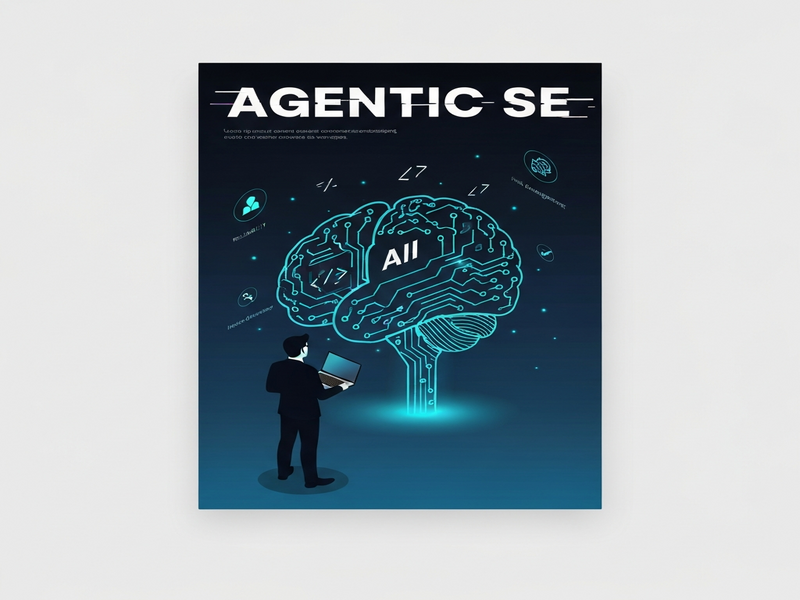
The illustration above captures the four agent categories (Creator, Validator, Orchestrator, Observer) linked through a central knowledge graph. Notice how the trust layer sits between stochastic outputs and deterministic enforcement, embodying the core principle of Agentic SE.
Explore Related UBOS Resources
UBOS provides a suite of tools that align perfectly with the Agentic SE methodology. Below are curated links you can explore to deepen your implementation strategy:
- UBOS platform overview – Learn how the platform’s modular architecture supports autonomous agents.
- AI agents – A deep dive into the pre‑built agent library that powers intent‑first workflows.
- Enterprise AI platform by UBOS – Scale agentic processes across large organizations with governance and compliance features.
- Workflow automation studio – Visually design orchestrator agents and risk boundaries without writing code.
- Web app editor on UBOS – Rapidly prototype creator agents that generate UI components from high‑level specifications.
- AI marketing agents – See how autonomous agents can also drive go‑to‑market strategies, complementing development pipelines.
- UBOS pricing plans – Choose a plan that fits your team’s scale, from startups to enterprises.
- UBOS templates for quick start – Jump‑start your agentic workflows with ready‑made templates like the AI SEO Analyzer or AI Article Copywriter.
- About UBOS – Discover the mission and team behind the platform.
- UBOS partner program – Collaborate with UBOS to co‑create custom agentic solutions.
Original Source
For a full read of the Agentic SE book and its audio summary, refer to the original news article.
Conclusion: The Future Is Agentic
Agentic Software Engineering marks a decisive move toward autonomous development ecosystems. By embedding intent‑first design, risk‑bounded autonomy, and evidence‑driven feedback, organizations can tame complexity and accelerate innovation. UBOS’s comprehensive AI platform—complete with creator, validator, and orchestrator agents—offers a practical pathway to adopt these principles today.
Whether you are a software engineer seeking to offload repetitive tasks, an AI researcher exploring stochastic‑to‑deterministic pipelines, or a tech entrepreneur building the next generation of developer tools, the Agentic SE framework provides a clear, actionable blueprint. Embrace the shift now, and let autonomous agents turn your high‑level visions into reliable, production‑grade software—faster than ever before.
Andrii Bidochko
CTO UBOS
Andrii Bidochko is an AI entrepreneur and researcher focused on AI agents, reinforcement learning, and autonomous systems. He writes about the technologies shaping the future of machine intelligence, from frontier models and agent architectures to real-world AI applications.