

- Updated: December 28, 2025
- 6 min read
AI Trends 2025: From Stochastic Parrots to AGI Prospects
AI Trends 2025: The Next Wave of Intelligent Systems
Answer: In 2025 AI is moving beyond “stochastic parrots” toward chain‑of‑thought prompting, reinforced learning loops, AI‑assisted programming, and even non‑Transformer architectures, all of which are accelerating progress toward AGI and delivering measurable gains on the ARC benchmark.
When the calendar flipped to 2025, the AI community witnessed a seismic shift. What was once dismissed as a clever statistical trick has become a toolbox of techniques that empower large language models (LLMs) to reason, code, and even self‑improve. This article distills the most compelling AI trends 2025—from the rise of chain‑of‑thought prompting to the resurgence of symbolic models—while showing how UBOS’s ecosystem makes these advances instantly actionable for developers, researchers, and business leaders.
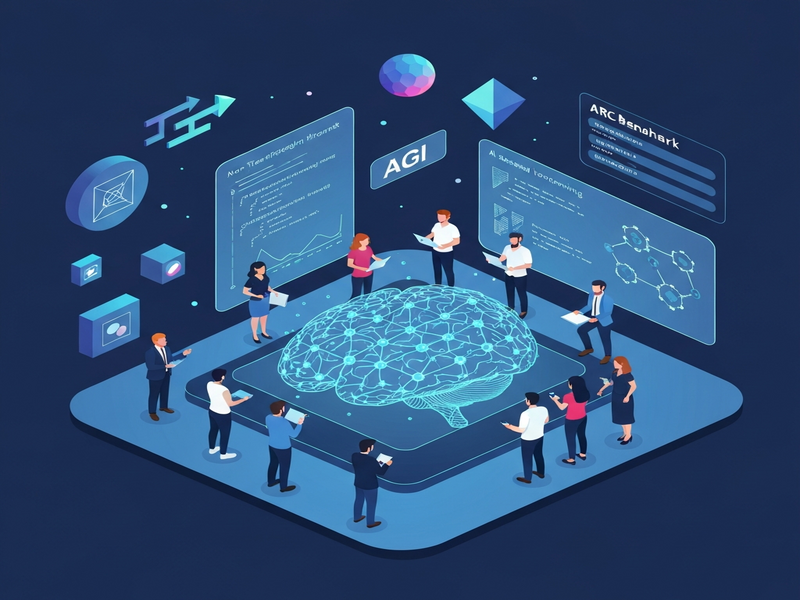
1. Overview of AI Trends in 2025
2025 is defined by four converging currents:
- Reasoning‑first LLMs: Chain‑of‑thought (CoT) prompting turns raw token prediction into step‑by‑step problem solving.
- Reinforcement learning loops: Reward‑driven fine‑tuning lets models iterate toward optimal answers, breaking the token‑budget ceiling.
- AI‑assisted development: Integrated code generation and debugging tools are now mainstream in IDEs and CI pipelines.
- Architectural diversification: Researchers revisit non‑Transformer designs, hybrid symbolic‑neural systems, and efficient sparse models.
These trends are not isolated; they reinforce each other, creating a virtuous cycle of capability and adoption. For enterprises looking to ride this wave, the UBOS platform overview offers a unified environment to experiment, deploy, and scale AI services.
2. Evolution of Large Language Models: From Stochastic Parrots to Chain‑of‑Thought Prompting
Early critiques labeled LLMs as “stochastic parrots” – models that merely regurgitate patterns without understanding. By 2025, the community has largely moved past that narrative thanks to chain‑of‑thought prompting. CoT works by coaxing the model to generate intermediate reasoning steps before delivering a final answer, effectively turning the model into an internal search engine.
Two mechanisms drive CoT’s success:
- Representation sampling: The model surfaces relevant concepts within its context window, allowing richer semantic connections.
- Sequential token optimization: When combined with reinforcement learning, each token becomes a decision point that nudges the model toward a higher‑reward answer.
UBOS makes CoT experimentation painless. The OpenAI ChatGPT integration lets you inject custom CoT templates directly into your workflows, turning raw prompts into structured reasoning pipelines.
3. Reinforcement Learning for LLMs: Closing the Gap Between Prediction and Purpose
Reinforcement learning (RL) has traditionally powered game‑playing AIs like AlphaGo. In 2025, RL is being repurposed for language models, where the “game” is delivering correct, useful, and safe responses. By defining verifiable reward signals—such as correctness on benchmark datasets or user satisfaction scores—LLMs can iteratively improve beyond the static limits of pre‑training.
Key breakthroughs include:
- Reward‑shaped fine‑tuning that respects token budgets while encouraging deeper reasoning.
- Hybrid pipelines that blend supervised fine‑tuning with RL‑from‑human‑feedback (RLHF) for nuanced alignment.
- Scalable RL environments built on Workflow automation studio, enabling rapid iteration on custom reward functions.
These advances are already visible in real‑world deployments: AI‑driven customer support bots now resolve complex queries with fewer escalation loops, and code‑generation assistants can iteratively refine snippets until they meet performance targets.
4. AI‑Assisted Programming: From Skepticism to Standard Practice
Just a few years ago, many developers dismissed AI code generators as unreliable. Today, the return on investment is evident across startups and large enterprises. Modern LLMs can suggest entire functions, refactor legacy code, and even predict performance bottlenecks.
Practical adoption patterns include:
- Embedding LLMs in IDEs for on‑the‑fly suggestions (e.g., GitHub Copilot‑style assistants).
- Automated test‑case generation that validates generated code against specifications.
- Continuous integration pipelines that use AI to suggest optimizations before merge.
UBOS’s AI marketing agents showcase how the same underlying LLM can be repurposed for both marketing copy and code synthesis, illustrating the versatility of a single model across domains.
5. Beyond Transformers: The Rise of Non‑Transformer AI
While Transformers dominate the mainstream, 2025 sees a resurgence of alternative architectures:
- Mixture‑of‑Experts (MoE): Sparse activation reduces compute while preserving capacity.
- Neural‑symbolic hybrids: Explicit symbolic reasoning modules augment neural nets, offering interpretability.
- Recurrent and convolutional hybrids: Designed for low‑latency edge inference.
These models aim to overcome the quadratic scaling of attention mechanisms and to embed world‑model knowledge directly. The Enterprise AI platform by UBOS already supports plug‑and‑play deployment of non‑Transformer models, allowing data scientists to benchmark them against classic Transformers on tasks like ARC.
6. AGI Development: Converging Paths Across Diverse Model Families
Artificial General Intelligence (AGI) remains the holy grail, but 2025 offers concrete evidence that multiple pathways may converge:
- Chain‑of‑thought prompting gives LLMs a quasi‑algorithmic reasoning ability.
- Reinforcement learning injects goal‑directed behavior, narrowing the gap between prediction and purposeful action.
- Hybrid symbolic‑neural systems provide explicit reasoning steps, a key ingredient for general intelligence.
Startups are capitalizing on this momentum. The UBOS for startups program offers credits and mentorship to teams building AGI‑adjacent products, from autonomous agents to knowledge‑graph‑enhanced assistants.
7. ARC Benchmark Progress: From “Anti‑LLM” Test to Validation Suite
The AI2 Reasoning Challenge (ARC) was once considered a litmus test that most LLMs failed. In 2025, both small, task‑specific models and massive CoT‑enhanced LLMs achieve impressive scores on ARC‑AGI‑1 and ARC‑AGI‑2.
Key factors driving this turnaround:
- Fine‑tuned reward models that explicitly target reasoning accuracy.
- Prompt engineering libraries that automatically generate CoT scaffolds.
- Hybrid architectures that combine neural inference with symbolic rule engines.
Developers can experiment with ARC‑focused templates directly from UBOS’s marketplace. For example, the AI SEO Analyzer template demonstrates how to adapt a reasoning pipeline for content‑optimization tasks, mirroring the logical steps required by ARC questions.
8. Conclusion: Seize the Momentum of AI Trends 2025
The landscape of artificial intelligence in 2025 is no longer a collection of isolated experiments; it is an integrated ecosystem where chain‑of‑thought prompting, reinforcement learning, AI‑assisted programming, and non‑Transformer research reinforce each other. Companies that embed these capabilities now will not only stay ahead of the curve but also help shape the path toward true AGI.
Ready to embed the latest AI trends into your products? Explore the UBOS templates for quick start, test a AI Video Generator or a AI Chatbot template, and accelerate your time‑to‑value.
For pricing details, visit our UBOS pricing plans. If you’re a partner or reseller, the UBOS partner program offers co‑marketing, technical support, and revenue‑share opportunities.
Stay informed with the latest breakthroughs by following our UBOS news feed and the AI trends hub. Together, we can turn today’s research into tomorrow’s industry standards.
For a deeper dive into the original observations that sparked this discussion, see the original Antirez article.
Andrii Bidochko
CTO UBOS
Andrii Bidochko is an AI entrepreneur and researcher focused on AI agents, reinforcement learning, and autonomous systems. He writes about the technologies shaping the future of machine intelligence, from frontier models and agent architectures to real-world AI applications.