

- Updated: April 5, 2026
- 6 min read
Iran Threatens OpenAI’s Abu Dhabi Data Center – UBOS News
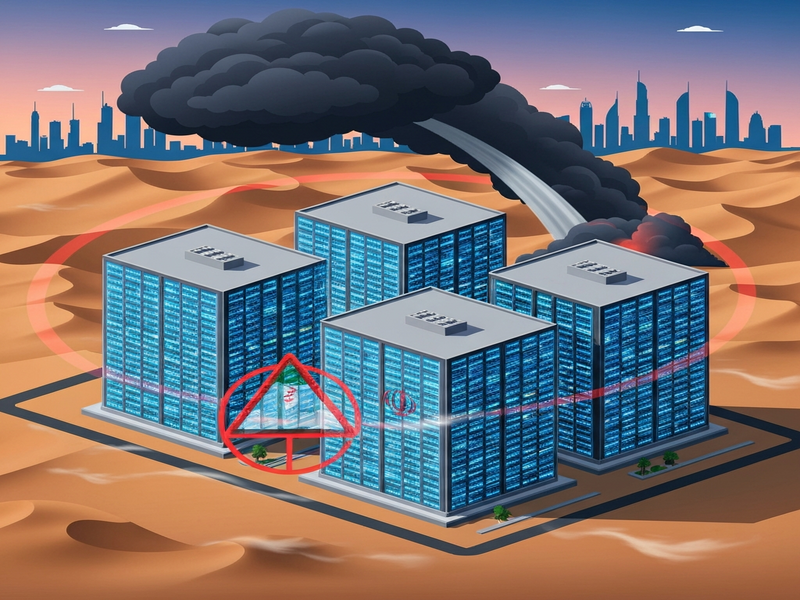
Iran’s Islamic Revolutionary Guard Corps (IRGC) has publicly threatened to destroy OpenAI’s $30 billion “Stargate AI” data centre in Abu Dhabi, warning that any U.S. or Israeli action against Iranian power infrastructure will be met with “complete and utter annihilation” of the facility.
Iran Threatens OpenAI’s Abu Dhabi “Stargate AI” Data Centre – What It Means for Global AI Infrastructure
In a video released on April 3, 2026, IRGC spokesperson Brigadier General Ebrahim Zolfaghari singled out the hidden AI hub that OpenAI is building in the United Arab Emirates. The threat follows a series of reported strikes on Amazon Web Services (AWS) sites in the Gulf, raising fresh concerns about the geopolitical stability of the region’s rapidly expanding AI cloud ecosystem.
Background: OpenAI’s “Stargate AI” Hub in Abu Dhabi
OpenAI announced in late 2025 that it would partner with regional investors to construct a purpose‑built AI super‑computing campus in Abu Dhabi, codenamed “Stargate AI.” The facility is expected to host thousands of GPUs, high‑speed interconnects, and a dedicated power grid capable of supporting petaflop‑scale workloads. According to OpenAI’s own statements, the data centre will serve as a strategic node for serving ChatGPT, DALL‑E, and upcoming multimodal models to customers across the Middle East, Africa, and South‑Asia.
The project is part of a broader push by sovereign wealth funds to diversify into AI infrastructure, positioning the UAE as a “Silicon Desert” for next‑generation compute. While OpenAI has not disclosed the exact location, satellite imagery released by the IRGC shows a cleared desert plot near the coast, overlaid with a night‑vision view that allegedly reveals the data centre’s perimeter.
Iran’s IRGC Statements and Satellite Imagery Claims
The IRGC’s video begins with a stark warning: any U.S. strike on Iranian power plants will trigger “complete and utter annihilation” of U.S. and Israeli facilities in the region. The camera then zooms into Google Maps, highlighting an “empty” desert zone that the IRGC claims is the hidden Stargate AI site. A caption reads, “Nothing stays hidden to our sight, though hidden by Google.”
- IRGC alleges it possesses high‑resolution satellite data capable of pinpointing the data centre’s exact coordinates.
- The video shows a night‑vision overlay that allegedly reveals cooling towers, antenna farms, and a perimeter fence.
- General Zolfaghari explicitly threatens “complete and utter annihilation” of the facility if the United States proceeds with its threats against Iranian infrastructure.
Recent Attacks on Regional Data Centres
Iran’s threats come on the heels of confirmed drone and missile strikes that disrupted AWS data centres in Bahrain and the United Arab Emirates earlier this year. According to independent monitoring firms, at least three AWS sites experienced temporary outages, prompting AWS to reinforce its perimeter defenses and relocate critical workloads to more secure zones.
The pattern suggests a strategic escalation: by targeting high‑value cloud infrastructure, Tehran aims to leverage its asymmetric capabilities to pressure Western tech firms that support U.S. sanctions. The attacks also expose a growing vulnerability: AI workloads demand massive, uninterrupted power and cooling, making them attractive high‑value targets.
Reactions from OpenAI, AWS, and Industry Experts
OpenAI has not issued a formal public statement beyond a brief tweet confirming that its Abu Dhabi project remains “on schedule” and that “security remains a top priority.” AWS, meanwhile, released a security advisory urging customers to review their disaster‑recovery plans and consider multi‑region redundancy.
Cybersecurity analysts warn that the threat is “realistic” given Iran’s demonstrated ability to strike hardened facilities. Dr. Lina Patel, senior fellow at the Global Cyber‑Risk Institute, notes:
“AI data centres are the new oil wells of the digital age. Any nation that can disrupt them gains disproportionate leverage in the geopolitical arena.”
Cloud providers are responding by hardening physical security, increasing redundancy, and exploring “air‑gap” architectures that isolate critical AI workloads from external networks.
Implications for Global AI Infrastructure Security
The Iranian threat underscores three emerging trends that every AI‑focused enterprise must monitor:
- Geopolitical risk is now a core component of AI‑cloud strategy. Companies must factor nation‑state threats into site selection, redundancy planning, and insurance coverage.
- Physical security is as critical as cyber‑security. Traditional firewalls cannot protect against kinetic attacks; perimeter fencing, underground vaults, and satellite monitoring are becoming standard.
- Multi‑region, multi‑cloud architectures are no longer optional. Distributing workloads across AWS, Azure, Google Cloud, and emerging regional providers mitigates the impact of a single‑point failure.
For businesses that rely on AI for core operations—whether it’s generative content creation, real‑time analytics, or autonomous decision‑making—these risks translate directly into potential revenue loss, regulatory penalties, and brand damage.
How UBOS Helps Mitigate AI‑Infrastructure Risks
Companies looking to future‑proof their AI workloads can turn to the UBOS homepage for a resilient, low‑code AI platform that abstracts away the underlying hardware. UBOS offers:
- Built‑in AI marketing agents that run on edge nodes, reducing reliance on a single data centre.
- A robust Workflow automation studio that can orchestrate fail‑over across multiple cloud providers.
- Pre‑configured UBOS templates for quick start, including an AI SEO Analyzer and an AI Article Copywriter that can be deployed on any compliant region.
- Integration capabilities such as ChatGPT and Telegram integration and OpenAI ChatGPT integration, enabling secure, encrypted communication channels.
For startups, the UBOS for startups program offers discounted compute credits and a dedicated security liaison. SMBs can leverage the UBOS solutions for SMBs, while enterprises benefit from the Enterprise AI platform by UBOS, which includes built‑in redundancy across three geographic zones.
The platform’s Web app editor on UBOS lets developers prototype AI‑driven applications without deep infrastructure knowledge, dramatically reducing time‑to‑market and exposure to geopolitical risk.
What You Can Do Next
• Review your AI workload placement strategy against the latest geopolitical risk maps.
• Explore multi‑cloud redundancy using UBOS’s UBOS platform overview.
• Sign up for a free trial of the UBOS pricing plans that include a built‑in disaster‑recovery module.
• Browse the UBOS portfolio examples to see how other firms have hardened their AI pipelines.
For a deeper dive into the technical specifics of the Stargate AI data centre, read the original Tom’s Hardware article. Stay informed, stay resilient, and consider partnering with a platform that treats security as a product, not an afterthought.
This article is for informational purposes only and does not constitute legal or security advice. For personalized guidance, consult a qualified cybersecurity professional.
Andrii Bidochko
CTO UBOS
Andrii Bidochko is an AI entrepreneur and researcher focused on AI agents, reinforcement learning, and autonomous systems. He writes about the technologies shaping the future of machine intelligence, from frontier models and agent architectures to real-world AI applications.