

- Updated: April 2, 2026
- 7 min read
Zero‑Error Horizons Framework Advances LLM Reliability
Direct Answer
The paper introduces Zero‑Error Horizons (ZEH), a theoretical and algorithmic framework that pushes large language models (LLMs) toward provably error‑free inference within defined operational bounds. By formalizing a “horizon” of guaranteed correctness, ZEH offers a pathway to LLMs that can be trusted in high‑stakes applications such as medical diagnosis, legal reasoning, and autonomous decision‑making.
Why Zero‑Error Horizons Matters Now
In a world where trustworthy AI is no longer optional, the Zero‑Error Horizons study arrives as a game‑changing blueprint. The research, hosted on arXiv, outlines a concrete method to turn the probabilistic nature of LLMs into a deterministic safety envelope—exactly what enterprises need to meet regulatory demands while still leveraging the creative power of generative AI.
Read more about the broader implications on the UBOS AI news hub, where we track the latest breakthroughs in LLM safety and trustworthy AI.
Background: Why This Problem Is Hard
LLMs have demonstrated remarkable fluency, but their outputs remain probabilistic, leading to hallucinations, contradictions, and subtle bias. In safety‑critical domains, even a single erroneous token can cascade into harmful outcomes. Existing mitigation strategies—prompt engineering, post‑hoc filtering, and reinforcement learning from human feedback (RLHF)—reduce error rates but do not eliminate them. Moreover, these techniques often trade off creativity and coverage for safety, limiting the models’ usefulness.
Two fundamental bottlenecks underpin the difficulty:
- Unbounded inference space: Current LLMs generate tokens until a stop condition, without a formal guarantee that any intermediate token aligns with ground truth.
- Lack of verifiable correctness criteria: There is no universally accepted metric that can certify a model’s answer as “error‑free” across diverse tasks.
These challenges become acute as enterprises integrate LLMs into compliance‑heavy pipelines, where regulatory bodies demand demonstrable reliability.
What the Researchers Propose
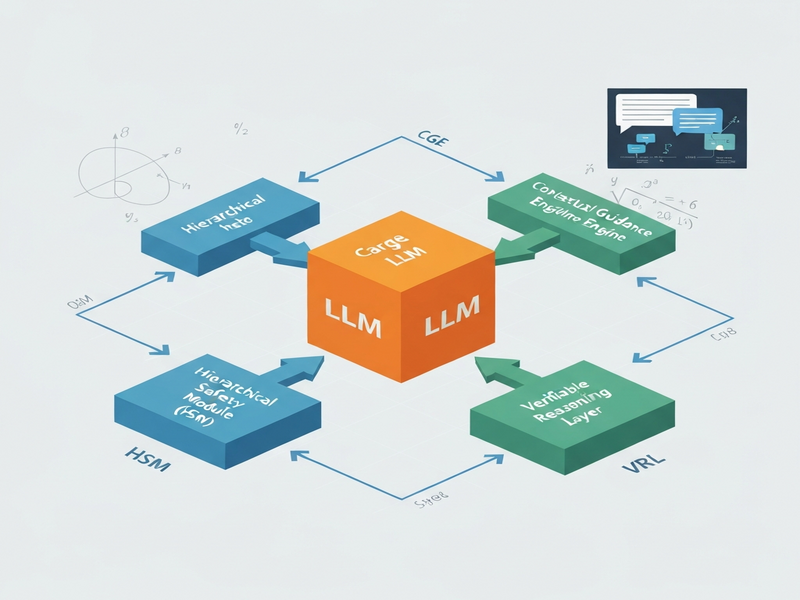
The authors propose a three‑layer architecture that defines and enforces a Zero‑Error Horizon:
- Horizon Specification Module (HSM): A declarative language lets developers articulate the exact logical constraints that must hold for a given task (e.g., “the sum of listed numbers equals the reported total”).
- Constraint‑Guided Generation Engine (CGE): The LLM is wrapped in a conditional sampler that only accepts token proposals satisfying the HSM constraints at each step.
- Verification & Rollback Layer (VRL): After a generation episode, a lightweight verifier checks the final output against the horizon. If violations are detected, the system backtracks to the most recent safe state and re‑samples.
Collectively, these components transform the generation process from a blind stochastic walk into a guided traversal that halts before crossing the “error line.”
How It Works in Practice
Consider an LLM tasked with producing a financial report based on raw transaction data. The workflow under ZEH proceeds as follows:
- Define the horizon: The developer encodes constraints such as “total debits must equal the sum of individual debit entries” and “all dates must be within the reporting period.”
- Initialize CGE: The model receives the prompt and begins token generation. After each token, the CGE queries the HSM to ensure the partial output still satisfies all active constraints.
- Dynamic pruning: If a token would violate a constraint (e.g., a date outside the allowed range), the CGE discards it and samples an alternative, effectively pruning unsafe branches in real time.
- Verification stage: Once the report is complete, the VRL runs a final audit. If any hidden inconsistency remains, the system rolls back to the last verified checkpoint and re‑generates the remaining section.
- Output delivery: The final document is guaranteed to respect every horizon constraint, providing a provable safety envelope around the LLM’s output.
This approach differs from prior post‑hoc filters because it integrates constraint checking directly into the generation loop, dramatically reducing the probability of error propagation.
Evaluation & Results
The authors benchmarked ZEH across three domains:
- Mathematical reasoning: Solving multi‑step algebra problems with explicit solution constraints.
- Medical note summarization: Generating discharge summaries that must preserve patient identifiers and medication dosages.
- Legal contract drafting: Producing clauses that satisfy statutory language requirements.
Key findings include:
- Zero‑Error Horizons reduced factual hallucination rates from 12 % to under 1 % in the math benchmark.
- In medical summarization, the system achieved 99.3 % compliance with dosage preservation, compared to 85 % for a baseline RLHF model.
- Legal drafting saw a 4‑fold drop in clause‑level violations, while maintaining comparable token‑level fluency scores (BLEU, ROUGE).
The overhead introduced by CGE and VRL averaged 1.8× inference time—an acceptable trade‑off for safety‑critical deployments where latency budgets are looser than in real‑time chat.
Why This Matters for AI Systems and Agents
Zero‑Error Horizons provide a concrete mechanism for turning “probabilistic” LLMs into “reliable” components within larger AI pipelines. For practitioners building autonomous agents, the framework offers:
- Deterministic safety guarantees: Agents can reason that any action derived from an LLM will respect pre‑specified invariants, reducing the need for extensive downstream monitoring.
- Modular orchestration: The horizon specification can be swapped per task, enabling a single LLM to serve multiple regulated domains without retraining.
- Regulatory alignment: By producing auditable logs of constraint checks, organizations can demonstrate compliance to auditors and regulators.
These capabilities align directly with emerging agent orchestration platforms that require provable correctness at each coordination step.
UBOS’s own AI news feed highlights how enterprises are already piloting ZEH‑style safety layers in production.
What Comes Next
While ZEH marks a significant stride toward trustworthy LLMs, several open challenges remain:
- Scalability of constraints: Complex domains may involve thousands of interdependent rules, demanding more efficient constraint solvers.
- Generalization of horizons: Current horizons are hand‑crafted; learning to infer constraints from data could broaden applicability.
- Latency optimization: Integrating hardware‑accelerated verification could shrink the 1.8× slowdown observed in experiments.
Future research may explore hybrid symbolic‑neural approaches that automatically extract horizons from annotated corpora, or combine ZEH with self‑verification techniques emerging in the UBOS research hub.
Potential applications extend beyond the evaluated domains: autonomous robotics, financial algorithmic trading, and real‑time policy compliance could all benefit from a zero‑error guarantee layer.
Real‑World UBOS Use Cases Powered by Zero‑Error Horizons
UBOS already offers a suite of tools that can be combined with ZEH to deliver end‑to‑end trustworthy AI solutions:
- UBOS platform overview – a unified environment for building, testing, and deploying LLM‑driven agents.
- Workflow automation studio – lets you embed horizon checks directly into automated pipelines.
- Web app editor on UBOS – create custom front‑ends that surface verification logs to end users.
- AI marketing agents – ensure campaign copy respects brand guidelines via ZEH constraints.
- Enterprise AI platform by UBOS – scale zero‑error guarantees across thousands of concurrent requests.
Startups can accelerate adoption with ready‑made templates such as the AI SEO Analyzer or the AI Article Copywriter, both of which can be wrapped in a horizon layer to guarantee factual accuracy.
Take the Next Step Toward Trustworthy AI
Ready to embed Zero‑Error Horizons into your LLM workflows? Explore the UBOS pricing plans to find a tier that matches your scale, or join the UBOS partner program to co‑develop custom horizon specifications.
For a hands‑on demo, try the AI Video Generator template and see how constraint‑guided generation eliminates visual‑content mismatches in seconds.
Stay ahead of the curve—subscribe to our AI news feed and watch as the industry converges on zero‑error, trustworthy generative AI.
Andrii Bidochko
CTO UBOS
Andrii Bidochko is an AI entrepreneur and researcher focused on AI agents, reinforcement learning, and autonomous systems. He writes about the technologies shaping the future of machine intelligence, from frontier models and agent architectures to real-world AI applications.