

- Updated: April 2, 2026
- 5 min read
How to Build Production‑Ready AgentScope Workflows – A Complete Guide
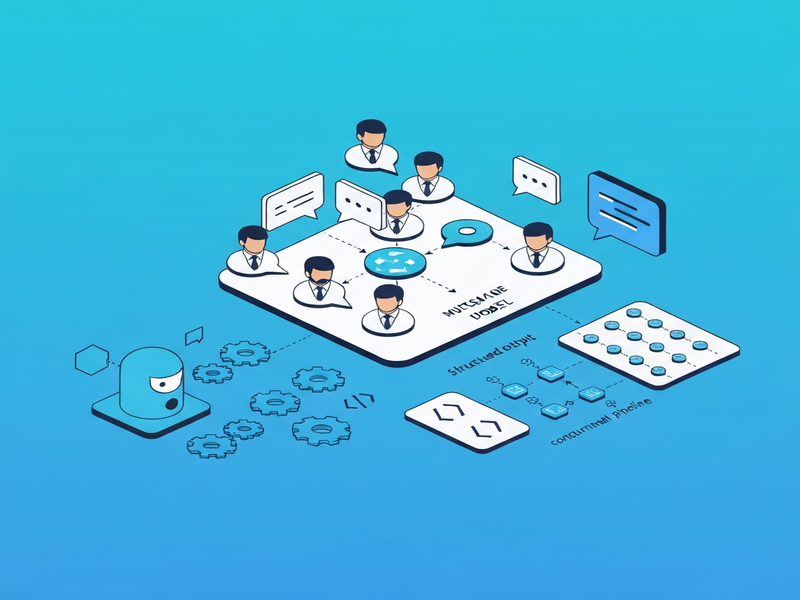
AgentScope enables developers to build production‑ready AI workflows that combine ReAct agents, custom tools, multi‑agent debate, structured outputs, and concurrent pipelines—all within a single, scalable framework.
Why AgentScope Is the New Backbone for AI Workflow Automation
AI developers, machine‑learning engineers, and tech enthusiasts are constantly searching for a framework that can move beyond isolated prompts and into orchestrated, reliable pipelines. UBOS homepage highlights the growing demand for such capabilities, and AgentScope answers that call with a clean API, built‑in memory handling, and native support for tool integration.
In this article we break down the core components of a production‑ready AgentScope workflow, illustrate real‑world code snippets, and show how you can leverage UBOS’s ecosystem—like the UBOS platform overview—to accelerate development.
AgentScope Workflow Capabilities at a Glance
AgentScope provides a modular stack that lets you:
- Connect to large language models (LLMs) with
OpenAIChatModelor custom endpoints. - Register custom tool functions that agents can invoke on‑the‑fly.
- Deploy ReAct agents that reason, act, and iterate until a goal is met.
- Coordinate multiple agents through
MsgHubfor structured debates. - Enforce typed, schema‑validated outputs using Pydantic models.
- Run parallel pipelines so specialist agents work concurrently.
All of these features are exposed through the Workflow automation studio, a visual builder that lets you drag‑and‑drop agents, tools, and data flows without writing a single line of code.
Custom Tool Functions & ReAct Agents
One of the most powerful aspects of AgentScope is the ability to expose Python functions as first‑class tools. For example, a calculate_expression function can safely evaluate math expressions, while a get_current_datetime function returns timezone‑aware timestamps. These functions are registered in a Toolkit and automatically generate JSON schemas that the LLM can understand.
When paired with a ReAct agent—such as the MathBot example—AgentScope lets the model decide when to call a tool versus when to continue reasoning. This dynamic loop reduces hallucinations and ensures that the final answer is grounded in verified computation.
Developers can prototype these agents in a Colab notebook, then export the entire pipeline to the Web app editor on UBOS for production deployment.
Multi‑Agent Debate Using MsgHub
Complex decision‑making often benefits from multiple perspectives. AgentScope’s MsgHub creates a shared communication channel where agents can exchange messages in a controlled debate.
In a typical setup, a Proponent and an Opponent each receive a system prompt that defines their stance. The hub orchestrates turn‑taking, allowing each agent to respond, rebut, and refine its argument. After a configurable number of rounds, a synthesiser agent aggregates the discourse into a concise summary.
This pattern is ideal for policy analysis, product feature trade‑offs, or any scenario where balanced reasoning is required. The entire debate can be visualized in the AgentScope workflow view, making it easy to debug and iterate.
Ensuring Structured Output with Pydantic
Raw text responses are great for chat, but downstream systems often need predictable data structures. By defining a Pydantic model—such as a MovieReview schema—developers can ask an agent to return JSON that conforms to the model.
The framework validates the response against the schema, automatically correcting minor format errors and raising clear exceptions for mismatches. This guarantees that downstream pipelines (e.g., a database insert or a dashboard widget) receive clean, typed data.
For teams that require strict contracts, the AI tools page showcases additional validators and schema generators that integrate seamlessly with AgentScope.
Concurrent Pipelines for Parallel Expertise
When a problem spans multiple domains—economics, ethics, technology—running specialist agents in parallel dramatically reduces latency. AgentScope’s async support lets you launch a set of ReAct agents simultaneously, collect their individual analyses, and feed the results into a synthesiser.
The following pattern is common in enterprise settings:
- Spawn domain‑specific agents (e.g., Economist, Ethicist, Technologist).
- Gather their outputs via
asyncio.gather. - Pass the concatenated insights to a final agent that produces a unified executive summary.
This approach scales horizontally; you can add more specialist agents without changing the core orchestration logic. The Enterprise AI platform by UBOS provides built‑in monitoring and auto‑scaling for such workloads.
Related AI News Roundup
Staying current on AI advancements helps you choose the right tools for your AgentScope pipelines. Here are three headlines that complement the workflow concepts discussed above:
- AI SEO Analyzer – a template that demonstrates how structured output can power automated SEO audits.
- AI Article Copywriter – showcases multi‑agent collaboration for content generation.
- AI Video Generator – leverages concurrent pipelines to render video frames in parallel.
These ready‑made templates live in the UBOS templates for quick start marketplace, allowing you to prototype new ideas in minutes.
Take the Next Step with AgentScope and UBOS
Building production‑ready AI agents no longer requires stitching together disparate scripts. AgentScope gives you a unified, testable, and scalable foundation, while UBOS supplies the surrounding ecosystem—pricing plans, partner programs, and a vibrant template marketplace.
Ready to accelerate your AI projects?
- Explore the UBOS pricing plans that fit startups and SMBs alike.
- Join the UBOS partner program to get co‑marketing and technical support.
- Kick‑start your first workflow with the UBOS portfolio examples and adapt them to your domain.
For a deeper dive into the original tutorial, read the full MarkTechPost article: How to Build Production‑Ready AgentScope Workflows.
Whether you’re a startup looking to prototype AI assistants or an enterprise scaling multi‑agent systems, AgentScope combined with UBOS’s AI marketing agents gives you the speed, reliability, and flexibility you need.
Andrii Bidochko
CTO UBOS
Andrii Bidochko is an AI entrepreneur and researcher focused on AI agents, reinforcement learning, and autonomous systems. He writes about the technologies shaping the future of machine intelligence, from frontier models and agent architectures to real-world AI applications.