

- Updated: March 30, 2026
- 5 min read
Apple QuickTime Evolution: Multimedia History and Tech Evolution
QuickTime is Apple’s pioneering multimedia framework, launched in 1991, that introduced real‑time video and audio playback to the Macintosh without requiring extra hardware, fundamentally reshaping how computers handle time‑based media.
QuickTime’s Birth: A Revolution in Multimedia
In the late 1980s, playing a video on a desktop required a separate, expensive decoder card. Apple’s internal Advanced Technology Group (ATG) dared to imagine a software‑only solution. The result was QuickTime, announced at WWDC 1991 and later chronicled by The Verge. This article traces the technology’s origins, milestones, and lasting influence on Apple’s broader multimedia strategy.
QuickTime Origins and Development
Apple’s ATG team, led by Steve Perlman and Eric Hoffert, first built a hardware prototype called QuickScan. While impressive, QuickScan required a costly compression chip. Determined to eliminate the hardware barrier, the team pivoted to a pure‑software codec—codenamed “Road Pizza.” This breakthrough enabled real‑time decoding on the existing Mac CPU.
The “Road Pizza” Breakthrough
Road Pizza’s algorithm traded off color‑block quantization for texture detail, delivering acceptable quality at dramatically lower bitrates. By compressing video entirely in software, Apple proved that any Macintosh could become a media player without additional peripherals.
Key takeaway: The decision to go software‑first set a precedent for Apple’s later emphasis on seamless, hardware‑agnostic experiences.
For developers interested in building modern, hardware‑agnostic AI solutions, the UBOS platform overview offers a comparable philosophy: deliver powerful capabilities through cloud‑native software rather than specialized devices.
Key Milestones and Impact on Multimedia
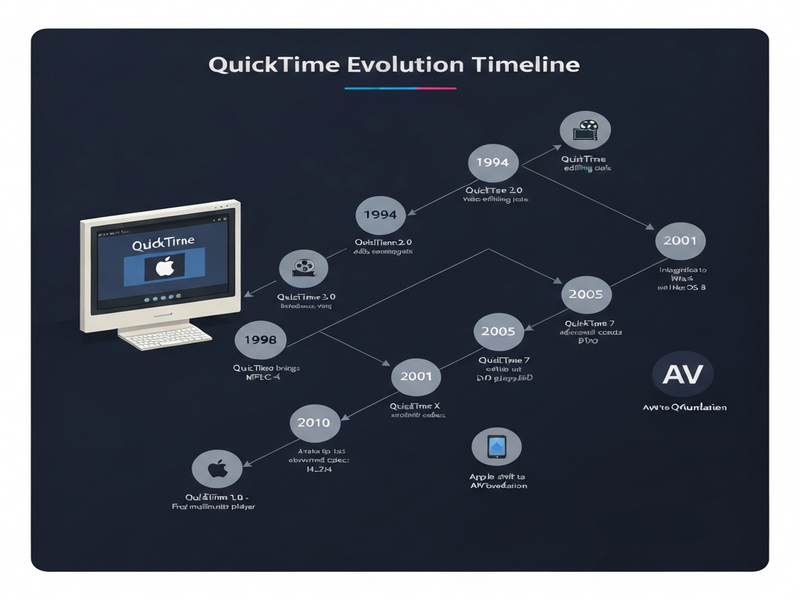
- 1991 – WWDC Debut: QuickTime 1.0 shipped with a 3‑second video demo of the 1984 Super Bowl commercial, proving software video playback.
- 1992 – QuickTime 2.0: Introduced support for multiple tracks, enabling synchronized audio and video streams.
- 1994 – QuickTime 3.0: Added CD‑ROM video playback and the first version of the QuickTime Player UI.
- 1998 – QuickTime 4.0: Brought streaming over the internet, a precursor to today’s video‑on‑demand services.
- 2001 – QuickTime 5.0: Integrated with iTunes, allowing users to manage music and video in a single library.
- 2005 – QuickTime 6.0: Introduced support for MPEG‑4, H.264, and AAC, aligning Apple with emerging industry standards.
- 2009 – QuickTime 7.0: Added 64‑bit support and the ability to edit video directly within the player.
- 2015 – Transition to AVFoundation: Apple deprecated QuickTime for developers, moving to a more modular framework while retaining QuickTime’s core concepts.
Each iteration expanded the ecosystem: content creators, educators, and enterprises adopted QuickTime as the de‑facto standard for cross‑platform media. The framework’s open‑source QuickTime File Format (QTFF) inspired later containers like MP4 and MOV.
Apple’s Broader Multimedia Strategy
QuickTime was not an isolated product; it became the backbone of Apple’s multimedia suite.
iTunes, iMovie, and Final Cut Pro
iTunes leveraged QuickTime’s codec library to manage video podcasts and movies, while iMovie and Final Cut Pro used its editing capabilities to give hobbyists and professionals a unified workflow. This synergy reinforced Apple’s “hardware‑software‑services” trifecta.
From QuickTime to AVFoundation
In 2015, Apple introduced AVFoundation, a modern, low‑level API that retained QuickTime’s timeline concept but offered finer‑grained control for iOS, macOS, and tvOS. The transition illustrates Apple’s commitment to evolving its multimedia stack while preserving backward compatibility.
Enterprises seeking a similarly future‑proof media stack can explore the Enterprise AI platform by UBOS, which mirrors Apple’s approach of layering new capabilities atop a stable core.
Legacy: Lessons for Today’s AI‑Driven Media Tools
QuickTime’s story offers three timeless lessons for AI product teams:
- Software‑First Innovation: Prioritize algorithms that run on existing hardware, reducing barriers to adoption.
- Open, Extensible Formats: Provide developers with a clear, documented file format to foster ecosystem growth.
- Iterative, Backward‑Compatible Releases: Each version should add value without breaking existing workflows.
UBOS embodies these principles. For example, the AI marketing agents run on a cloud‑native stack that works on any device, just as QuickTime made video universal across Macs.
UBOS Template Marketplace: Quick‑Start AI Media Apps
Developers can accelerate AI‑powered media projects using ready‑made templates:
- AI Video Generator – Create video content from text prompts, echoing QuickTime’s original goal of democratizing video creation.
- AI SEO Analyzer – Optimize multimedia assets for search, a modern twist on QuickTime’s cross‑platform reach.
- AI Chatbot template – Build conversational agents that can retrieve and play media files on demand.
- GPT-Powered Telegram Bot – Combine the power of ChatGPT with Telegram, reminiscent of Apple’s early integration of messaging and media.
- AI Image Generator – Produce still images that can be embedded in QuickTime‑style presentations.
- AI Email Marketing – Automate multimedia‑rich newsletters, a natural evolution of QuickTime’s role in digital communication.
These templates illustrate how a modern platform can inherit QuickTime’s ethos: empower creators with plug‑and‑play tools that run anywhere.
What’s Next? Harness QuickTime’s Spirit with UBOS
If you’re a developer, marketer, or startup founder looking to embed rich media into your product, explore the UBOS templates for quick start. For deeper integration, the Web app editor on UBOS lets you customize UI/UX without writing a single line of code.
Businesses of any size can benefit from the UBOS solutions for SMBs, while startups may find the UBOS for startups program especially valuable for rapid go‑to‑market.
Ready to experiment with AI‑driven media? Join the UBOS partner program and get early access to new integrations like Telegram integration on UBOS and the OpenAI ChatGPT integration.
Bottom line
QuickTime’s legacy lives on in every modern multimedia workflow—from streaming services to AI‑generated video. By studying its history, today’s innovators can replicate its software‑first, open‑format, and iterative approach, ensuring that the next generation of media tools—whether built on Apple’s AVFoundation or UBOS’s AI platform—remains accessible, extensible, and future‑proof.
Andrii Bidochko
CTO UBOS
Andrii Bidochko is an AI entrepreneur and researcher focused on AI agents, reinforcement learning, and autonomous systems. He writes about the technologies shaping the future of machine intelligence, from frontier models and agent architectures to real-world AI applications.