

- Updated: March 26, 2026
- 5 min read
Open‑source C Compiler Tutorial (acwj) Now Available – UBOS News
acwj: A Hands‑On Open‑Source C Compiler Tutorial
The acwj project is an open‑source, self‑compiling C compiler tutorial that guides developers step‑by‑step through building a functional subset of the C language from scratch.
Why acwj Matters for Modern Developers
In an era where high‑level frameworks dominate, understanding the low‑level mechanics of a compiler remains a rare but powerful skill. The acwj GitHub repository offers a practical, hands‑on journey that bridges theory and production code, making it ideal for software engineers, computer‑science students, and tech enthusiasts eager to demystify compiler construction.
Whether you aim to deepen your grasp of C programming, explore language design, or simply enjoy the satisfaction of watching your own code compile itself, acwj provides a structured learning path that is both rigorous and approachable.
Project Overview
The repository is organized into 64 incremental modules, each representing a logical phase in compiler development. Starting with lexical scanning and ending with backend code generation for ARM, 6809, and QBE, the project mirrors the classic compiler pipeline:
- Scanner (01_Scanner) – Tokenizes raw source text.
- Parser (02_Parser) – Builds an abstract syntax tree (AST).
- Operator Precedence (03_Precedence) – Handles expression evaluation order.
- Assembly Generation (04_Assembly) – Emits target‑specific assembly.
- …and many more modules covering statements, variables, control flow, functions, types, structs, unions, enums, and optimizations.
Each folder contains concise C source files, a README.md explaining the design decisions, and a set of test cases that validate the compiler’s correctness at that stage.
Key Features & Learning Outcomes
By progressing through acwj, learners acquire a portfolio of concrete skills that are directly transferable to real‑world software development:
- Lexical Analysis Mastery – Understand how regular expressions translate into token streams.
- Recursive‑Descent Parsing – Build robust parsers without relying on external tools like Yacc.
- AST Construction & Traversal – Manipulate tree structures for semantic analysis.
- Symbol Table Management – Implement scoped variable resolution and type checking.
- Code Generation Techniques – Emit efficient ARM assembly and explore alternative backends (QBE, 6809).
- Optimization Strategies – Apply constant folding, register spilling, and lazy evaluation.
- Testing & Debugging Practices – Use regression suites to catch subtle compiler bugs.
The project also emphasizes self‑hosting: the compiler eventually compiles its own source, a milestone that demonstrates full-circle competence.
Visualizing the Compiler Pipeline
The diagram below captures the flow from source code to executable binary, mirroring the folder structure of acwj. It highlights where each module fits into the overall pipeline, making it easier for newcomers to see the big picture.
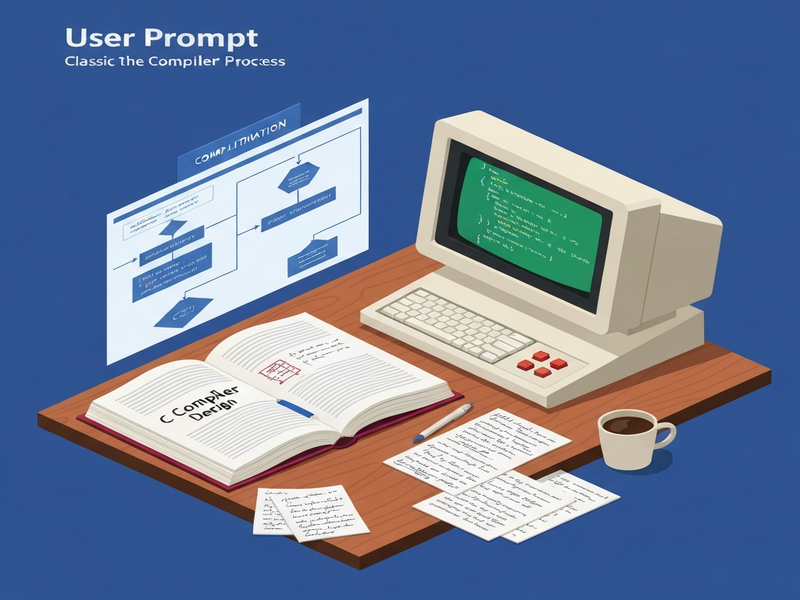
Notice how the Scanner feeds tokens into the Parser, which then constructs an AST that is traversed by the Code Generator. Optimizations such as constant folding and register spilling are applied just before the final assembly output, reflecting the modular design of the repository.
Extend Your Learning with UBOS Resources
While acwj focuses on compiler theory, UBOS offers a suite of tools that let you apply those concepts to modern AI‑driven applications. Below are curated resources that complement the acwj journey:
- UBOS homepage – Explore the full platform and its low‑code capabilities.
- About UBOS – Learn the mission behind the AI‑first development environment.
- UBOS platform overview – See how the visual workflow studio can accelerate prototyping.
- AI SEO Analyzer – Apply AI to audit your own content for better rankings.
- AI Article Copywriter – Generate drafts that you can refine with the compiler knowledge you just gained.
- UBOS templates for quick start – Jump‑start projects with pre‑built app skeletons.
- UBOS for startups – Leverage low‑code to validate ideas faster.
- UBOS solutions for SMBs – Scale automation without a large engineering team.
- Enterprise AI platform by UBOS – Integrate AI agents into large‑scale workflows.
- Web app editor on UBOS – Build interactive front‑ends for your compiler tools.
- Workflow automation studio – Orchestrate testing pipelines similar to acwj’s regression suite.
- UBOS pricing plans – Choose a plan that fits your learning budget.
- UBOS portfolio examples – See real‑world apps built with the platform.
- Talk with Claude AI app – Experiment with conversational AI that could assist you while coding.
- AI YouTube Comment Analysis tool – Learn data‑driven insights, a skill useful for compiler usage analytics.
- AI Video Generator – Create tutorial videos for your own compiler projects.
- AI Chatbot template – Build a help‑desk bot that can answer C‑language questions.
- GPT-Powered Telegram Bot – Deploy a bot that can compile snippets on demand.
- AI Image Generator – Produce visual assets for documentation, like the diagram above.
- AI Email Marketing – Promote your open‑source compiler project effectively.
By combining the low‑level insights from acwj with UBOS’s high‑level AI tools, you can prototype end‑to‑end solutions—such as a web‑based C compiler that leverages AI for code suggestions, error explanations, and automated testing.
Conclusion: Why acwj Should Be on Your Learning Roadmap
The acwj GitHub repository stands out as a rare, hands‑on C compiler tutorial that balances depth with accessibility. Its stepwise modules, self‑hosting milestone, and extensive test suite make it an ideal reference for anyone serious about compiler construction or looking to deepen their C programming learning journey.
Pairing this knowledge with UBOS’s AI marketing agents and low‑code environment can accelerate the creation of innovative developer tools—whether you’re building a custom IDE, an educational platform, or an AI‑augmented code reviewer.
Start exploring the repository today, experiment with the modules, and then leverage UBOS’s ecosystem to turn theory into production‑ready applications. Your next breakthrough in software engineering could begin with a single commit in the acwj project.
Andrii Bidochko
CTO UBOS
Andrii Bidochko is an AI entrepreneur and researcher focused on AI agents, reinforcement learning, and autonomous systems. He writes about the technologies shaping the future of machine intelligence, from frontier models and agent architectures to real-world AI applications.