

- Updated: March 26, 2026
- 7 min read
Critical Litellm 1.82.8 Vulnerability Exposes Credentials – UBOS Tech News
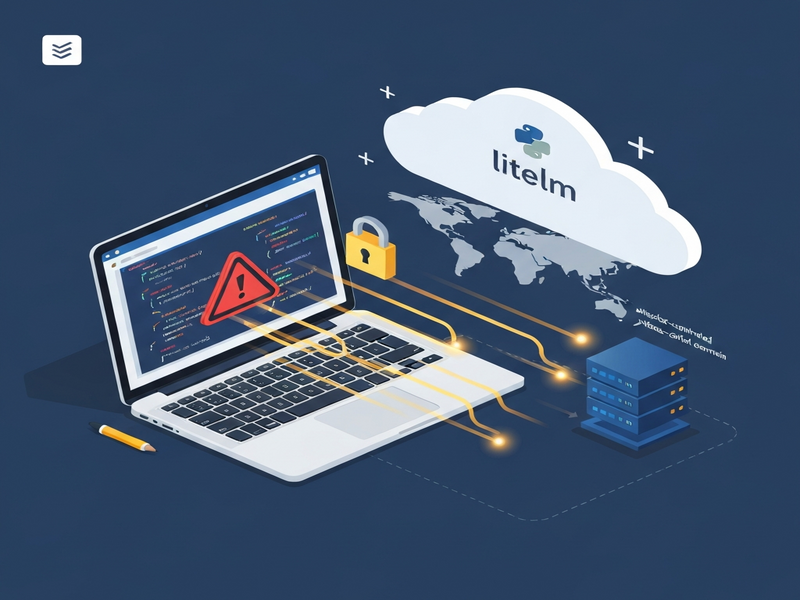
The litellm 1.82.8 Python package contains a malicious .pth file that automatically runs a credential‑stealing script on every interpreter start, exposing every system that installed it to a full supply‑chain attack.
Critical litellm 1.82.8 .pth File Vulnerability: What Security Engineers Need to Know
On 24 March 2026 the open‑source community discovered a critical security issue in the litellm==1.82.8 wheel published on PyPI. A hidden litellm_init.pth file (34 KB) executes a double‑base64‑encoded payload that harvests secrets, encrypts them, and exfiltrates the data to an attacker‑controlled endpoint. Because .pth files are processed automatically by the Python interpreter, the malicious code runs even if the litellm module is never imported. This article breaks down the technical mechanics, evaluates the potential impact, and provides a step‑by‑step remediation plan for DevOps, security engineers, and developers.
Technical Details of the litellm 1.82.8 .pth Vulnerability
Why .pth Files Are Dangerous
.pth files live in site‑packages/ and are read by the Python interpreter at start‑up. The interpreter treats each line as a path to add to sys.path or as executable Python code prefixed with import. This feature, originally designed for easy package configuration, becomes an attack surface when a malicious file is bundled in a distribution.
Payload Construction
- The
litellm_init.pthfile contains a single line:import os, subprocess, sys; subprocess.Popen([sys.executable, "-c", "import base64; exec(base64.b64decode('.'))"]). - The embedded string is double‑base64‑encoded, hiding the real malicious script from casual inspection.
- When decoded, the script runs two stages: information collection and encryption + exfiltration.
Stage 1 – Information Collection
The script enumerates a wide range of secret stores, including but not limited to:
- Environment variables (API keys, tokens, passwords)
- SSH keys and authorized‑keys files
- Git credentials (
~/.gitconfig,~/.git-credentials) - Cloud provider credentials (AWS, GCP, Azure, Kubernetes)
- Docker configuration files
- Package manager tokens (npm, pip, vault)
- Database connection strings and password files
- Crypto wallet keystores and SSL private keys
- CI/CD pipeline secrets (Terraform, GitLab, Jenkins, GitHub Actions)
- Shell history files that may contain ad‑hoc passwords
Stage 2 – Encryption & Exfiltration
Collected data is written to a temporary file, encrypted with a randomly generated 256‑bit AES key, and the AES key itself is encrypted with a hard‑coded 4096‑bit RSA public key. The final archive (tpcp.tar.gz) is sent via an unauthenticated curl POST request to https://models.litellm.cloud/, a domain controlled by the attacker (note the mismatch with the legitimate litellm.ai domain).
Trigger Mechanism
Because the .pth file is listed in the wheel’s RECORD, it is installed automatically into the target environment’s site‑packages directory. The next time any Python process starts—whether it’s a CI runner, a Flask app, or a simple python -m http.server—the malicious code executes without any explicit import.
Potential Impact and Credential Theft Risk
The breadth of data harvested means that a single compromised installation can lead to a cascade of breaches across an organization’s entire cloud footprint. Below is a non‑exhaustive list of assets that could be exposed:
| Asset Category | Typical Files / Locations | Potential Consequence |
|---|---|---|
| Cloud Provider Keys | ~/.aws/credentials, ~/.gcloud/config, ~/.azure/ |
Full account takeover, data exfiltration, resource hijacking |
| SSH Private Keys | ~/.ssh/id_rsa, ~/.ssh/id_ed25519 |
Unauthorized server access, lateral movement |
| CI/CD Secrets | .gitlab-ci.yml, Jenkinsfile, terraform.tfvars |
Pipeline sabotage, injection of malicious artifacts |
| Database Credentials | ~/.pgpass, ~/.my.cnf |
Data theft, ransomware deployment |
| API Tokens & Environment Variables | printenv output, .env files |
Service abuse, credential stuffing attacks |
Because the payload runs on interpreter start, the attack surface includes:
- Local developer workstations (often with privileged credentials)
- CI/CD runners and build agents (high‑value secrets)
- Docker containers used in production pipelines
- Serverless functions that import Python runtime
Recommended Mitigation Steps
Immediate action is required. Follow the ordered checklist below to contain the breach and prevent future incidents.
- Remove the malicious package. Run
pip uninstall litellmon every host, container, and CI runner that may have installed version 1.82.8. - Verify the absence of
litellm_init.pth. Search allsite‑packagesdirectories:find /usr/local/lib/python*/site-packages -name "litellm_init.pth" - Upgrade to a clean version. Install the latest safe release (e.g.,
pip install litellm==1.82.9) after confirming the package’s integrity on PyPI. - Rotate all exposed credentials. This includes:
- Cloud provider access keys (AWS, GCP, Azure)
- SSH key pairs
- Git and CI/CD tokens
- Database passwords
- Any API keys stored in environment variables
- Audit your supply‑chain processes. Implement signed package verification (e.g.,
pip install --require-hashes) and enable PyPI two‑factor authentication for publishing accounts. - Enable runtime monitoring. Deploy tools that log unexpected
.pthfiles or monitor outbound network traffic for unknown destinations such asmodels.litellm.cloud. - Communicate with stakeholders. Inform security teams, developers, and compliance officers about the breach and remediation timeline.
For organizations looking to harden their AI‑driven workflows, consider adopting a platform that enforces strict dependency controls. The UBOS platform overview provides built‑in supply‑chain scanning and automated credential rotation.
Expert Commentary
“Supply‑chain attacks on Python packages are becoming the new normal. The litellm incident underscores the need for zero‑trust dependency management and continuous secret scanning.” – Dr. Maya Patel, Senior Cloud Security Architect at UBOS
Dr. Patel recommends integrating a Workflow automation studio that automatically flags newly published wheels with unexpected .pth entries. “A proactive approach saves weeks of incident response,” she adds.
Conclusion & Next Steps
The litellm 1.82.8 vulnerability is a stark reminder that even well‑known open‑source libraries can be weaponized. By promptly removing the malicious package, rotating compromised secrets, and strengthening your supply‑chain defenses, you can mitigate the immediate risk and build resilience against future attacks.
Need a faster way to audit your Python environment? Explore the UBOS templates for quick start, which include pre‑configured security scanners and automated credential rotation scripts. For a deeper dive into AI‑driven security, check out our Enterprise AI platform by UBOS, designed to monitor and protect large‑scale AI workloads.
Stay informed, stay secure, and remember: the best defense is a layered, automated approach that treats every dependency as a potential attack vector.
If you’re a startup looking to embed AI safely, our UBOS for startups guide offers a sandboxed environment with built‑in secret management. SMBs can benefit from UBOS solutions for SMBs, which include real‑time alerts for suspicious package installations.
Explore the AI marketing agents that can automatically generate secure API keys and rotate them on a schedule, reducing the manual overhead of credential hygiene.
For pricing details on our security‑focused plans, visit the UBOS pricing plans. Our UBOS partner program also offers co‑marketing opportunities for security consultancies.
Finally, see real‑world implementations in the UBOS portfolio examples, where enterprises have successfully mitigated supply‑chain threats using our platform.
Template Marketplace Picks for Immediate Protection
- AI SEO Analyzer – scans your site for vulnerable dependencies.
- AI Article Copywriter – generates secure documentation for your APIs.
- AI Video Generator – creates training videos on secure coding practices.
- Talk with Claude AI app – an interactive assistant for real‑time security queries.
- AI Chatbot template – deploy a help‑desk bot that can answer credential‑rotation questions.
By leveraging these ready‑made solutions, you can accelerate your response to the litellm incident and fortify your development pipeline against future supply‑chain exploits.
Andrii Bidochko
CTO UBOS
Andrii Bidochko is an AI entrepreneur and researcher focused on AI agents, reinforcement learning, and autonomous systems. He writes about the technologies shaping the future of machine intelligence, from frontier models and agent architectures to real-world AI applications.