

- Updated: March 16, 2026
- 6 min read
Virtual Fly Brain Upload Claims Spark Debate
Virtual Fly Brain Upload: Hype, Science, and What It Means for AI
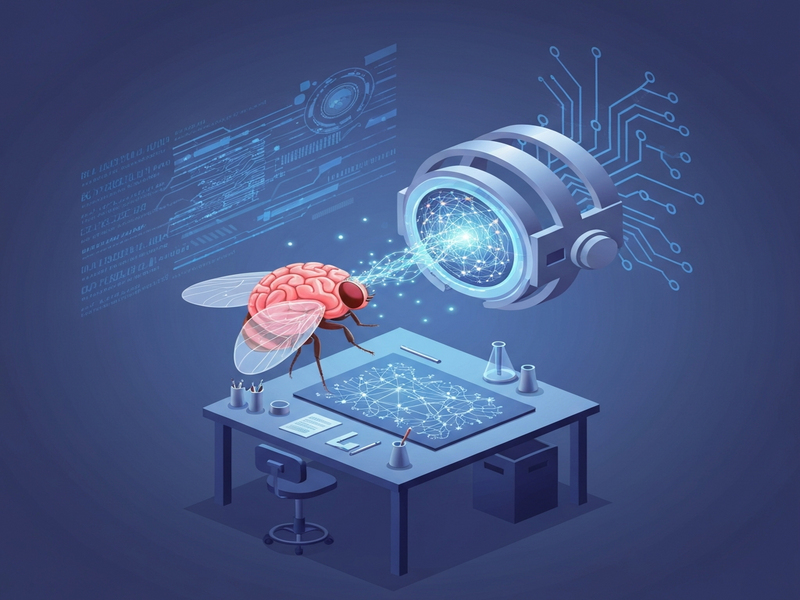
The claim that a fruit fly’s brain has been uploaded into a computer is currently unverified, heavily debated, and far from the “whole‑brain emulation” milestone many tech enthusiasts imagine.
Why the Virtual Fly Is Sparking a Firestorm
Last week, the original Verge article showcased a short video of a digital fruit fly walking, eating, and rubbing its legs—behaviors that look eerily familiar. The footage, released by San Francisco‑based Eon Systems, was accompanied by bold statements such as “the world’s first embodiment of a whole‑brain emulation.” Within hours, the clip went viral on X, Reddit, and countless tech newsletters, igniting a frenzy of speculation about the future of brain‑computer interfaces and AI neuroscience.
For readers who follow the intersection of artificial intelligence and neurotechnology, the story raises three immediate questions:
- What exactly did Eon Systems demonstrate?
- How credible are the claims of a “fly brain upload”?
- What are the broader implications for AI, whole‑brain emulation, and future biotech startups?
What The Verge Reported
The Verge story distilled the viral hype into a concise narrative:
- Source of the footage: A tweet from Eon co‑founder Alexander Wissner‑Gross, labeling the clip as “the world’s first embodiment of a whole‑brain emulation that produces multiple behaviors.”
- Technical claim: The team allegedly used the publicly available FlyWire connectome, applied a simple neuron model (referencing a 2024 Nature paper by Philip Shiu), and linked it to a MuJoCo physics simulation of a fly body.
- Performance metric: Eon’s CEO Michael Andregg cited “91 % behavior accuracy,” suggesting the virtual fly mimics real‑fly actions with high fidelity.
- Future roadmap: Eon claims it will scale the approach to a mouse brain within two years, positioning the company as a pioneer of “digital human intelligence.”
Crucially, the Verge article highlighted the absence of a peer‑reviewed paper, open‑source code, or independent replication—only two short videos and a series of hype‑laden social‑media posts.
What Scientists Are Saying
When the story reached academic circles, several leading neuroscientists and AI researchers offered measured, often skeptical, commentary.
“For a claim of this magnitude, we would expect a detailed technical report that includes software, code, and simulation environments that allow reproducibility.” – Shahab Bakhtiari, University of Montreal
Other notable reactions include:
- Harvard’s Alexander Bates: “The blog post provides more context, but it still under‑delivers. A real uploaded animal would require precise synaptic weights, neurotransmitter dynamics, and a fully integrated motor system—none of which were demonstrated.”
- Carnegie Mellon’s Aran Nayebi: “We are not even close to faithfully simulating a fly’s brain in silico. The connectome alone lacks critical biochemical detail.”
- Philosopher Jonathan Birch (LSE): “The term ‘uploaded animal’ is philosophically ambiguous. Even if the neural wiring is copied, the embodied biology—metabolism, hormonal feedback, and lived experience—remains missing.”
These critiques converge on a single point: the current demonstration is a sophisticated model, not a full brain upload. The distinction matters because it shapes expectations for future AI‑neuroscience collaborations.
Why This Matters for AI, Brain‑Computer Interfaces, and Startups
Even if the virtual fly falls short of a true upload, the project illustrates several trends that are reshaping the AI‑neuroscience landscape.
1. Accelerating Whole‑Brain Emulation Pipelines
Combining large‑scale connectomes with physics engines (MuJoCo, Unity, or custom simulators) is becoming a standard workflow. Companies like UBOS platform overview now offer modular pipelines that let developers plug in neural models, run real‑time simulations, and expose the results via APIs.
2. Democratizing Access to Neuro‑Data
Open datasets such as FlyWire, the Human Connectome Project, and the Mouse Brain Atlas enable startups to bypass costly wet‑lab experiments. By leveraging Chroma DB integration, developers can store high‑dimensional neural activity vectors and query them efficiently for downstream AI tasks.
3. New Business Models Around “Digital Organisms”
Imagine a marketplace where researchers sell “digital twins” of organisms—complete with behavior scripts, sensory modalities, and API endpoints. UBOS’s UBOS templates for quick start already include pre‑built agents like the “AI YouTube Comment Analysis tool” and “AI SEO Analyzer,” hinting at a future where neuro‑simulations become plug‑and‑play SaaS products.
4. Ethical and Philosophical Frontiers
Even a partial brain emulation raises questions about consciousness, rights, and the definition of “life.” As About UBOS notes, responsible AI development must incorporate interdisciplinary oversight—from ethicists to neurobiologists—to avoid premature claims that could mislead investors and the public.
In short, the virtual fly is less a finished product and more a proof‑of‑concept that highlights where the field is headed.
What You Can Do Next
If you’re a developer, researcher, or startup founder interested in exploring AI‑neuroscience, UBOS offers a suite of tools that can accelerate your experiments:
- AI marketing agents – integrate generative models with neuro‑data pipelines.
- Enterprise AI platform by UBOS – scale simulations from a single fly to multi‑organism ecosystems.
- Web app editor on UBOS – build interactive dashboards for visualizing neural activity.
- Workflow automation studio – automate data ingestion from connectome repositories.
- UBOS pricing plans – choose a tier that matches your compute budget.
Explore real‑world examples in the UBOS portfolio examples and discover ready‑made solutions for startups at UBOS for startups or SMBs via UBOS solutions for SMBs.
Looking for a quick prototype? Try one of our marketplace templates:
- AI SEO Analyzer – boost your site’s search visibility with AI‑driven insights.
- AI Article Copywriter – generate high‑quality content at scale.
- Talk with Claude AI app – experiment with advanced conversational agents.
- Your Speaking Avatar template – create lifelike voice agents using ElevenLabs AI voice integration.
By leveraging these resources, you can move from “virtual fly” curiosity to building robust, reproducible neuro‑AI applications that stand up to scientific scrutiny.
Bottom Line
The buzz around Eon Systems’ “virtual fly” underscores a pivotal moment: AI and neuroscience are converging faster than ever, but the gap between a simulated behavior and a true whole‑brain upload remains wide. As the field matures, transparent methodology, open data, and rigorous peer review will be the yardsticks that separate hype from breakthrough.
Stay informed, experiment responsibly, and consider partnering with platforms that champion reproducibility—like UBOS homepage—to ensure your next AI‑neuroscience project is built on solid, shareable foundations.
Andrii Bidochko
CTO UBOS
Andrii Bidochko is an AI entrepreneur and researcher focused on AI agents, reinforcement learning, and autonomous systems. He writes about the technologies shaping the future of machine intelligence, from frontier models and agent architectures to real-world AI applications.