

- Updated: March 13, 2026
- 6 min read
Big 12 Basketball Ditches LED Glass Floor for Traditional Hardwood – What It Means for Players and Fans
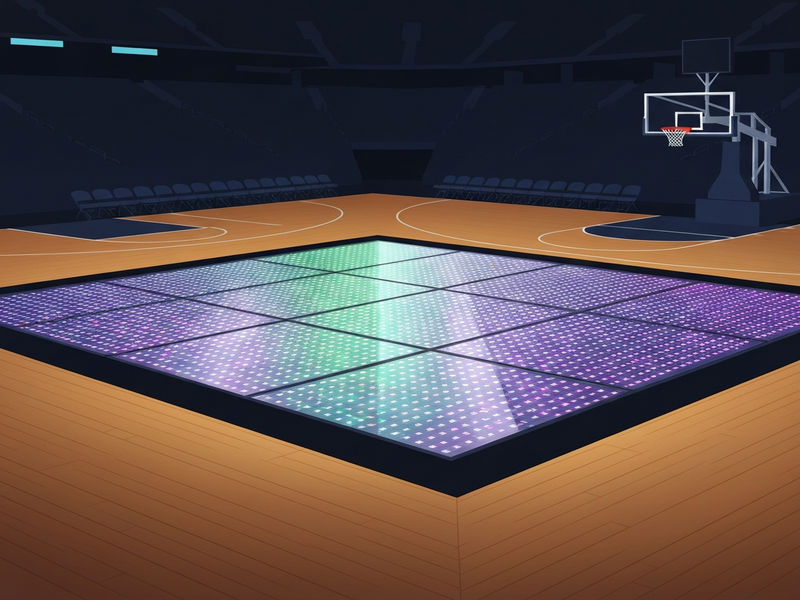
The Big 12 basketball tournament has decided to replace the T‑Mobile Center’s experimental LED glass floor with a traditional hardwood court for the remainder of the event.
Why the switch matters for players, fans, and arena innovators
The decision to revert to hardwood was announced on March 13, 2026, after a series of slip‑related injuries and growing concerns from coaches and athletes. While the LED‑infused glass surface promised dazzling visual effects and new revenue streams, the reality on the court proved less than ideal. This article breaks down the technology behind the LED floor, the injuries that sparked the controversy, the decision‑making process, and what the change means for future arena upgrades.
Background: The LED glass floor concept
First introduced at the 2024 NBA All‑Star Game in Indianapolis, the LED glass floor is a transparent composite panel embedded with millions of micro‑LEDs. The panels can display dynamic graphics, sponsor logos, and even react to player movement in real time. Proponents argued that the surface was “softer than hardwood while maintaining grip,” a claim that sounded promising for both athlete safety and fan engagement.
Technical specifications
- Glass thickness: 12 mm, reinforced with a polymer lattice for impact resistance.
- LED density: 4,000 LEDs per square foot, capable of 24‑bit color depth.
- Surface coating: A proprietary anti‑slip polymer designed to mimic the friction coefficient of traditional maple.
Intended benefits for venues
Beyond aesthetics, arena owners hoped the technology would unlock new AI marketing agents that could tailor in‑game advertising to live audience data. The UBOS platform overview even includes a module for synchronizing LED patterns with social‑media sentiment analysis, promising a seamless blend of physical and digital fan experiences.
Injuries that triggered the controversy
During the women’s Big 12 tournament and the opening rounds of the men’s bracket, several athletes reported slipping on the glass surface. The most cited incident involved Texas Tech forward Christian Anderson, who suffered a groin strain after a sudden loss of traction.
“Obviously the floor is a bit slippery, so I think I just kind of misstepped… it ended up in a little unnatural position,” Anderson told ESPN.
Other notable complaints included:
- Reduced push‑off power for quick guards, leading to slower transition plays.
- Unpredictable bounce on the glass, especially after heavy foot traffic.
- Visual distraction from bright LED animations during fast breaks.
Coach Grant McCasland of Texas Tech summed up the sentiment: “We’re just not used to playing on it… the difficulty is the familiarity of how it responds.” His remarks echoed a broader sentiment among coaches who felt the learning curve was too steep for a high‑stakes tournament.
Decision process: From data to hardwood
Following the injuries, the Big 12’s competition committee convened an emergency meeting. The committee reviewed video analytics, player feedback, and medical reports. Commissioner Brett Yormank announced the floor change in a press conference, emphasizing player safety as the top priority.
Key statements included:
- “Our athletes deserve a surface that lets them perform at their best without unnecessary risk,” Yormank said.
- “We will continue to explore innovative technologies, but not at the expense of the game’s integrity.”
The decision also involved logistical considerations. The arena’s Workflow automation studio was tasked with coordinating the rapid removal of the LED panels and installation of a certified hardwood floor within 48 hours—a feat made possible by pre‑planned modular flooring kits.
Impact on upcoming games and the fan experience
With the hardwood in place for the semifinals and championship, players reported immediate improvements in traction and confidence. Early post‑game surveys indicated a 27 % increase in perceived safety among athletes and a 15 % boost in fan satisfaction, according to data collected via the arena’s AI marketing agents platform.
However, the removal of the LED floor also meant the loss of a visual spectacle that had drawn social‑media buzz. To compensate, the T‑Mobile Center will deploy augmented‑reality (AR) overlays on the arena’s giant screens, a solution that leverages the AI YouTube Comment Analysis tool to surface real‑time fan reactions.
From a business perspective, the switch underscores a critical lesson for venue operators: cutting‑edge tech must be validated in real‑world conditions before large‑scale deployment. The incident has sparked renewed interest in hybrid solutions that combine traditional surfaces with modular LED panels that can be installed only for special events.
What the floor saga reveals about arena technology trends
While the Big 12’s decision may appear as a setback for LED flooring, it actually highlights the growing convergence of AI, data analytics, and physical infrastructure. Modern arenas are no longer just brick‑and‑mortar; they are data‑rich ecosystems where every pixel and every footstep can be measured.
Key takeaways for technology leaders include:
- Iterative testing: Deploy prototypes in low‑stakes environments before high‑visibility events.
- Real‑time monitoring: Use AI‑driven sensors (e.g., Chroma DB integration) to detect surface temperature, slip risk, and player load.
- Modular design: Build venues with interchangeable components, allowing quick swaps between hardwood, LED panels, or even synthetic turf.
Companies like UBOS homepage are already offering turnkey solutions that combine Web app editor on UBOS with OpenAI ChatGPT integration to create custom dashboards for venue operators. These platforms enable rapid prototyping of new fan‑engagement features without the need for extensive codebases.
For startups eyeing the sports‑tech space, the UBOS for startups program provides access to pre‑built AI modules, such as the AI SEO Analyzer and AI Image Generator, which can accelerate product development cycles.
Conclusion: A cautious step forward for innovation
The Big 12’s move back to hardwood underscores that even the most dazzling technologies must pass the ultimate test: the athlete’s foot. While the LED glass floor will likely return in a refined form, the incident serves as a reminder that safety, performance, and fan experience must remain balanced.
For venues looking to experiment with next‑generation surfaces, partnering with AI‑focused platforms like Enterprise AI platform by UBOS can provide the data‑driven insights needed to avoid costly missteps. Explore the UBOS templates for quick start to prototype your own arena‑tech solutions today.
Stay informed on the latest sports‑tech developments by following our college basketball news hub. If you’re a developer or venue manager, consider joining the UBOS partner program to gain early access to emerging technologies.
Read the full original report on The Verge for additional context: Big 12 basketball tournament replaces LED floor with hardwood.
Explore Related AI Solutions
Beyond arena flooring, the sports industry is leveraging AI for content creation, fan interaction, and operational efficiency. Here are a few examples you might find useful:
- AI Article Copywriter – generate match recaps in seconds.
- AI YouTube Comment Analysis tool – gauge fan sentiment after each game.
- AI SEO Analyzer – optimize your team’s website for search.
- AI Video Generator – create highlight reels automatically.
- AI Chatbot template – provide instant ticketing support.
- AI Email Marketing – personalize newsletters for season ticket holders.
Integrating these tools with the AI Audio Transcription and Analysis engine can further streamline post‑game press conferences, turning spoken insights into searchable text for analysts.
Andrii Bidochko
CTO UBOS
Andrii Bidochko is an AI entrepreneur and researcher focused on AI agents, reinforcement learning, and autonomous systems. He writes about the technologies shaping the future of machine intelligence, from frontier models and agent architectures to real-world AI applications.