

- Updated: March 4, 2026
- 6 min read
AI Giants Drive $189 B VC Surge in February 2026
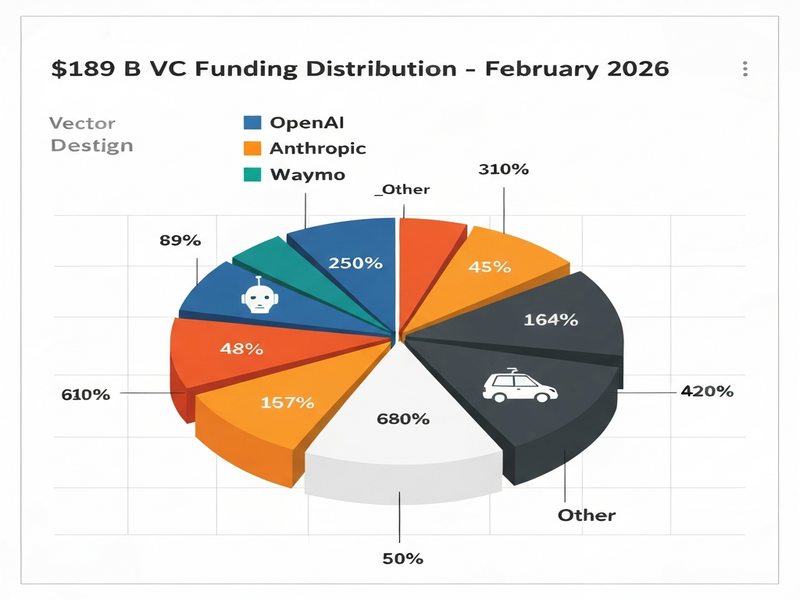
February 2026 recorded a historic $189 billion in global venture‑capital funding, with AI powerhouses OpenAI, Anthropic and Waymo alone accounting for more than 80 % of the total.
Investors, founders and tech enthusiasts are scrambling to decode what this surge means for the next wave of AI‑driven startups. The TechCrunch report reveals that AI startups captured $171 billion—90 % of all capital raised—while the remaining $18 billion spread across non‑AI sectors.
1. Overview of the $189 B Funding Spike
The February 2026 VC landscape shattered previous records in three key ways:
- Scale: $189 billion is more than three times the $58 billion raised in January 2026.
- AI Dominance: $171 billion (90 %) went to AI‑centric companies, underscoring the sector’s maturation from hype to core infrastructure.
- Concentration: Three mega‑rounds—OpenAI, Anthropic, Waymo—absorbed 83 % of the total capital.
Total VC Flow by Region
| Region | VC Funding (USD B) | AI Share |
|---|---|---|
| North America | $112 | 92 % |
| Europe | $45 | 88 % |
| Asia‑Pacific | $32 | 85 % |
2. Funding Breakdown by the Three Titans
While the overall AI surge is impressive, the three headline rounds deserve a closer look.
- OpenAI secured a staggering $110 billion in a private round, pushing its valuation to $730 billion—one of the largest private financings ever recorded.
- Anthropic closed a $30 billion Series G, valuing the company at $380 billion and cementing its position as the second‑largest AI model provider.
- Waymo raised $16 billion, achieving a $126 billion valuation and signaling the continued convergence of autonomous‑vehicle tech with generative AI.
Combined, these three rounds represent $156 billion—exactly one‑third of the $425 billion total VC spend recorded in 2025, according to Crunchbase.
Why These Companies Attracted Massive Capital
- Strategic moat: Proprietary models (GPT‑4‑Turbo, Claude‑3, Waymo’s self‑driving stack) create high entry barriers.
- Revenue traction: Enterprise contracts, API consumption, and licensing deals now generate multi‑billion‑dollar ARR.
- Regulatory tailwinds: Governments worldwide are allocating funds to AI safety and infrastructure, indirectly boosting investor confidence.
3. The Broader AI Startup Boom
Beyond the megacap players, a vibrant ecosystem of niche AI startups is flourishing. These companies are leveraging the same foundational models that power OpenAI and Anthropic, but they specialize in vertical‑specific solutions.
For founders looking to ride this wave, the UBOS platform overview offers a low‑code environment to prototype, test, and launch AI‑enhanced products in weeks rather than months.
Key Trends Shaping the Landscape
- AI‑first SaaS: Companies are embedding large‑language models (LLMs) directly into core workflows, from marketing automation to legal document review.
- Multimodal AI: Integration of text, image, audio, and video (e.g., ElevenLabs AI voice integration) is unlocking new product categories.
- Data‑centric engineering: Tools like Chroma DB integration enable efficient vector search for enterprise knowledge bases.
- AI‑powered compliance: Regulatory‑ready models are becoming a differentiator for fintech and health‑tech startups.
UBOS’s AI marketing agents illustrate how a single platform can spin up a full‑stack campaign—copy, graphics, and voice—using pre‑built templates like the AI SEO Analyzer or the AI Article Copywriter. These templates reduce time‑to‑market from months to days, a crucial advantage when capital is flowing fast.
From Prototype to Production: A UBOS Success Path
- Start with a UBOS templates for quick start such as the AI YouTube Comment Analysis tool to validate market demand.
- Leverage the Web app editor on UBOS to customize UI/UX without writing extensive code.
- Automate backend workflows with the Workflow automation studio, linking LLM calls to data pipelines (e.g., OpenAI ChatGPT integration).
- Scale securely using the Enterprise AI platform by UBOS, which offers built‑in compliance, monitoring, and multi‑tenant isolation.
- Monetize via subscription or usage‑based pricing—details are transparent on the UBOS pricing plans page.
4. Implications for Investors
For venture capitalists, the February data signals both opportunity and risk. Below are actionable takeaways.
- Double‑down on AI infrastructure: Funding rounds for model‑hosting, vector databases, and prompt‑engineering platforms are likely to continue expanding.
- Seek vertical specialization: Startups that combine LLMs with domain expertise (e.g., legal AI, biotech data mining) can command premium multiples.
- Watch for “AI‑as‑a‑service” consolidation: Companies like UBOS partner program are building ecosystems that could become acquisition targets for the megacap players.
- Prioritize governance: With $171 billion now tied to AI, regulatory scrutiny will intensify. Startups with built‑in compliance frameworks will be more attractive.
- Leverage data‑driven due diligence: Tools such as the Keywords Extraction with ChatGPT can automate market sizing and competitive analysis.
Portfolio Diversification Strategies
Investors can balance exposure by allocating capital across three buckets:
- Core AI Leaders: Direct stakes in OpenAI‑type entities or their close affiliates.
- Emerging Vertical Players: Companies using UBOS’s AI Video Generator or AI Image Generator to serve niche markets.
- Infrastructure & Enablers: Platforms offering low‑code development, data pipelines, or compliance tooling (e.g., Unstructured Data AI Parser).
5. Call to Action for Founders and Investors
If you’re ready to capitalize on the AI funding surge, explore the resources below to accelerate your journey.
- Visit the UBOS homepage for a live demo of AI‑first product building.
- Learn more about the company’s mission on the About UBOS page.
- Browse real‑world success stories in the UBOS portfolio examples to see how startups turned ideas into funded businesses.
- Join the UBOS partner program to gain early access to new AI modules and co‑marketing opportunities.
- Start building today with the UBOS templates for quick start, such as the AI Survey Generator or the AI Email Marketing template.
Whether you’re a venture capitalist seeking the next unicorn or a founder aiming to secure a slice of the $189 billion pie, the tools and insights above can give you a decisive edge.
6. Additional Resources & Integrations
UBOS’s ecosystem includes a rich set of integrations that make AI development frictionless:
- Telegram integration on UBOS – deploy conversational bots directly to Telegram.
- ChatGPT and Telegram integration – combine real‑time messaging with LLM reasoning.
- OpenAI ChatGPT integration – plug GPT‑4‑Turbo into any workflow.
- Chroma DB integration – power semantic search across massive document corpora.
- ElevenLabs AI voice integration – add lifelike speech to your apps.
Explore niche templates that showcase these integrations, such as the GPT-Powered Telegram Bot or the Video AI Chat Bot, to see how quickly you can move from concept to production.
7. Closing Thoughts
The $189 billion VC surge in February 2026 is more than a headline—it’s a structural shift toward AI‑centric value creation. Companies that can harness large‑language models, multimodal data, and low‑code platforms like UBOS will dominate the next decade of tech innovation. Investors who understand the concentration risk, yet diversify across infrastructure, vertical, and application layers, stand to reap outsized returns.
Stay ahead of the curve. Leverage the tools, templates, and partnerships highlighted above, and position your portfolio or startup at the forefront of the AI revolution.
Andrii Bidochko
CTO UBOS
Andrii Bidochko is an AI entrepreneur and researcher focused on AI agents, reinforcement learning, and autonomous systems. He writes about the technologies shaping the future of machine intelligence, from frontier models and agent architectures to real-world AI applications.