

- Updated: March 3, 2026
- 8 min read
Understanding CRDTs: Real‑Time Collaboration Made Simple
Conflict‑free Replicated Data Types (CRDTs) are mathematically proven data structures that let multiple devices update the same data independently while guaranteeing that all replicas will eventually converge to the same state without any central coordination.
Why CRDTs Matter for Modern Distributed Systems
In an era where real‑time collaboration tools (think Google Docs, Figma, or multiplayer games) must stay responsive even when network conditions are flaky, developers need a way to avoid the classic “write‑conflict” problem. CRDTs solve this by embedding conflict‑resolution logic directly into the data type, turning every write into a safe, merge‑able operation.
For developers, engineers, and tech enthusiasts focused on distributed systems and real‑time collaboration, understanding CRDT fundamentals unlocks the ability to build offline‑first apps, peer‑to‑peer editors, and scalable micro‑services without a single point of failure.
UBOS, a leading UBOS homepage platform, already leverages CRDT concepts in its collaborative editing solutions, allowing teams to co‑author content without waiting for server acknowledgments.
State‑Based CRDTs: Core Properties and Guarantees
State‑based CRDTs (also called CvRDTs) propagate the entire replica state to peers. When a node receives a remote state, it merges it with its local copy using a deterministic merge function. The merge must satisfy three algebraic properties:
- Commutativity:
A ∨ B = B ∨ A– order of merges does not matter. - Associativity:
(A ∨ B) ∨ C = A ∨ (B ∨ C)– grouping of merges is irrelevant. - Idempotence:
A ∨ A = A– merging a state with itself leaves it unchanged.
These guarantees ensure that, regardless of network latency, message loss, or out‑of‑order delivery, every replica will eventually converge to the same value—a property known as eventual consistency.
The UBOS platform overview provides built‑in support for state‑based CRDTs, exposing them through its Web app editor on UBOS so developers can focus on UI logic instead of low‑level synchronization.
Walkthrough: Last‑Write‑Wins (LWW) Register
The LWW Register is the simplest CRDT. It stores a single value together with a monotonically increasing timestamp and the identifier of the peer that performed the last write. When two replicas exchange states, the one with the higher timestamp wins; ties are broken by comparing peer IDs.
class LWWRegister<T> {
  readonly id: string;
  state: [peer: string, timestamp: number, value: T];

  get value() { return this.state[2]; }

  constructor(id: string, init: [string, number, T]) {
    this.id = id;
    this.state = init;
  }

  set(value: T) {
    this.state = [this.id, this.state[1] + 1, value];
  }

  merge(remote: [string, number, T]) {
    const [rPeer, rTs] = remote;
    const [lPeer, lTs] = this.state;
    if (rTs > lTs || (rTs === lTs && rPeer > lPeer)) {
      this.state = remote;
    }
  }
}
In practice, the LWW Register powers features such as “presence indicators” in chat apps—each client writes its online/offline flag with a timestamp, and every other client can instantly see the most recent status without a round‑trip to a server.
UBOS’s Enterprise AI platform by UBOS uses LWW Registers under the hood to synchronize AI model configuration across data‑center clusters, guaranteeing that the latest hyper‑parameters win.
Walkthrough: Last‑Write‑Wins (LWW) Map
Real‑world applications rarely need a single scalar; they need a collection of key‑value pairs that evolve independently. The LWW Map composes many LWW Registers—one per key—so each entry can be updated concurrently without interfering with others.
class LWWMap<T> {
  readonly id: string;
  #data = new Map<string, LWWRegister<T | null>>();

  constructor(id: string, initState: Record<string, [string, number, T | null]>) {
    this.id = id;
    for (const [k, s] of Object.entries(initState)) {
      this.#data.set(k, new LWWRegister(this.id, s));
    }
  }

  get value() {
    const out: Record<string, T> = {};
    for (const [k, reg] of this.#data) {
      if (reg.value !== null) out[k] = reg.value;
    }
    return out;
  }

  get state() {
    const out: Record<string, [string, number, T | null]> = {};
    for (const [k, reg] of this.#data) out[k] = reg.state;
    return out;
  }

  set(key: string, val: T) {
    const reg = this.#data.get(key);
    if (reg) reg.set(val);
    else this.#data.set(key, new LWWRegister(this.id, [this.id, 1, val]));
  }

  delete(key: string) {
    const reg = this.#data.get(key);
    if (reg) reg.set(null); // tombstone
  }

  merge(remote: Record<string, [string, number, T | null]>) {
    for (const [k, rState] of Object.entries(remote)) {
      const local = this.#data.get(k);
      if (local) local.merge(rState);
      else this.#data.set(k, new LWWRegister(this.id, rState));
    }
  }
}
The LWW Map shines in collaborative document editing. Each paragraph can be treated as a key; users edit different sections simultaneously, and the map merges changes without overwriting each other’s work.
UBOS’s Workflow automation studio lets non‑technical teams build “key‑value” pipelines where each step is a CRDT‑backed node, ensuring that automation rules stay consistent even when multiple admins edit them concurrently.
Benefits of CRDTs for Collaborative Applications
- Offline‑First Experience – Users can continue working without a network connection; once back online, their local state merges automatically.
- Zero Server Bottleneck – No central authority is needed for conflict resolution, reducing latency and scaling costs.
- Deterministic Merges – Guarantees that every replica arrives at the same final state, simplifying testing and debugging.
- Fine‑Grained Concurrency – Individual keys or registers can be updated in parallel, enabling high‑throughput collaborative editing.
- Built‑In Audit Trail – Timestamps and peer IDs provide a natural history of changes, useful for compliance.
These advantages translate into concrete use‑cases:
- Real‑time whiteboards – Each stroke is an entry in an LWW Map, allowing artists to draw together without flicker.
- Shared code editors – Files are represented as maps of line numbers to text registers, enabling seamless pair programming.
- Distributed configuration management – Feature flags stored in registers propagate instantly across micro‑services.
- Collaborative AI prompt libraries – Teams co‑author prompt templates; CRDTs keep every version in sync.
Companies building AI‑driven products can accelerate time‑to‑market by embedding CRDTs into their AI marketing agents. These agents share knowledge bases across regions without a single point of failure, ensuring that the latest campaign insights are instantly visible to every sales rep.
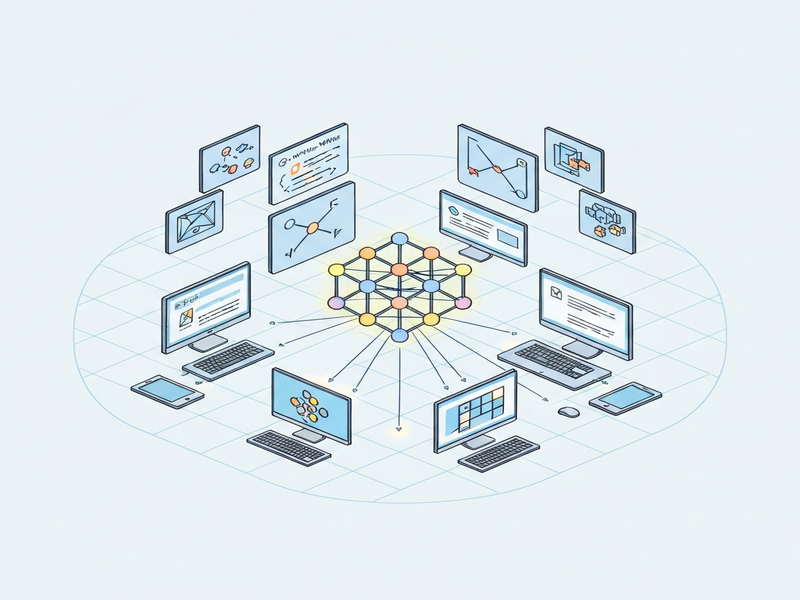
How UBOS Implements CRDTs in Its Product Suite
UBOS integrates CRDTs at three architectural layers:
- Data Layer – The Chroma DB integration stores vector embeddings as LWW Registers, guaranteeing that updates from multiple AI inference nodes never clash.
- Application Layer – The UBOS templates for quick start include pre‑wired CRDT components (e.g., “AI SEO Analyzer” and “AI YouTube Comment Analysis tool”) that developers can drop into a project with a single click.
- Collaboration Layer – The collaborative editing solution uses LWW Maps to synchronize document fragments, delivering a Google‑Docs‑like experience inside any UBOS‑hosted web app.
For startups looking to prototype quickly, the UBOS for startups plan includes unlimited CRDT‑backed templates and a sandbox environment where developers can experiment with offline‑first features without provisioning extra infrastructure.
Small‑to‑medium businesses benefit from the UBOS solutions for SMBs, which bundle CRDT‑enabled real‑time dashboards with role‑based access control, eliminating the need for costly third‑party sync services.
Getting Started: Pricing, Templates, and Support
UBOS offers transparent UBOS pricing plans that scale from free developer tiers (ideal for experimenting with CRDTs) to enterprise licenses that include dedicated support for high‑throughput collaborative workloads.
To accelerate development, explore the UBOS portfolio examples. You’ll find a live demo of a collaborative whiteboard built entirely with LWW Maps, showcasing how low‑latency merges feel to the end user.
If you need a ready‑made CRDT‑powered app, try the “AI SEO Analyzer” template. It demonstrates how to combine the OpenAI ChatGPT integration with a state‑based CRDT to keep keyword suggestions synchronized across multiple SEO specialists.
Further Reading
For a deep dive into the theory behind CRDTs, see Jake Lazaroff’s interactive introduction: An Interactive Intro to CRDTs. The article walks through the same LWW Register and Map examples we covered, but adds visualizations that help you grasp the merge algebra.
Conclusion: Embrace CRDTs to Future‑Proof Your Collaboration Stack
Conflict‑free Replicated Data Types turn the age‑old problem of concurrent writes into a solved engineering pattern. By leveraging state‑based CRDTs such as LWW Register and LWW Map, developers can build offline‑first, low‑latency, and highly scalable collaborative applications without a central bottleneck.
UBOS makes this transition effortless. Whether you are a startup prototyping a new AI‑powered editor, an SMB seeking real‑time dashboards, or an enterprise building a distributed AI model registry, UBOS’s CRDT‑enabled platform, templates, and integrations give you the tools to ship faster and stay resilient.
Ready to experiment? Visit the UBOS homepage, spin up a free sandbox, and start building your own CRDT‑backed app today.
Andrii Bidochko
CTO UBOS
Andrii Bidochko is an AI entrepreneur and researcher focused on AI agents, reinforcement learning, and autonomous systems. He writes about the technologies shaping the future of machine intelligence, from frontier models and agent architectures to real-world AI applications.