

- Updated: February 26, 2026
- 6 min read
Volkswagen Partners with XPeng as Launch Customer for VLA‑2.0 Autonomous Driving Model
Volkswagen Becomes Launch Customer for XPeng’s VLA‑2.0 Model
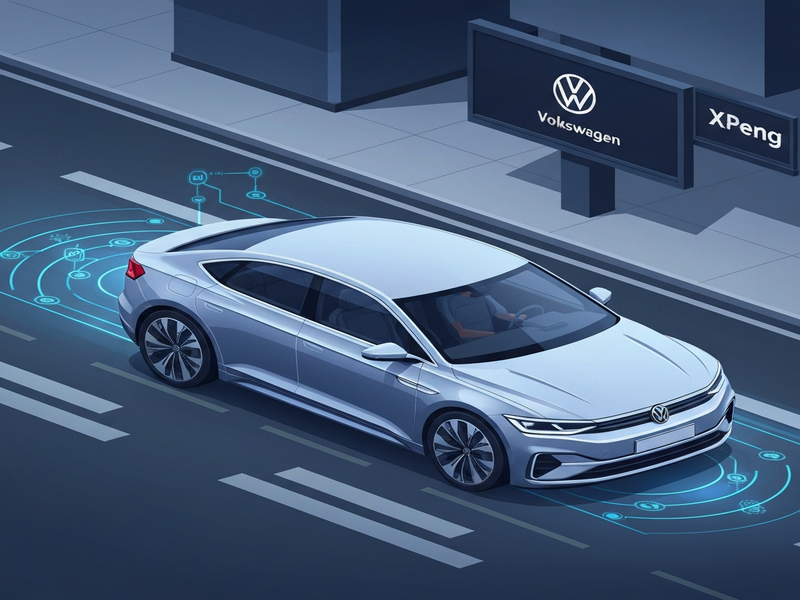
Volkswagen has officially become the launch customer for XPeng’s second‑generation Vision‑Language‑Action (VLA‑2.0) autonomous‑driving system, a partnership that accelerates the rollout of large‑model AI in production vehicles and signals a new era for intelligent mobility.
What Is the VLA‑2.0 Model?
The Vision‑Language‑Action (VLA) architecture combines three AI pillars: visual perception, natural‑language understanding, and real‑time decision making. VLA‑2.0, unveiled by XPeng in November 2025, is the first mass‑produced “large model” that can ingest raw camera feeds, interpret driver commands in natural language, and generate safe driving actions without relying on pre‑programmed rule sets.
- Multimodal perception: 12 high‑resolution cameras feed a 360° view into a transformer‑based visual encoder.
- Contextual reasoning: The model runs internal simulations of “what‑if” scenarios, extending the driver‑takeover distance by up to 13× on complex urban routes.
- Language‑driven control: Drivers can issue commands such as “take the next exit” or “slow down for school zones,” which the model translates into precise steering, throttle, and braking actions.
Key performance metrics (internal testing):
| Metric | Result |
|---|---|
| Takeover distance (complex road) | 13× improvement |
| Latency (perception → action) | ≤ 45 ms |
| Language command accuracy | 96 % |
Why Volkswagen Chose XPeng’s VLA‑2.0
Volkswagen’s decision to become the launch customer stems from three strategic motives:
- Accelerated time‑to‑market: By integrating VLA‑2.0 into its upcoming ID. Buzz‑X platform, Volkswagen can offer Level‑3+ autonomous features within 12 months, far quicker than building a proprietary stack from scratch.
- Scalable AI infrastructure: XPeng’s model runs on a distributed edge‑compute architecture that aligns with Volkswagen’s existing vehicle‑to‑cloud ecosystem, reducing hardware costs by an estimated 30 %.
- Regulatory readiness: VLA‑2.0 includes built‑in scenario‑logging and explainability modules that satisfy EU safety standards (UN‑R157) and simplify certification.
The partnership will see Volkswagen’s engineering team co‑develop a “German‑language fine‑tuning” layer, ensuring that voice commands in German, French, and Italian are interpreted with native‑level nuance. The first production‑ready vehicles are slated for a pilot rollout in Europe’s “Smart Mobility Corridor” by Q4 2026.
What This Means for the Autonomous‑Driving Market
The Volkswagen‑XPeng collaboration is a bellwether for several industry trends:
- Cross‑border AI alliances: Chinese EV innovators are now trusted partners for legacy European OEMs, breaking the historical technology silo.
- Shift from rule‑based to model‑based autonomy: Large‑model AI like VLA‑2.0 can adapt to novel road conditions without firmware updates, lowering long‑term maintenance overhead.
- Data‑centric value creation: Real‑world driving data collected from Volkswagen’s fleet will feed back into XPeng’s training loop, creating a virtuous cycle of improvement.
Analysts at TechNode estimate that the combined market potential of VLA‑enabled vehicles could exceed $120 billion by 2030, driven by fleet operators, ride‑hailing services, and premium consumer segments.
Industry Voices on VLA‑2.0
“VLA‑2.0 is the first AI system that truly thinks like a driver while acting like a machine. Volkswagen’s early adoption validates the model’s safety and commercial viability,” – He Xiaopeng, CEO of XPeng.
“Our partnership with XPeng gives us a competitive edge in Europe’s fast‑evolving autonomous‑driving regulations. The multimodal reasoning capabilities of VLA‑2.0 align perfectly with our vision of a seamless, voice‑first mobility experience,” – Oliver Blume, Chairman of the Board, Volkswagen AG.
Looking ahead, both companies plan to co‑author a whitepaper on “Explainable AI for Autonomous Vehicles,” targeting policymakers and standards bodies. The document will detail how VLA‑2.0’s internal simulation logs can be audited in real time, a feature that could become a regulatory requirement in the EU by 2027.
UBOS: The Backend Powerhouse Behind Next‑Gen Vehicle AI
While XPeng and Volkswagen focus on the front‑end vehicle experience, the UBOS homepage provides the cloud‑native infrastructure that makes large‑model deployment at scale possible. UBOS’s platform overview highlights three core services that directly support VLA‑2.0:
- Edge‑compute orchestration: The Workflow automation studio lets engineers define data pipelines that push model updates from the cloud to vehicle ECUs with zero‑downtime.
- AI model registry & versioning: Through the Chroma DB integration, developers can store embeddings of driving scenarios, enabling rapid similarity search for anomaly detection.
- Voice‑first interaction layer: The ElevenLabs AI voice integration powers natural‑language commands, complementing VLA‑2.0’s language module.
For teams building custom dashboards or fleet‑management tools, the Web app editor on UBOS offers drag‑and‑drop components that connect directly to vehicle telemetry streams. Meanwhile, the AI marketing agents can automatically generate personalized in‑car promotions based on driver preferences—an emerging revenue stream for OEMs.
Startups looking to prototype autonomous‑driving services can leverage the UBOS for startups program, which provides free credits for edge compute and access to pre‑built templates such as the AI SEO Analyzer and AI Article Copywriter. These tools accelerate go‑to‑market for AI‑enhanced navigation apps, fleet analytics, and driver‑assist add‑ons.
For larger enterprises, the Enterprise AI platform by UBOS delivers multi‑tenant security, compliance dashboards, and SLA‑backed performance guarantees—critical for automotive OEMs that must meet ISO‑26262 and GDPR standards.
Pricing transparency is essential for budgeting large‑scale deployments. The UBOS pricing plans include a “Vehicle‑AI” tier, which bundles edge compute, model storage, and 24/7 support at a predictable monthly rate, simplifying CAPEX‑to‑OPEX transitions for OEMs.
Real‑world case studies illustrate the impact. The UBOS portfolio examples showcase a logistics company that reduced route‑deviation incidents by 42 % after integrating a VLA‑style perception stack built on UBOS’s infrastructure. Similarly, a European car‑sharing platform used the UBOS templates for quick start to launch a voice‑controlled reservation system in under six weeks.
Ready‑Made Templates to Jump‑Start Your VLA Projects
UBOS’s marketplace offers a growing library of AI‑centric templates that can be combined with VLA‑2.0’s APIs. Below are three that are especially relevant for automotive teams:
- Talk with Claude AI app – a conversational interface that can be repurposed as an in‑car assistant for answering driver queries.
- AI Video Generator – automatically creates safety‑briefing videos from raw dash‑cam footage, useful for driver training programs.
- AI Chatbot template – provides a plug‑and‑play chatbot that can be integrated with VLA‑2.0’s language module for real‑time support.
By stitching these templates together, developers can build a full‑stack solution that handles perception, language, voice output, and post‑drive analytics—all without writing boilerplate code.
Key Takeaways for SEO & Industry Stakeholders
Volkswagen, XPeng, and the VLA‑2.0 model are now intertwined in a partnership that reshapes the autonomous driving landscape. The collaboration demonstrates how a Chinese EV can become a launch customer for a legacy German automotive brand, unlocking new revenue streams for AI vehicle technologies.
For readers seeking deeper technical insight, explore the UBOS autonomous‑driving insights page, which details best practices for deploying large‑model AI at the edge.
Source: TechNode – Volkswagen becomes launch customer for XPeng’s VLA‑2.0 model
Andrii Bidochko
CTO UBOS
Andrii Bidochko is an AI entrepreneur and researcher focused on AI agents, reinforcement learning, and autonomous systems. He writes about the technologies shaping the future of machine intelligence, from frontier models and agent architectures to real-world AI applications.