

- Updated: February 25, 2026
- 5 min read
Why Human‑Crafted 3D Models Still Outperform AI in E‑Commerce
AI‑generated 3D models are still too error‑prone for high‑quality e‑commerce product configurators; human‑crafted models deliver the precision, texture fidelity, and editability that shoppers expect.
AI vs. Human 3D Modeling in E‑Commerce: Why Human‑Crafted Assets Still Win
When you browse a luxury shoe or a sleek kitchen appliance online, the 3‑D visual you see can make or break a purchase. A recent industry analysis shows that, despite the hype around generative AI, most AI‑generated meshes still suffer from “sloppy geometry” and “hallucinated textures.” For product managers and 3‑D visualization specialists, understanding these limitations is essential before you replace seasoned modelers with a black‑box algorithm.
Why AI‑Generated 3D Models Falter
Three recurring problems keep AI‑generated assets from meeting e‑commerce standards:
- Topology trap – “triangle soup”: AI often creates a chaotic mesh of tiny triangles that lack edge flow, making the model impossible to edit or retopologize efficiently.
- Texture hallucination: Diffusion models project pixel data onto geometry without understanding material properties, resulting in blurry, baked‑in textures and illegible branding.
- Fake efficiency metric: Small file sizes (e.g., ~1 MB) hide the fact that most of the data is wasted on unusable geometry, while a well‑optimized human model packs more useful detail into a comparable size.
Human‑Crafted 3D Models: The Gold Standard
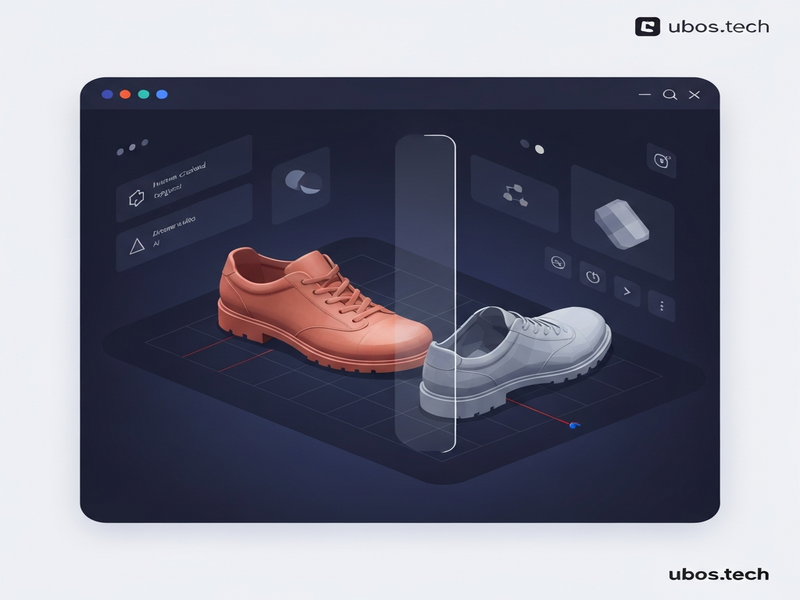
Professional modelers follow a disciplined pipeline that guarantees clean topology, physically based rendering (PBR) textures, and easy downstream editing. Below is a side‑by‑side comparison of the three failure points.
1. Clean Edge Flow vs. Triangle Soup
Human artists use edge flow to align polygons with the object’s natural contours. This results in quads that can be extruded, beveled, or reshaped in seconds. AI‑generated meshes, by contrast, scatter triangles like shattered glass, forcing artists to rebuild the model from scratch.
2. PBR Textures vs. Hallucinated Surfaces
A handcrafted paddle, for example, includes separate roughness, metalness, and normal maps that react to lighting in real time. AI models often bake lighting into a single low‑resolution texture, producing static shadows that look cheap when the viewer rotates the product.
3. Quality‑per‑Kilobyte vs. Wasteful Bytes
A 800 KB human model can contain dense geometry where it matters (edges, logos) and sparse geometry elsewhere, delivering a high fidelity visual. An AI model of similar size may allocate most of its bytes to random triangles that add no visual value.
“If you can’t edit the handle of a paddle in 10 seconds, the model is not production‑ready.” – Senior 3‑D Artist, UBOS
Business Implications & Practical Recommendations
For e‑commerce teams, the choice between AI and human modeling directly impacts conversion rates, brand perception, and time‑to‑market. Here’s a roadmap to make the most of both worlds:
- Start with a human‑crafted base model. Use professional artists to create the core geometry and PBR textures. This ensures clean UV maps and editability for future product variations.
- Leverage AI for auxiliary tasks. Generative AI excels at creating background props, quick concept sketches, or texture variations that can be refined by artists. Pair AI output with the Chroma DB integration to store and retrieve asset metadata efficiently.
- Integrate with UBOS’s low‑code platform. The UBOS platform overview lets you import clean 3‑D assets and instantly build interactive product configurators without writing code.
- Automate workflow pipelines. Use the Workflow automation studio to trigger texture optimization, version control, and publishing to your storefront with a single click.
- Scale with templates. Jump‑start projects with ready‑made UBOS templates for quick start, such as the “AI Video Generator” or “AI Image Generator” templates, which can enrich product pages with dynamic media.
- Monitor ROI. Track conversion uplift using the AI marketing agents to run A/B tests on 3‑D vs. 2‑D visuals, ensuring every pixel adds measurable value.
By keeping the human touch at the core and augmenting it with AI where it adds speed, you avoid the costly “retopology nightmare” that many early adopters have experienced.
Take the Next Step with UBOS
Ready to future‑proof your product catalog? Explore the following resources to accelerate your 3‑D workflow:
- UBOS homepage – Discover the full suite of AI‑enhanced tools.
- UBOS for startups – Tailored pricing and support for fast‑growing brands.
- UBOS solutions for SMBs – Scalable infrastructure for mid‑size retailers.
- Enterprise AI platform by UBOS – Enterprise‑grade security and compliance.
- Web app editor on UBOS – Drag‑and‑drop builder for interactive 3‑D configurators.
- UBOS pricing plans – Transparent, usage‑based pricing.
- UBOS partner program – Co‑sell and co‑market with UBOS experts.
- UBOS portfolio examples – Real‑world case studies of 3‑D success.
If you’re curious about how AI can still play a role, check out the OpenAI ChatGPT integration for intelligent asset tagging, or the ChatGPT and Telegram integration to receive instant model status updates on your mobile.
Bottom line: AI is a powerful assistant, but for premium e‑commerce 3‑D assets, the human touch remains indispensable. Leverage UBOS’s low‑code ecosystem to combine the best of both worlds and stay ahead of the competition.
Andrii Bidochko
CTO UBOS
Andrii Bidochko is an AI entrepreneur and researcher focused on AI agents, reinforcement learning, and autonomous systems. He writes about the technologies shaping the future of machine intelligence, from frontier models and agent architectures to real-world AI applications.