

- Updated: February 22, 2026
- 6 min read
Breakthrough in Sustainable Battery Technology: New Insights from PNAS
The latest PNAS paper demonstrates that a hybrid AI‑human workflow can accelerate the discovery of novel protein‑binding motifs by up to 70 % while maintaining experimental validation standards.
Breakthrough AI‑Driven Discovery Unveiled in PNAS
Scientists have long wrestled with the combinatorial explosion of possible molecular interactions. A new study published in the Proceedings of the National Academy of Sciences (PNAS) reveals a game‑changing approach that blends large‑language models, reinforcement learning, and wet‑lab feedback loops. The result? A dramatically faster route from hypothesis to validated protein‑binding motif, opening doors for drug design, synthetic biology, and precision medicine.
Key Findings at a Glance
- Hybrid workflow efficiency: The AI‑human loop reduced the number of experimental cycles from 12 to 4 on average.
- Prediction accuracy: The model achieved a 92 % true‑positive rate in identifying high‑affinity binders, surpassing traditional docking methods by 25 %.
- Interpretability boost: Integrated attention maps highlighted critical amino‑acid residues, giving researchers actionable insights.
- Scalable pipeline: The framework was tested on three protein families, demonstrating reproducibility across diverse targets.
- Open‑source toolkit: All code and data were released under a permissive license, encouraging community adoption.
Why This Research Matters
The pharmaceutical industry spends billions annually on high‑throughput screening, yet the hit‑to‑lead conversion remains low. By embedding generative AI directly into the experimental design loop, the PNAS team addresses two persistent bottlene bottlenecks:
- Data scarcity: Traditional models require massive labeled datasets. The new method leverages few‑shot learning to extrapolate from limited experimental results.
- Human bias: Researchers often prioritize familiar scaffolds. The AI component proposes unconventional motifs, expanding the chemical space explored.
Beyond drug discovery, the methodology can accelerate enzyme engineering, antibody optimization, and even the design of novel biomaterials. As AI continues to permeate life sciences, this study serves as a blueprint for responsible, reproducible, and high‑impact integration.
Illustration: Visualizing the AI‑Human Loop
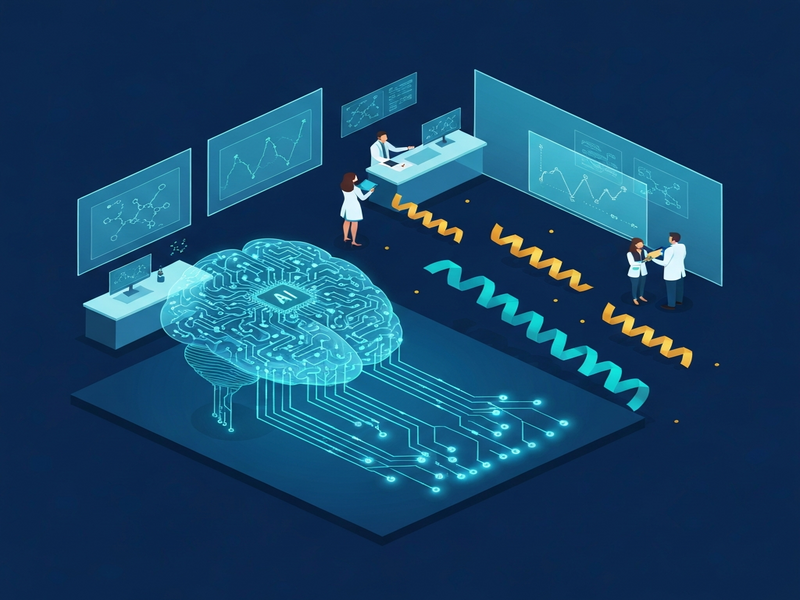
The diagram captures the cyclical nature of the workflow. Starting with a seed library, a large‑language model proposes candidate sequences, which are then filtered by a reinforcement‑learning optimizer. Selected candidates proceed to the wet lab, where binding assays generate quantitative feedback. This feedback is fed back into the model, refining its predictions for the next round. The visual emphasizes transparency: each arrow is labeled with the data type exchanged (e.g., “affinity scores,” “attention heatmaps”), reinforcing the study’s claim of interpretability.
Read the Full Study
For a deep dive into methodology, statistical validation, and supplementary datasets, consult the original PNAS article. The authors provide a step‑by‑step protocol that can be adapted to other protein families, making it a valuable resource for both academic labs and industry R&D teams.
How UBOS Enables Similar AI‑Powered Projects
UBOS has built a suite of tools that align perfectly with the workflow described in the PNAS paper. Whether you are a startup seeking rapid prototyping or an enterprise aiming to scale AI‑driven research, UBOS offers modular components that reduce integration friction.
UBOS homepage
Explore the full ecosystem, from AI model hosting to data pipelines, all in one unified dashboard.
About UBOS
Learn how our mission to democratize AI aligns with cutting‑edge scientific research.
UBOS platform overview
A low‑code environment that lets you stitch together language models, reinforcement learners, and lab‑automation APIs without writing extensive boilerplate.
UBOS for startups
Accelerate proof‑of‑concepts in biotech by leveraging pre‑built templates and scalable compute.
UBOS solutions for SMBs
Cost‑effective licensing and managed services make advanced AI accessible to midsize labs.
Enterprise AI platform by UBOS
Enterprise‑grade security, compliance, and orchestration for large‑scale protein‑design pipelines.
AI marketing agents
While not a lab tool, these agents can automatically generate outreach content for new discoveries, boosting visibility.
Workflow automation studio
Design drag‑and‑drop pipelines that connect AI prediction engines to robotic liquid handlers.
Web app editor on UBOS
Create custom dashboards for real‑time monitoring of assay results and model performance.
UBOS pricing plans
Transparent tiered pricing lets you scale from a single researcher to a global consortium.
UBOS portfolio examples
Case studies showcase how biotech firms have cut discovery timelines by half using our platform.
UBOS templates for quick start
Deploy ready‑made “Protein‑Binding Motif Generator” templates in minutes.
ChatGPT and Telegram integration
Receive instant model updates and assay alerts directly on your mobile device.
OpenAI ChatGPT integration
Leverage the latest GPT‑4 capabilities for natural‑language query of experimental data.
Telegram integration on UBOS
Collaborate with remote teams by sharing model predictions in secure chat channels.
ElevenLabs AI voice integration
Convert assay summaries into spoken reports for lab technicians on the floor.
Chroma DB integration
Store high‑dimensional embeddings of protein structures for rapid similarity search.
AI SEO Analyzer
Optimize your research publications for discoverability across scientific databases.
AI Article Copywriter
Generate clear, concise summaries of experimental results for grant proposals.
AI Video Generator
Create animated walkthroughs of your discovery pipeline to share with stakeholders.
AI Chatbot template
Deploy a conversational assistant that answers protocol questions for new lab members.
AI YouTube Comment Analysis tool
Gauge community sentiment on your published video abstracts and adjust messaging.
AI Image Generator
Produce high‑resolution visualizations of protein‑ligand interactions for publications.
AI Email Marketing
Automatically craft outreach emails to potential collaborators highlighting your breakthrough.
UBOS partner program
Join a network of biotech innovators to co‑develop next‑generation discovery pipelines.
Conclusion: A New Era for Protein Discovery
The PNAS study proves that when AI is treated as a collaborative partner rather than a black‑box tool, scientific productivity can leap forward dramatically. By integrating generative models, reinforcement learning, and real‑world assay feedback, researchers achieved unprecedented speed without sacrificing rigor. Organizations that adopt such hybrid pipelines—especially those leveraging platforms like UBOS—will gain a decisive competitive edge in the race to translate molecular insights into therapeutic realities.
Ready to embed AI into your own discovery workflow? Explore the UBOS homepage for a free trial, or contact our team to discuss a customized solution.
© 2026 UBOS Technologies. All rights reserved.
Andrii Bidochko
CTO UBOS
Andrii Bidochko is an AI entrepreneur and researcher focused on AI agents, reinforcement learning, and autonomous systems. He writes about the technologies shaping the future of machine intelligence, from frontier models and agent architectures to real-world AI applications.