

- Updated: February 20, 2026
- 6 min read
Investors Flock to Solid‑State Transformers: Boosting Smart Grid Innovation
Solid‑State Transformers: The Power‑Electronics Revolution Reshaping the Grid
Solid‑state transformers (SSTs) are advanced power‑electronics devices that replace traditional iron‑core transformers, delivering real‑time voltage control, bidirectional power flow, and seamless integration with renewable energy, storage, and digital grid services.
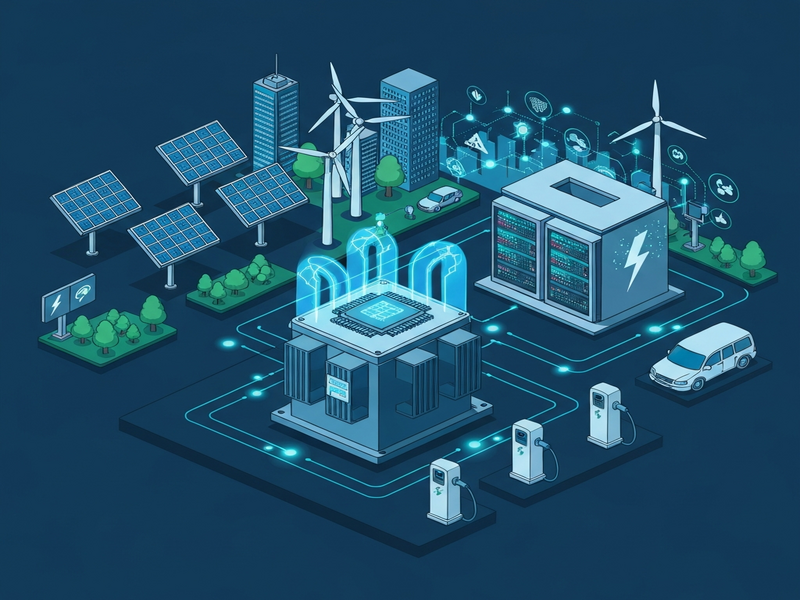
What Are Solid‑State Transformers? – Technology Overview
SSTs combine three core power‑electronics stages:
- Rectifier: Converts incoming alternating current (AC) to direct current (DC).
- DC‑DC Converter: Adjusts voltage levels using silicon‑carbide (SiC) or gallium‑nitride (GaN) switches, enabling rapid, loss‑reduced transformation.
- Inverter: Re‑creates AC at the desired frequency and voltage for downstream loads.
Unlike conventional transformers that rely on copper windings and iron cores, SSTs are software‑updatable. Their semiconductor switches can be re‑programmed to respond to grid events, support multiple voltage tiers, and even switch between AC and DC output on demand. This flexibility turns a once‑passive device into a grid‑edge intelligence hub, akin to a router for electricity.
Key Technical Advantages
- **Bidirectional Power Flow** – Enables local generation (solar, wind, battery) to feed back into the network without additional hardware.
- **Dynamic Voltage Regulation** – Real‑time voltage sag/swell mitigation reduces stress on downstream equipment.
- **Compact Footprint** – Eliminates the need for separate inverters, UPS, and step‑down transformers, saving up to 70% space in data centers.
- **Reduced Material Costs** – Silicon‑based semiconductors are less exposed to commodity price volatility than copper and steel.
- **Enhanced Monitoring & Cyber‑Security** – Built‑in telemetry feeds grid‑management software, supporting predictive maintenance.
Market Potential and Recent Funding Rounds
The global solid‑state transformer market is projected to exceed $12 billion by 2035, driven by the convergence of three megatrends: aging infrastructure, exponential growth of data‑center power demand, and the rapid rollout of electric‑vehicle (EV) charging networks.
Recent capital injections illustrate the market’s momentum:
| Company | Funding Round | Amount | Focus |
|---|---|---|---|
| DG Matrix | Series A | $60 million | Multi‑source routing (Interport) |
| Heron Power | Series B | $140 million | Medium‑voltage SSTs for data centers & solar farms |
| Amperesand | Series A | $80 million | Data‑center power‑distribution platforms |
These rounds were led by a mix of traditional venture firms (e.g., Sequoia, Andreessen Horowitz) and strategic energy investors (e.g., Shell Ventures, Siemens Energy). The capital influx is not merely financing hardware; it fuels software ecosystems that turn SSTs into intelligent assets capable of participating in ancillary services markets.
Investor Interest and Key Startup Players
Beyond the headline deals, a broader cohort of innovators is shaping the SST landscape:
- VoltEdge – Focuses on modular SST kits for micro‑grids, backed by UBOS partner program.
- PowerPulse AI – Leverages AI‑driven load forecasting to dynamically re‑configure SSTs; its platform integrates with the Enterprise AI platform by UBOS.
- GridFlex – Offers a SaaS layer that visualizes SST telemetry; built using the Web app editor on UBOS.
- ChargeFlow – Targets EV‑charging hubs, using the Workflow automation studio to orchestrate demand‑response events.
Investors are attracted by three core value propositions:
- High‑margin hardware combined with recurring software revenue.
- Strategic alignment with decarbonization policies and utility modernization plans.
- Potential to capture ancillary service markets worth billions of dollars annually.
Grid Implications: Smart Grid, Data Centers, EV Charging, Aging Infrastructure
Solid‑state transformers are not a niche upgrade; they are a foundational block for the next‑generation smart grid. Their impact can be grouped into four interlocking domains:
1. Smart‑Grid Intelligence
SSTs provide granular, real‑time data streams that enable:
- Dynamic load balancing across distribution feeders.
- Automated voltage regulation without manual tap‑changing.
- Participation in frequency‑regulation markets via rapid response.
2. Data‑Center Power Consolidation
Modern hyperscale facilities demand high density and low latency power. By collapsing the traditional transformer‑inverter‑UPS chain into a single SST, operators can:
- Reduce floor space by up to 70%.
- Lower total cost of ownership (TCO) by 30‑40%.
- Integrate on‑site battery storage for seamless backup.
3. EV‑Charging Hubs
Fast‑charging stations require high‑power, multi‑voltage supplies. SSTs can:
- Deliver DC fast‑charge directly, eliminating separate converters.
- Modulate charging rates in response to grid congestion signals.
- Support vehicle‑to‑grid (V2G) services, turning fleets into distributed storage.
4. Replacement of Aging Infrastructure
In the United States alone, more than 50 % of distribution transformers are over 35 years old. Replacing them with SSTs offers:
- Longer operational life (20‑30 years) with fewer oil‑related failures.
- Reduced maintenance cycles thanks to predictive analytics.
- Lower environmental impact—no oil, less metal waste.
Collectively, these capabilities enable utilities to squeeze more kilowatt‑hours through existing poles and conductors, directly addressing the “capacity squeeze” projected by the grid technology research hub.
Strategic Recommendations for Energy Executives
For decision‑makers evaluating SST adoption, consider the following roadmap:
- Pilot in High‑Value Segments: Start with data‑center or EV‑charging sites where space savings translate to immediate ROI.
- Integrate with Existing Energy‑Management Systems (EMS): Leverage APIs from platforms like the UBOS energy‑innovation hub to ingest SST telemetry.
- Secure Funding Early: Align with investors who specialize in power‑electronics; showcase software‑as‑a‑service revenue streams.
- Standardize Communication Protocols: Adopt IEC 61850 or OpenADR to ensure interoperability across vendors.
- Plan for Workforce Upskilling: Engineers need training on semiconductor‑based power conversion and AI‑driven control loops.
By following a phased approach, utilities can mitigate risk while unlocking the economic upside of higher grid utilization and lower carbon intensity.
Why the Buzz? A Quick Recap
“Solid‑state transformers turn a passive metal box into a programmable, data‑rich asset—essentially the router of the electric grid.” – original TechCrunch story
The convergence of power‑electronics, AI, and renewable integration makes SSTs a cornerstone of the electrical grid modernization narrative. As capital flows, standards evolve, and early adopters demonstrate cost savings, the technology is poised to transition from niche data‑center deployments to mainstream distribution networks.
Related UBOS Resources for AI‑Powered Energy Solutions
UBOS offers a suite of tools that can accelerate SST‑related projects:
- UBOS homepage – Central portal for AI‑driven infrastructure solutions.
- About UBOS – Learn how the team blends AI with energy tech.
- AI marketing agents – Automate stakeholder outreach for new SST rollouts.
- UBOS platform overview – A low‑code environment to build monitoring dashboards.
- UBOS for startups – Accelerate prototype development of SST control software.
- UBOS solutions for SMBs – Scalable monitoring for small‑scale micro‑grids.
- UBOS pricing plans – Transparent pricing for AI‑enabled grid services.
- UBOS portfolio examples – Case studies of AI integration in power systems.
- UBOS templates for quick start – Ready‑made templates for SST data pipelines.
- AI SEO Analyzer – Optimize your project documentation for discoverability.
- AI Article Copywriter – Generate technical briefs for stakeholder communication.
- AI Video Generator – Create explainer videos on SST benefits.
- AI Chatbot template – Deploy a support bot for field technicians.
The convergence of solid‑state transformer technology with AI‑enabled platforms like UBOS creates a powerful synergy: hardware that can be programmed, monitored, and monetized through software. For executives, investors, and grid operators, the message is clear—embrace SSTs now, or risk being left behind in the next wave of energy transformation.
Stay ahead of the curve. Explore the latest innovations in power electronics and AI‑driven grid solutions with UBOS.
Andrii Bidochko
CTO UBOS
Andrii Bidochko is an AI entrepreneur and researcher focused on AI agents, reinforcement learning, and autonomous systems. He writes about the technologies shaping the future of machine intelligence, from frontier models and agent architectures to real-world AI applications.