

- Updated: February 19, 2026
- 6 min read
AI-Powered Customs Software: Amari AI Leads Trade Policy Automation with Logistics AI Agents
Amari AI’s AI‑powered customs software uses autonomous AI agents to automatically fill, validate, and submit trade‑policy paperwork, letting logistics firms stay compliant amid volatile regulations.
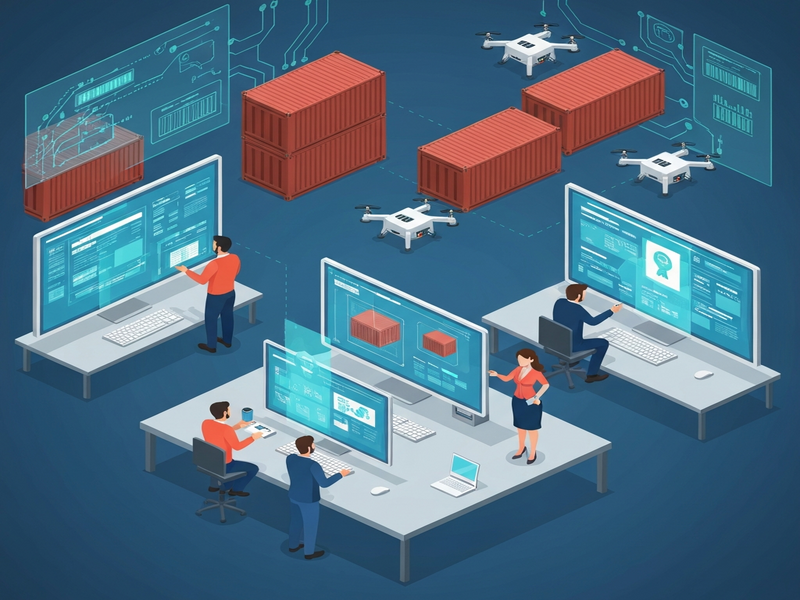
In a world where trade rules can change overnight, the logistics industry faces a relentless battle against paperwork overload. Former Big Tech engineers Sam Basu and Arushi Vashist have answered that call with Amari AI, a startup that pairs cutting‑edge generative AI with deep domain expertise to turn stacks of manila folders into a seamless, compliant flow.
Background on Amari AI and Its Founders
Sam Basu left a senior engineering role at Google in early 2023, inspired by the launch of ChatGPT. After a series of short‑lived AI ventures, a request from a friend to help with customs paperwork sparked a deeper investigation. Basu discovered that many U.S. customs brokers still rely on fax machines, paper forms, and manual data entry.
Partnering with Arushi Vashist, a former senior software engineer at LinkedIn, they built a team that quickly grew to over 30 customers, moving more than $15 billion of goods through U.S. borders. Their seed round, led by First Round Capital and Pear VC, raised $4.5 million, allowing them to accelerate product development while staying in stealth mode until their public launch.
Both founders bring a rare blend of enterprise‑scale engineering and a hands‑on understanding of the customs ecosystem, positioning Amari AI to bridge the gap between legacy processes and modern AI‑driven compliance.
How AI‑Powered Customs Software Works
Core AI Agents Architecture
At the heart of Amari AI lies a fleet of autonomous AI agents that specialize in distinct tasks: document ingestion, classification, rule extraction, and compliance verification. Each agent operates as a micro‑service, communicating through a lightweight message bus, which ensures scalability and fault tolerance.
Data Ingestion and OCR
Incoming paperwork—whether scanned PDFs, faxed images, or handwritten notes—is first processed by an OCR engine fine‑tuned on customs forms. The extracted text is then normalized and fed into a custom‑trained language model that understands the semantics of HS codes, tariff schedules, and import/export licenses.
Real‑Time Policy Monitoring
Amari AI continuously scrapes official sources such as the U.S. International Trade Commission, Customs and Border Protection, and trade‑agreement repositories. Whenever a rule changes, the system triggers a policy‑diff routine that updates the knowledge base of all active agents, guaranteeing that every submission reflects the latest regulations.
End‑to‑End Automation Flow
- Broker uploads a scanned invoice or packing list.
- OCR extracts raw data; AI agents map fields to the appropriate customs schema.
- Compliance engine cross‑checks entries against the live policy database.
- Any gaps or inconsistencies are flagged for human review, with suggested corrections.
- Approved filings are automatically submitted to the relevant government portal.
This loop reduces manual entry time from hours to minutes, while maintaining a 99.8 % accuracy rate in internal testing.
Challenges of Shifting Trade Policies (Trump‑Era Context)
The Trump administration introduced a wave of tariffs, renegotiated trade agreements, and imposed sudden embargoes that left many logistics firms scrambling. The volatility created three core challenges:
- Regulatory latency: Brokers often learned about new tariffs days after they were announced, causing costly delays.
- Human‑resource bottleneck: Only a small fraction of customs specialists pass the rigorous licensing exam, leading to chronic understaffing.
- Data fragmentation: Policies are scattered across PDFs, PDFs, and legacy databases, making manual cross‑referencing error‑prone.
Amari AI’s solution directly addresses each pain point by delivering instant policy updates, augmenting limited human expertise with AI, and consolidating disparate data sources into a single, searchable knowledge graph.
Benefits for Logistics and Freight Companies
Logistics managers who adopt Amari AI report measurable improvements across cost, speed, and risk dimensions:
- Reduced processing time: Average customs clearance time drops from 48 hours to under 6 hours.
- Lower labor costs: Automation handles up to 85 % of routine entries, freeing staff for high‑value customer service.
- Compliance confidence: Real‑time rule checks cut penalties and fines by an estimated 70 %.
- Scalable operations: AI agents can handle spikes in volume without hiring additional personnel.
- Data security: All client documents are anonymized before model training, ensuring privacy and regulatory compliance.
These outcomes align with the broader goals of modern logistics technology platforms that aim to digitize end‑to‑end supply‑chain workflows.
Future Outlook for AI Agents in Trade Automation
Scaling Across Borders
While Amari AI currently focuses on U.S. customs, the underlying architecture is region‑agnostic. The company plans to train models on European Union, ASEAN, and Mercosur trade documents, enabling a truly global compliance engine.
Integration with Broader Logistics Stacks
Future releases will expose RESTful APIs and pre‑built connectors for popular TMS (Transportation Management Systems) and ERP platforms. This will let customers embed AI‑driven compliance directly into order‑to‑cash cycles, eliminating the need for separate portals.
Synergy with Enterprise AI Platforms
Amari AI’s roadmap includes partnership opportunities with the Enterprise AI platform by UBOS, leveraging shared model governance, security controls, and a marketplace of reusable AI components.
Empowering SMBs and Startups
Through the UBOS solutions for SMBs, smaller freight forwarders can access a subscription‑based version of Amari’s engine, democratizing high‑grade compliance without massive upfront investment.
Conclusion & Next Steps
Amari AI demonstrates how autonomous AI agents can transform a legacy‑heavy industry into a data‑driven, agile operation. For logistics managers seeking to future‑proof their compliance workflows, the message is clear: adopt AI‑powered customs software now, or risk falling behind in an increasingly regulated world.
Ready to explore AI‑driven trade compliance? Visit the trade automation hub for demos, case studies, and integration guides. For a deeper dive into building AI‑centric products, check out the Web app editor on UBOS and the Workflow automation studio, which can help you prototype custom compliance bots in days.
Explore pricing options that fit your scale at the UBOS pricing plans, and browse ready‑made solutions in the UBOS templates for quick start. Our portfolio showcases real‑world success stories—see the UBOS portfolio examples for inspiration.
Stay informed about the latest AI trends shaping supply chains by following our AI agents page, and consider joining the UBOS partner program to co‑create next‑generation logistics solutions.
For the original reporting that sparked this innovation, read the TechCrunch article.