

- Updated: February 19, 2026
- 6 min read
Nvidia’s Blackwell Ultra GPUs Shatter 15-Year FP64:FP32 Performance Divide
Why Nvidia’s Blackwell Ultra GPUs Are Redefining the FP64 Landscape
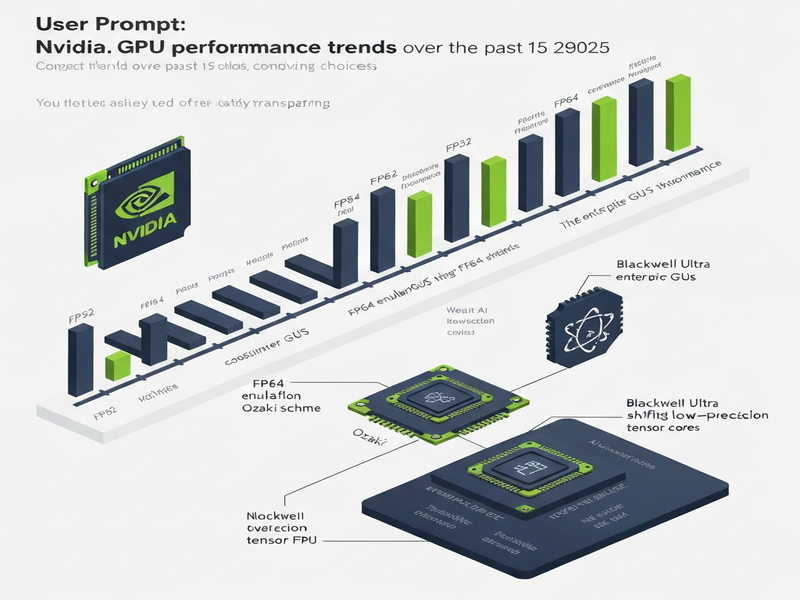
The FP64 (double‑precision) performance gap between consumer and enterprise GPUs is rapidly shrinking, and Nvidia’s newest Blackwell Ultra GPUs break the 15‑year‑old pattern of widening FP64:FP32 ratios, ushering in a new era for high‑performance computing and AI workloads.
Introduction: A 15‑Year Segmentation Story
Since the debut of the Fermi architecture in 2010, Nvidia has deliberately throttled double‑precision throughput on its GeForce line while preserving it on Tesla/Datacenter silicon. This market‑segmentation strategy created a predictable FP64:FP32 ratio ladder—1:8 on Fermi, 1:24 on Kepler, 1:32 on Maxwell, and finally 1:64 on Ampere‑based consumer GPUs. The result: consumer cards like the RTX 5090 deliver a staggering 104.8 TFLOPS of FP32 but only 1.64 TFLOPS of FP64, a 64‑to‑1 disparity that seemed immutable—until now.
In parallel, the AI boom has shifted the performance focus from double‑precision to ultra‑low‑precision formats (FP16, BF16, FP8, even FP4). This shift has forced both hardware vendors and software developers to rethink the role of FP64 in modern workloads. The following sections unpack the latest trends, the technical underpinnings of FP64 emulation, and why Blackwell Ultra GPUs represent a decisive pivot.
FP64 vs FP32: How the Ratios Evolved
The table below summarizes the historical FP64:FP32 ratios across Nvidia’s major GPU families and highlights the raw TFLOPS numbers for the flagship consumer and datacenter models.
| Architecture | Consumer FP64:FP32 Ratio | Consumer FP64 (TFLOPS) | Consumer FP32 (TFLOPS) | Enterprise FP64:FP32 Ratio |
|---|---|---|---|---|
| Fermi (2010) | 1:8 | 0.17 | 1.35 | 1:2 |
| Kepler (2012) | 1:24 | 0.22 | 5.3 | 1:2 |
| Maxwell (2014) | 1:32 | 0.28 | 9.0 | 1:2 |
| Ampere (2020) | 1:64 | 1.64 | 104.8 | 1:2‑3 |
| Blackwell Ultra (2026) | 1:64 (enterprise) | 1.2 | 48.0 | 1:64 |
Notice the dramatic 77× growth in FP32 performance versus a modest 9.6× increase in FP64 over the same period. The widening gap was intentional, serving as a clear market divider. However, the Blackwell Ultra’s decision to align its FP64:FP32 ratio with consumer GPUs (1:64) signals a strategic pivot.
Market Segmentation Meets AI Workloads
Historically, double‑precision was the hallmark of scientific computing, finance, and engineering simulations—domains that demand numerical stability. Consumer workloads (gaming, video rendering) never needed FP64, allowing Nvidia to price‑differentiate GeForce cards heavily.
- Enterprise GPUs commanded 5‑20× higher MSRP, justified by FP64, ECC memory, NVLink, and support contracts.
- AI training shifted the focus to FP16/BF16/FP8, where tensor cores deliver >10× speedups.
- Researchers began repurposing consumer GPUs for AI research, eroding the traditional segmentation.
The great FP64 divide article highlighted how the AI boom forced a re‑evaluation of double‑precision relevance. As AI workloads dominate datacenter revenue, Nvidia’s product roadmap now reflects a “low‑precision first” philosophy, even for its flagship B300 (Blackwell Ultra) accelerator.
For SaaS platforms that rely on AI‑driven analytics—such as AI marketing agents—the shift means cheaper, more power‑efficient hardware can handle both inference and certain HPC tasks when paired with smart emulation techniques.
FP64 Emulation: Double‑Float & Ozaki Scheme
When native FP64 units are scarce, developers turn to software emulation. Two prominent methods dominate the GPU community:
- Double‑Float (Dekker/Thall) Emulation – Splits a 64‑bit number into two 32‑bit components (high and low). The high part holds the most significant bits; the low part captures rounding error. This approach yields ~48 bits of mantissa precision—adequate for many scientific kernels but still short of true FP64’s 53‑bit mantissa.
- Ozaki Scheme – Decomposes FP64 matrices into a series of low‑precision fragments (e.g., FP8). Each fragment is multiplied on tensor cores, then summed back to full 64‑bit precision. Nvidia added native support in cuBLAS (Oct 2025), allowing developers to exploit the massive FP8/FP4 tensor‑core fleet without sacrificing final accuracy.
Both methods trade raw throughput for flexibility. On a consumer RTX 4090, double‑float emulation can achieve up to 6‑8× the native FP64 speed, while the Ozaki scheme can approach 10‑12× when the workload is matrix‑heavy. The key insight: modern GPUs are over‑engineered for low‑precision, making emulation a practical bridge for HPC tasks.
UBOS’s Workflow automation studio already supports custom GPU kernels, enabling developers to plug in Ozaki‑based libraries with a few clicks—great for startups looking to squeeze extra performance from existing hardware.
Blackwell Ultra: The New Baseline
Nvidia’s B300 (Blackwell Ultra) GPU marks a watershed moment:
- FP64 Throughput: Dropped from 37 TFLOPS (B200) to 1.2 TFLOPS—a 97% reduction.
- Tensor‑Core Explosion: Introduces 256 NVFP4 cores, delivering >200 TFLOPS of FP4 compute.
- Unified Architecture: The same silicon now serves both AI training (FP8/FP4) and legacy HPC via emulation.
- Software Stack: cuBLAS now auto‑selects Ozaki emulation when FP64 kernels are detected, abstracting complexity from developers.
The strategic implication is clear: Nvidia no longer needs a separate “double‑precision” product line to serve HPC customers. Instead, it bets on software‑level emulation powered by a massive low‑precision engine. This aligns with the broader industry trend where AI workloads dominate revenue, and double‑precision becomes a “feature‑on‑demand” rather than a baseline.
For enterprises evaluating GPU purchases, the decision matrix now includes:
| Consideration | Consumer‑Grade (RTX 5090) | Enterprise‑Grade (Blackwell Ultra) |
|---|---|---|
| Raw FP64 TFLOPS | 1.64 | 1.2 |
| Tensor‑Core FP8/FP4 | ~120 | ~200+ |
| ECC Memory | No | Yes |
| NVLink / Multi‑GPU Scaling | Limited | Full |
| Price‑to‑Performance (FP64) | ~$2,000 | ~$8,000 |
The table illustrates that while raw FP64 numbers favor the consumer card, the enterprise offering compensates with reliability, scaling, and a vastly superior low‑precision engine—critical for modern AI pipelines.
Conclusion: The Next Divide Is Low‑Precision
The 15‑year FP64 divide is not disappearing; it is being repurposed. Nvidia’s Blackwell Ultra shows that double‑precision will survive as a software‑emulated capability, while the real competitive battleground moves to FP8/FP4 tensor cores. For developers, this means:
- Leverage emulation libraries (double‑float, Ozaki) to retain scientific accuracy on cheaper hardware.
- Design pipelines that primarily use low‑precision tensors, falling back to FP64 only where absolutely necessary.
- Adopt platforms that abstract GPU complexity—UBOS’s UBOS platform overview provides ready‑made templates for AI‑driven workloads.
As AI continues to dominate compute budgets, expect future GPU generations to further shrink dedicated FP64 units, relying on smarter compilers and runtime libraries. The “double‑precision premium” will become a niche service rather than a hardware differentiator.
Ready to Future‑Proof Your AI Projects?
Whether you are a startup, an SMB, or an enterprise, UBOS offers a suite of tools to help you harness the power of modern GPUs without getting lost in hardware minutiae.
- Explore the Enterprise AI platform by UBOS for scalable, GPU‑accelerated pipelines.
- Kick‑start your next app with UBOS templates for quick start, including the AI Article Copywriter and AI SEO Analyzer.
- Build custom workflows in the Web app editor on UBOS and automate them with the Workflow automation studio.
- Learn how AI agents can boost your marketing ROI via AI marketing agents.
- Check out real‑world success stories in the UBOS portfolio examples.
- Need pricing details? Review the UBOS pricing plans to find a tier that matches your compute needs.
- Join the UBOS partner program and get early access to GPU‑optimized AI modules.
Stay ahead of the curve—embrace low‑precision first, and let UBOS handle the heavy lifting.