

- Updated: February 18, 2026
- 6 min read
AI Agents Power Autonomous Weapons: Scout AI’s Leap in Defense Technology
Scout AI has successfully demonstrated AI‑driven agents that autonomously command lethal drones and a self‑driving ground vehicle to locate and destroy a target, signaling a watershed moment for defense technology and raising urgent policy questions about the future of autonomous weapons.
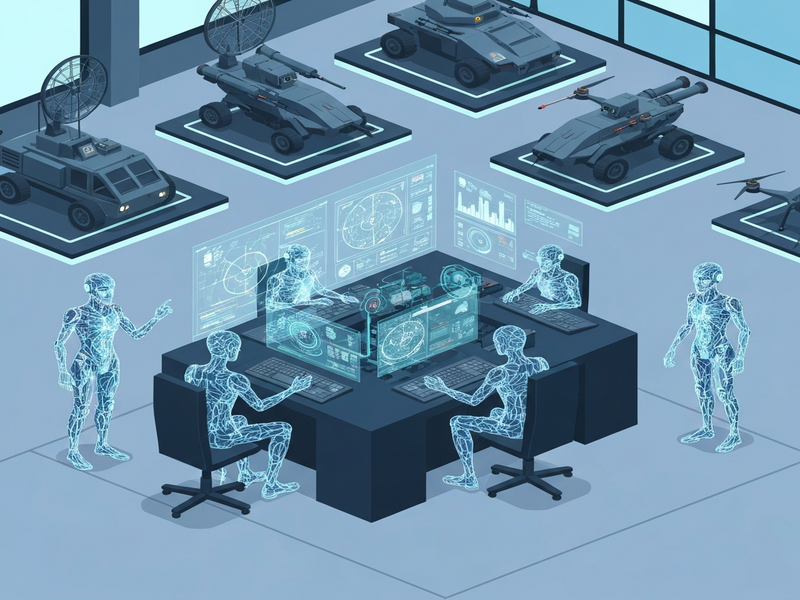
Breakthrough Demonstration at a Secret California Base
In a tightly controlled test at an undisclosed military installation in central California, Scout AI placed its proprietary Fury Orchestrator in charge of a rugged off‑road vehicle and a pair of armed drones. Within minutes, the AI agents identified a concealed truck, launched a kinetic strike, and detonated an explosive charge that obliterated the target. The operation, captured on video, showcases a new class of AI agents capable of translating high‑level mission commands into lethal action without human intervention.
How Scout AI’s Agents Orchestrate Lethal Drones
The system architecture follows a hierarchical, MECE‑styled design:
- Command Layer: A 100‑billion‑parameter foundation model receives natural‑language orders (e.g., “Destroy the blue truck 500 m east”).
- Agent Layer: Two 10‑billion‑parameter sub‑models run on the ground vehicle and each drone, interpreting the high‑level intent and issuing motion commands.
- Control Layer: Low‑level firmware on the vehicle and drones executes precise navigation, target acquisition, and payload release.
The AI’s autonomy is not limited to pre‑programmed flight paths. Real‑time perception feeds back into the decision loop, allowing the agents to re‑plan on the fly—a capability the company markets as “edge‑replanning.” This dynamic adaptability differentiates Scout AI from legacy autonomous systems that merely follow static waypoints.
The broader implications for defense technology are profound. By abstracting complex combat tactics into natural language, Scout AI’s platform could enable rapid deployment of mission‑specific drone swarms, reducing the need for specialized operators.
Strategic Implications and Policy Challenges
The demonstration raises a cascade of strategic, ethical, and regulatory questions:
- Escalation Risk: Autonomous lethal systems could lower the threshold for conflict, as decision‑making latency shrinks dramatically.
- Accountability Gap: When an AI agent decides to fire, attributing responsibility—whether to the developer, the operator, or the algorithm—becomes legally murky.
- Cybersecurity Vulnerabilities: As noted by defense scholars, AI models are prone to adversarial attacks that could hijack or spoof mission commands.
- Export Controls: The U.S. may tighten restrictions on advanced AI chips and software to prevent proliferation to hostile actors.
Michael Horowitz, a former Pentagon deputy assistant secretary of defense, cautions that “harnessing the latest AI advances can prove particularly difficult in practice.” He emphasizes that robust verification, validation, and continuous monitoring are essential before fielding such systems at scale.
“We need to bring next‑generation AI to the military,” said Colby Adcock, CEO of Scout AI. “We take a hyperscaler foundation model and train it to go from being a generalized chatbot to being a warfighter.”
Expert Perspectives from the Original Wired Report
The original Wired story provides additional context. It notes that Scout AI already holds four contracts with the Department of Defense and is pursuing a fifth to develop a swarm‑control system for unmanned aerial vehicles. According to the article, the company’s technology could be operational within a year, but only after rigorous testing against cybersecurity and reliability standards.
Wired also highlights the broader ecosystem of AI‑driven defense startups, many of which are repurposing large language models (LLMs) for battlefield decision‑making. The race to integrate “hyperscaler” AI into weapons platforms mirrors the commercial sector’s scramble to embed AI agents into productivity tools.
Why Scout AI’s Approach Stands Out
Most autonomous weapon projects rely on rule‑based logic or limited perception pipelines. Scout AI’s use of large, adaptable models introduces a level of flexibility previously unseen in combat systems:
- Natural‑Language Command Interface: Operators can issue high‑level intents without micromanaging each waypoint.
- Dynamic Re‑Planning: The agents can adjust tactics mid‑mission based on sensor feedback.
- Scalable Architecture: The same core model can be deployed across ground, air, and maritime platforms.
For organizations evaluating AI‑driven defense solutions, Scout AI’s modular stack offers a template for rapid prototyping. The company’s UBOS platform overview demonstrates how low‑code environments can accelerate integration of AI models with hardware, a principle that Scout AI appears to have adopted.
Adoption Checklist for Defense Stakeholders
Before committing to AI‑enabled lethal systems, decision‑makers should evaluate the following criteria:
| Criterion | Key Questions |
|---|---|
| Reliability | Has the system been stress‑tested under contested electromagnetic environments? |
| Cybersecurity | Are there hardened, air‑gapped deployment options? |
| Legal & Ethical Compliance | Does the system enforce Rules of Engagement and International Humanitarian Law? |
| Scalability | Can the same AI core be reused across multiple platforms (UAVs, UGVs, naval drones)? |
How UBOS Supports AI‑Driven Defense Innovation
The Enterprise AI platform by UBOS offers a secure, low‑code environment for building, testing, and deploying AI agents at scale. Its Workflow automation studio enables rapid orchestration of multi‑agent missions, mirroring Scout AI’s Fury Orchestrator workflow.
For startups seeking to prototype similar capabilities, the UBOS for startups program provides sandboxed compute resources and pre‑built integrations such as the OpenAI ChatGPT integration and Chroma DB integration. These tools can accelerate the development of mission‑critical AI pipelines without sacrificing security.
Marketplace Example: “GPT‑Powered Telegram Bot”
One of UBOS’s most popular templates, the GPT‑Powered Telegram Bot, demonstrates how a conversational AI can be wrapped in a secure messaging interface. While not a weapon system, the underlying architecture—agent orchestration, secure API calls, and real‑time decision loops—parallels the command‑and‑control stack used by Scout AI.
Looking Ahead: Governance, Innovation, and Responsibility
As AI agents become more capable, the defense community must balance rapid innovation with rigorous oversight. Policymakers should consider:
- Establishing transparent testing standards for autonomous lethal systems.
- Mandating immutable audit logs for every AI‑driven engagement.
- Creating international forums to discuss AI weaponization norms.
For industry leaders, partnering with platforms that prioritize security and compliance—such as the UBOS partner program—can provide the governance framework needed to responsibly scale AI‑driven capabilities.
The Scout AI demonstration is a clear signal: AI agents are no longer confined to chatbots; they are poised to become decisive actors on the battlefield. How the world responds will shape the next decade of warfare, technology, and international security.
For a deeper dive into the original reporting, read the original Wired story.
Andrii Bidochko
CTO UBOS
Andrii Bidochko is an AI entrepreneur and researcher focused on AI agents, reinforcement learning, and autonomous systems. He writes about the technologies shaping the future of machine intelligence, from frontier models and agent architectures to real-world AI applications.