

- Updated: February 16, 2026
- 6 min read
LLM‑Assisted Decompilation Revolutionizes Software Development
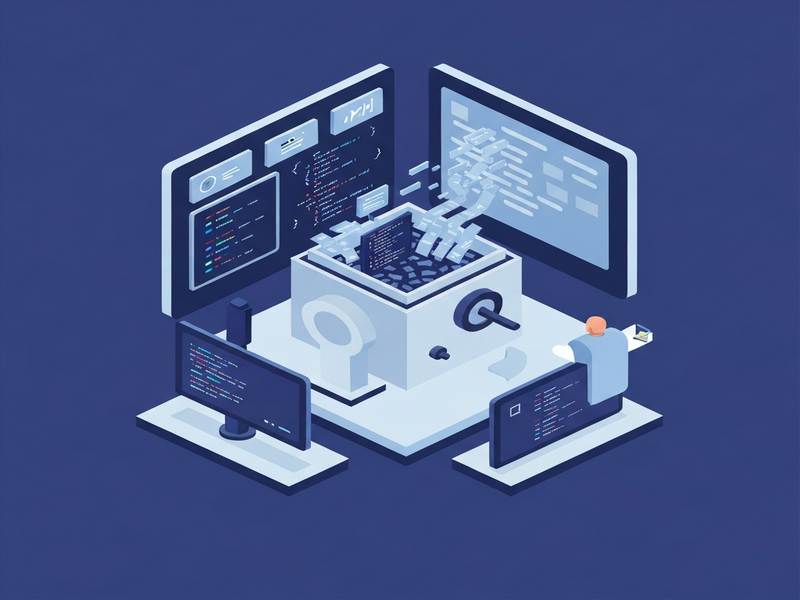
LLM‑assisted decompilation uses large language models to translate compiled binaries back into high‑level source code, dramatically speeding up reverse‑engineering and AI‑driven code analysis.
Introduction
The rise of generative AI has opened a new frontier for reverse engineering: LLM‑assisted decompilation. By feeding assembly or bytecode into powerful language models such as Claude, GPT‑4, or OpenAI’s latest offerings, developers can obtain near‑human‑readable C or Python equivalents in a fraction of the time traditional manual methods require. This article breaks down the technique, walks through the workflow described by Chris Lewis, highlights real‑world benefits and pitfalls, and explores the broader impact on software development and AI code analysis.
Overview of LLM‑Assisted Decompilation
What is decompilation?
Decompilation is the process of converting machine code (binary) back into a high‑level programming language. Historically, this required painstaking manual analysis of assembly, symbol reconstruction, and heuristic guessing. Modern LLMs bring pattern‑recognition and natural‑language reasoning to the table, allowing them to infer variable names, control‑flow structures, and even high‑level APIs from raw opcodes.
Why LLMs make a difference
- They can generalise from a few annotated functions to thousands of similar patterns.
- LLMs understand context, so they can suggest meaningful identifiers instead of generic
var_1placeholders. - Token‑based prompting enables rapid iteration without rewriting large scripts.
For teams already using the UBOS platform overview, integrating LLM‑assisted decompilation is a natural extension of existing AI‑driven workflows.
Workflow and Techniques Described in the Source Article
1. Prioritising Similar Functions
Early attempts used a logistic‑regression model to rank functions by estimated difficulty. While effective at the start, the queue soon filled with hard cases that stalled progress. Lewis switched to a similarity‑first approach: by embedding assembly instructions into a high‑dimensional space, the system could locate already‑decompiled “reference” functions that resembled the target. This dramatically increased the success rate because the LLM could copy proven patterns instead of starting from scratch.
2. Computing Function Similarity
Two strategies were compared:
- Hand‑crafted composite scores (n‑grams, control‑flow, memory‑access patterns).
- Levenshtein‑based opcode distance using the open‑source OpenAI ChatGPT integration tool Coddog, which directly measures edit distance between opcode sequences.
In practice, the simpler Levenshtein approach performed on par with the complex composite score, proving that “less is more” when the dataset is only a few thousand functions.
3. Skills and Tooling for the LLM
Specialized Claude skills such as gfxdis.f3dex2 (for Nintendo 64 graphics microcode) and decomp-permuter (brute‑force mutation) were crucial. The graphics skill gave the model a reference library for the Reality Display Processor, turning cryptic display‑list bytes into meaningful texture‑load calls. The permuter attempted millions of tiny code mutations to push a 95 % match to 100 %, but it also introduced noisy artefacts that required manual cleanup.
4. Scaling the Pipeline
As the project grew, Lewis introduced four engineering pillars:
- Worktrees – isolated Git workspaces that let multiple agents edit the same repository without stepping on each other’s toes.
- Claude Hooks – guardrails that block destructive actions (e.g., changing SHA‑1 hashes or editing generated files).
- Nigel the Cat – a task‑orchestration engine that batches candidate functions, injects prompts, and monitors progress.
- Glaude – a thin wrapper that routes cheap, high‑throughput tasks to the GLM model, preserving expensive Claude tokens for the hardest functions.
The combination of these tools allowed the team to push the match rate from ~25 % to over 75 % before hitting a plateau of stubborn functions.
Benefits and Challenges of AI‑Assisted Decompilation
Key Benefits
- Speed: One‑shot decompilation can convert dozens of functions in minutes, shaving weeks off manual reverse‑engineering.
- Consistency: LLMs apply uniform naming conventions and coding styles, making the resulting codebase easier to read.
- Knowledge Transfer: The generated source serves as documentation for future developers, reducing onboarding time.
- Scalability: With worktrees and automation, multiple agents can run in parallel, handling large firmware images.
Remaining Challenges
- Complex Control Flow: Functions exceeding 1,000 instructions still confuse LLMs, leading to early abandonment.
- Macro‑Heavy Code: Graphics‑intensive display‑list generation (e.g., F3Dex2) remains brittle despite specialised skills.
- Token Economics: High‑quality LLM calls consume many tokens; balancing cost vs. output is an ongoing concern.
- Noise from Permuters: Over‑aggressive mutation can produce unreadable code that requires manual sanitisation.
Teams looking for a cost‑effective solution can explore the UBOS pricing plans, which include token‑bundled credits for AI workloads.
Expert Opinions and Real‑World Examples
“LLM‑driven decompilation is the closest we’ve come to a universal reverse‑engineering assistant. The key is not just raw model power, but the surrounding tooling that keeps the model honest.” – Chris Lewis, Reverse‑Engineering Engineer
The Snowboard Kids 2 project, a classic Nintendo 64 title, demonstrated the approach. After applying similarity‑based prioritisation, the team lifted the matched‑function ratio from 58 % to 75 % before the remaining 124 functions proved intractable. Similar successes have been reported in firmware analysis for IoT devices, where the Workflow automation studio helped orchestrate multi‑agent pipelines.
For developers who want to prototype their own AI‑enhanced reverse‑engineering tools, the UBOS templates for quick start include a ready‑made “AI SEO Analyzer” that can be repurposed to parse opcode streams.
Implications for Software Development
The ripple effects of LLM‑assisted decompilation extend far beyond hobbyist console hacking:
- Security Audits: Security teams can automatically generate readable code from suspicious binaries, accelerating vulnerability discovery.
- Legacy Modernisation: Enterprises can resurrect abandoned codebases, translating them into maintainable languages for cloud migration.
- Intellectual Property Protection: Companies can verify that third‑party binaries do not contain proprietary logic.
- Education: Universities can use AI‑generated source as teaching material for low‑level programming courses.
The UBOS AI news portal regularly publishes case studies on how AI agents are reshaping development pipelines, including decompilation use‑cases.
Moreover, the rise of AI‑driven code analysis dovetails with the UBOS software development ecosystem, where developers can spin up custom agents, integrate with the ChatGPT and Telegram integration, and even add voice feedback via the ElevenLabs AI voice integration.
Conclusion
LLM‑assisted decompilation is rapidly evolving from a research curiosity into a production‑ready capability. By combining similarity‑based function prioritisation, lightweight opcode distance metrics, and robust orchestration tools, teams can achieve unprecedented speed and accuracy in reverse engineering. While challenges around large, macro‑heavy functions and token costs remain, the ecosystem of AI‑enhanced development platforms—exemplified by UBOS—offers the scaffolding needed to turn raw binaries into maintainable source code.
As generative models continue to improve, the “long tail” of stubborn functions will shrink, opening the door for fully automated code recovery across all software domains.