

- Updated: February 15, 2026
- 6 min read
Enterprise AI Land Grab: Glean Positions as AI Middleware Leader
Glean is shifting from a standalone enterprise chatbot to an AI middleware layer that connects large‑language models with a company’s internal data, providing model‑agnostic access, deep system connectors, and a permissions‑aware governance framework.
Glean’s New AI Middleware Layer Redefines the Enterprise AI Landscape
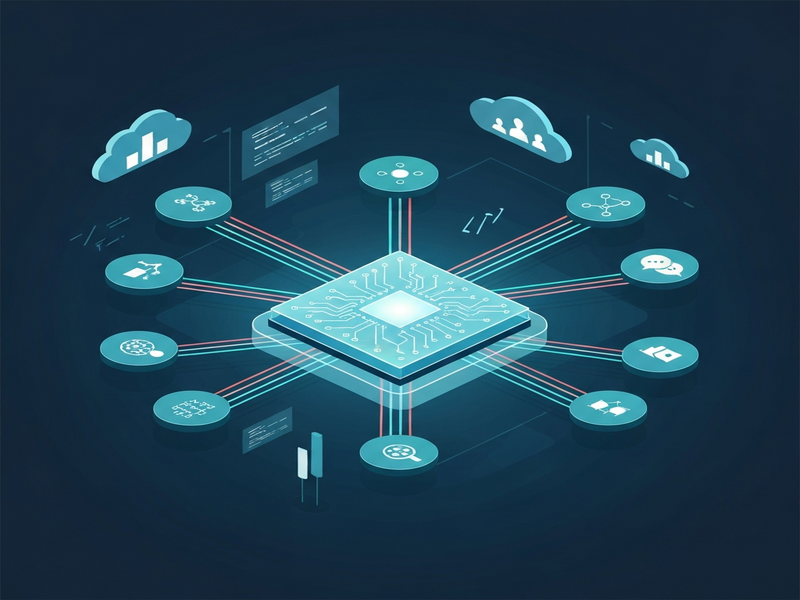
In the fast‑moving enterprise AI race, giants like Microsoft, Google, OpenAI, and Anthropic are busy embedding generative assistants directly into their productivity suites. While most vendors focus on the visible chat interface, Glean is betting on a less obvious but potentially more strategic piece of the puzzle: an intelligence layer beneath the interface. This shift, announced by CEO Arvind Jain at the recent Web Summit in Qatar, positions Glean as the connective tissue that lets any LLM work securely and contextually within a company’s existing SaaS ecosystem.
Background: From Enterprise Search to AI Middleware
Founded in 2017, Glean originally marketed itself as “the Google for the enterprise,” offering a powerful AI‑driven search across tools such as Slack, Jira, Google Drive, and Salesforce. The product’s core was a sophisticated indexing engine that learned how employees searched, collaborated, and accessed information. Over the past seven years, that search engine accumulated a rich map of user behavior, data relationships, and permission structures.
Today, Glean is repurposing that knowledge to become an AI middleware platform. Rather than building a single chatbot, the company now offers a set of services that sit between large‑language models (LLMs) and the data sources they need to answer questions accurately and safely.
What the AI Middleware Layer Actually Does
The new layer is built around three pillars: model‑agnostic access, deep connectors, and governance. Each pillar addresses a critical shortcoming of today’s “plug‑and‑play” AI assistants.
1. Model‑Agnostic Access
Enterprises no longer have to lock themselves into a single LLM provider. Glean’s abstraction layer lets organizations swap or combine models—ChatGPT, Gemini, Claude, or open‑source alternatives—without rewriting integrations. As Jain explains, “We don’t see OpenAI, Anthropic, or Google as competition; they are partners that continuously improve the capabilities we expose to our customers.”
2. Deep Connectors
Glean has built native connectors for the most widely used enterprise SaaS tools. These connectors do more than pull data; they map the flow of information across applications, enabling AI agents to act inside the tools (e.g., posting a Slack message, creating a Jira ticket, or updating a Salesforce record) while preserving context.
- Slack – real‑time conversation context and channel permissions.
- Jira – issue metadata, status, and assignee information.
- Salesforce – account hierarchies and field‑level security.
- Google Drive – document versions and sharing settings.
3. Permissions‑Aware Governance
Enterprises cannot expose every document to an LLM. Glean’s governance layer checks the requester’s identity, matches it against corporate access policies, and filters results accordingly. The system also validates model outputs against source documents, adds line‑by‑line citations, and flags potential hallucinations before the answer reaches the user.
CEO Arvind Jain on the Strategic Pivot
“The layer we built initially – a good search product – required us to deeply understand people and how they work. All of that is now becoming foundational in terms of building high‑quality agents.” – Arvind Jain, CEO of Glean
“The AI models themselves don’t really understand anything about your business. They don’t know who the different people are, what you build, or how you collaborate. Connecting the reasoning power of the models with the context inside your company is the missing piece.” – Arvind Jain
“Our product gets better because we’re able to leverage the innovation that they are making in the market. We see LLM providers as partners, not competitors.” – Arvind Jain
Market Implications: The AI Land Grab and the Role of Middleware
The AI land grab is now a battle for the deepest layer of the stack, not just the chat window. Microsoft’s Copilot and Google’s Gemini are already embedded in Office and Workspace, respectively. If those assistants can directly query internal data, a third‑party middleware might seem redundant.
Jain argues that enterprises value neutrality and flexibility. A middleware layer lets a company keep its data‑access policies consistent while swapping out the underlying model as technology evolves. This approach also mitigates vendor lock‑in, a concern that senior IT leaders repeatedly raise during digital transformation projects.
Analysts predict that the next wave of enterprise AI deals will focus on “data‑centric platforms” that provide the same governance and connector capabilities Glean now offers. Companies that can prove a secure, model‑agnostic bridge will likely capture a larger share of the multi‑billion‑dollar market.
Funding Milestone: $150 Million Series F
In June 2025, Glean closed a $150 million Series F round, almost doubling its valuation to $7.2 billion. Investors cited the company’s “unique position as the connective tissue of enterprise AI” as a key differentiator. Unlike pure‑play AI labs that burn massive compute budgets, Glean’s model‑agnostic layer requires comparatively modest infrastructure, allowing for faster profitability pathways.
Read the Full Story
For a deeper dive into Glean’s strategy and the broader AI landscape, see the original TechCrunch article by Rebecca Bellan.
Why This Matters for UBOS Customers
Enterprises looking for a robust, secure AI foundation can benefit from the same principles Glean champions. The Enterprise AI platform by UBOS offers a comparable middleware approach, delivering model‑agnostic orchestration, deep SaaS connectors, and granular governance.
Our AI agents are built on a similar abstraction layer, allowing you to plug in OpenAI, Anthropic, or custom models without rewriting business logic.
For a technical deep‑dive into the underlying architecture, explore the Glen technology page, which outlines how we handle data indexing, retrieval, and secure execution at scale.
Conclusion: The Future of Enterprise AI Is Under the Hood
Glean’s pivot to an AI middleware layer underscores a broader industry truth: the most valuable AI capabilities will be delivered by platforms that can safely and efficiently bind powerful models to the unique data fabric of each organization. Decision‑makers who prioritize flexibility, security, and vendor neutrality should evaluate middleware solutions now, before the next wave of vertically integrated assistants dominates the market.
Ready to future‑proof your AI strategy? Visit the UBOS homepage to discover how our platform can become the intelligence layer your enterprise needs.