

- Updated: February 14, 2026
- 7 min read
Encoding Data on 3D‑Printed Surfaces: Feasibility and Applications
Encoding data on 3D‑printed surfaces is feasible by modulating surface geometry or material properties, allowing tiny bits of information to be stored directly in the printed object and read back with standard or specialized measurement tools.
3D Printing Meets Data Encoding: Insights from Hacker News and the Future of Physical Information Storage
Why 3D‑Printed Data Matters
In an era where digital data dominates, the idea of embedding information directly into physical objects is gaining traction. 3D printing, with its layer‑by‑layer precision, offers a unique canvas for such “surface encoding.” From ultra‑secure cryptographic keys to century‑long archival tags, the possibilities stretch across industries—from aerospace to art conservation.
Tech enthusiasts have been debating the practicality of this concept on forums like Hacker News, where a recent thread sparked a lively discussion about the limits and opportunities of printing data onto objects. Below, we break down the conversation, explore the underlying technology, and highlight how platforms like UBOS platform overview can accelerate experimentation.
What the Hacker News Community Said
The original post on Hacker News asked whether anyone had built a proof‑of‑concept for encoding data on a 3D‑printed “disk.” The author imagined using a printer’s bed‑leveling sensors to read back the encoded pattern, envisioning applications such as long‑term archival storage or one‑time‑use encryption keys.
“I had a thought about encoding a very small amount of data onto some kind of ‘disk’ using 3D printing as the mechanism for filament‑based storage… I was thinking about long term (century +) archival storage, or encryption keys only stored as the print with no digital copies.” – Hacker News post
Community members responded with a mix of skepticism and creativity:
- Low data density compared to traditional media (laser‑engraving, QR codes).
- Suggestions to use punch‑card‑style embossing or resin‑encapsulated barcodes.
- Ideas about leveraging chemically inert surfaces for durability.
While no definitive prototype was shared, the thread highlighted three recurring themes that shape today’s research:
- Resolution limits of FDM printers.
- Read‑out methods (optical, tactile, sensor‑based).
- Use‑case specificity – security vs. archival vs. branding.
Technical Approaches to Surface Encoding
Turning a 3D model into a data carrier involves two core steps: encoding (designing the pattern) and decoding (reading the pattern). Below are the most viable techniques, each illustrated with a brief workflow that can be built using the Web app editor on UBOS and automated with the Workflow automation studio.
1. Geometric Modulation (Micro‑Relief Patterns)
By varying the height of tiny ridges or pits (often 0.1‑0.3 mm), binary data can be represented as “high” (1) or “low” (0) bits. Modern FDM printers can achieve ~100 µm XY resolution, sufficient for low‑density storage (≈10 bits/cm²).
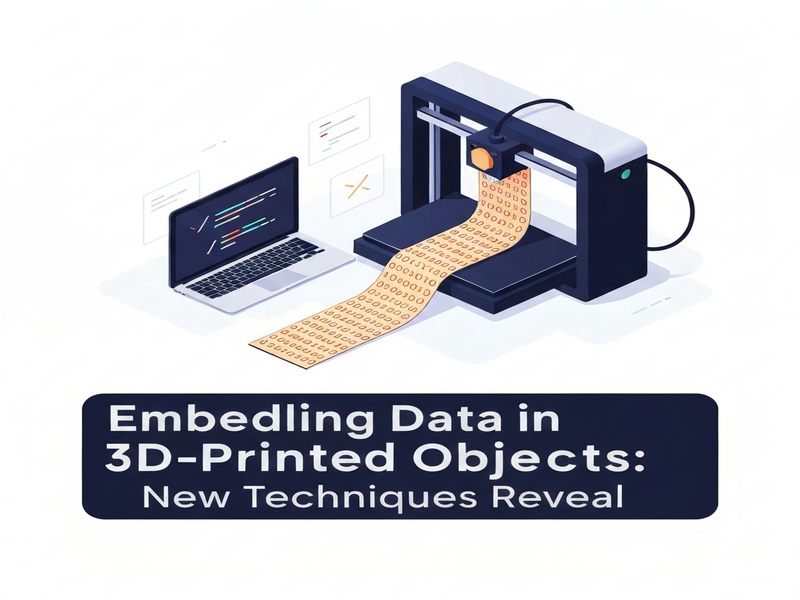
Reading these patterns can be done with a simple optical scanner or even a calibrated bed‑leveling probe, turning the physical surface back into a digital bitstream.
2. Embedded Material Contrast
Multi‑material printers allow selective deposition of conductive or fluorescent filaments. By alternating materials, a binary code is created that can be detected with a handheld UV light or a resistance meter.
For example, a filament blend containing carbon black can form “1” bits, while a clear PLA forms “0” bits. The Chroma DB integration can store the resulting data vectors for rapid lookup.
3. Resin‑Encapsulated Barcodes
After printing a flat surface, a high‑resolution inkjet or laser engraver can add a QR or DataMatrix code. The printed part is then submerged in UV‑curable resin, sealing the code against wear and environmental degradation. This method offers higher data density (up to 300 bits/cm²) and non‑destructive read‑out using any smartphone camera.
4. Acoustic or Vibrational Encoding
By designing internal lattice structures that resonate at specific frequencies, data can be encoded acoustically. A simple piezo sensor can detect these resonances, translating them back into bits. This approach is still experimental but aligns with the ElevenLabs AI voice integration for audio‑based verification.
All these techniques share a common workflow:
- Define the data payload (e.g., 128‑bit encryption key).
- Map bits to physical features using a custom script (Python, JavaScript).
- Generate a 3D model (STL) via the UBOS templates for quick start.
- Print the part on a calibrated printer.
- Read back the data with the chosen sensor and decode via software.
Real‑World Applications
Surface‑encoded 3D prints can solve niche problems where traditional digital storage falls short. Below are the most compelling use cases, each linked to a relevant UBOS solution that can streamline implementation.
Secure Hardware Tokens
Embedding a cryptographic key directly into a device’s chassis eliminates the need for separate secure elements. The key can be read only with a calibrated probe, making physical extraction extremely difficult. Enterprise AI platform by UBOS can manage key lifecycle and audit logs.
Long‑Term Archival Tags
Museums and archives can attach encoded identifiers to artifacts, ensuring provenance without relying on paper labels that degrade. The encoded data can include accession numbers, timestamps, or even environmental sensor calibrations.
Branding & Anti‑Counterfeit Measures
Luxury goods manufacturers can embed unique micro‑relief patterns that are invisible to the naked eye but verifiable with a handheld scanner. This adds a layer of authenticity that is hard to replicate.
IoT Device Configuration
Instead of manual firmware flashing, a printed enclosure can carry device configuration data (Wi‑Fi credentials, API keys). When the device powers up, it reads the pattern and self‑configures. The AI marketing agents can later personalize the device’s behavior based on the encoded profile.
Educational Tools
STEM kits can include printable “data cards” that students decode with simple sensors, teaching concepts of binary, encryption, and additive manufacturing.
Benefits, Challenges, and the Road Ahead
Key Benefits
- Physical‑Digital Fusion: Data becomes an intrinsic part of the object, reducing the attack surface.
- Durability: When sealed in resin or printed with inert materials, encoded data can survive decades.
- Cost‑Effectiveness: No extra chips or tags are required; the printer does the work.
- Customization: Each piece can carry a unique payload, enabling per‑unit personalization.
Current Challenges
- Resolution Limits: Consumer FDM printers struggle to achieve sub‑100 µm features, capping data density.
- Read‑Out Reliability: Ambient lighting, surface wear, and printer calibration affect decoding accuracy.
- Standardization: No industry‑wide format exists yet, making cross‑platform compatibility a hurdle.
- Security Concerns: If the encoding method is known, attackers could attempt physical tampering.
Future Possibilities
Advances in high‑resolution resin printers, multi‑material extrusion, and AI‑driven design optimization promise to push data density beyond 500 bits/cm². Integration with OpenAI ChatGPT integration could enable on‑the‑fly generation of encoding patterns based on user prompts, while the ChatGPT and Telegram integration could provide remote verification via a bot that receives a photo of the printed surface and returns the decoded payload.
Moreover, the rise of UBOS partner program invites hardware manufacturers to co‑develop proprietary encoding modules, fostering an ecosystem where software, firmware, and physical design converge.
Conclusion: Embrace the Fusion of Form and Information
Encoding data on 3D‑printed surfaces transforms objects from passive items into active carriers of information. While the technology is still maturing, the community insights from Hacker News demonstrate a clear appetite for experimentation and real‑world adoption.
If you’re a startup looking to prototype such solutions, explore the UBOS for startups program for rapid development resources. Small and medium businesses can leverage UBOS solutions for SMBs to embed product IDs directly into packaging.
For enterprises seeking large‑scale deployment, the Enterprise AI platform by UBOS offers secure storage, analytics, and compliance tooling for encoded data at scale.
Ready to experiment? Browse the UBOS portfolio examples for inspiration, or jump straight into a ready‑made template like the AI SEO Analyzer to see how data‑driven workflows can be built without writing a single line of code.
Stay tuned to our Innovation Hub for the latest breakthroughs in digital fabrication, AI‑enhanced design, and beyond.