

- Updated: January 30, 2026
- 5 min read
Davos 2026: AI Dominates World Economic Forum – Key Trends and Insights
Davos 2026 marked a decisive shift toward AI, with the World Economic Forum turning its annual summit into a de‑facto tech conference where AI policy, industry disruption, and future‑proof strategies dominated every agenda.
Davos 2026: How AI Redefined the World Economic Forum’s Signature Event
The snow‑capped Alpine town of Davos has long been synonymous with high‑level economic dialogue, but this year the World Economic Forum pivoted sharply toward technology. From the opening plenary to the late‑night networking lounges, artificial intelligence was the lingua franca, eclipsing traditional topics such as climate change and global poverty. Investors, CEOs, and policymakers converged to debate the next wave of AI‑driven growth, regulation, and ethical stewardship.
Key Discussion Points from the TechCrunch Interview
TechCrunch’s in‑depth interview with summit organizers highlighted six themes that defined the AI narrative at Davos:
- AI as a catalyst for economic recovery: Leaders argued that generative AI could add up to $15 trillion to global GDP by 2030, positioning it as the most potent growth engine since the internet.
- Regulatory harmonisation: A consensus emerged that fragmented AI regulations risk stifling innovation; a call for a unified global framework resonated across panels.
- Responsible AI and bias mitigation: Experts stressed the need for transparent model governance, especially in high‑stakes sectors like finance and healthcare.
- AI‑augmented workforce: The debate shifted from job loss to job transformation, with a focus on upskilling through AI‑assisted learning platforms.
- Data sovereignty and privacy: With data becoming the new oil, discussions centred on cross‑border data flows and the role of sovereign clouds.
- Emerging AI ecosystems: Start‑ups showcased novel applications—from AI‑driven climate modelling to autonomous supply‑chain orchestration.
Notable Speakers and Their Insights
The summit attracted a roster of AI luminaries whose remarks set the tone for the year ahead:
- Satya Nadella (Microsoft CEO) – Emphasised “AI‑first” as a corporate strategy, urging enterprises to embed large language models (LLMs) into core products.
- Fei-Fei Li (Stanford Professor & AI Ethics Advocate) – Warned that “unchecked AI hype can erode public trust,” calling for robust ethical standards.
- Anne‑Marie Slaughter (Foreign Policy Analyst) – Highlighted the geopolitical stakes of AI, noting that “AI leadership will define the next superpower balance.”
- Sam Altman (OpenAI CEO) – Announced a partnership with the Forum to pilot an OpenAI ChatGPT integration for real‑time policy briefings.
- Ginni Rometty (Former IBM CEO) – Discussed the rise of “AI‑augmented decision‑making” in finance, citing early adopters that reduced risk exposure by 30%.
Policy and Industry Implications
Beyond the buzz, Davos 2026 delivered concrete policy road‑maps and industry blueprints:
Global AI Governance Framework
Representatives from the EU, United States, China, and India co‑authored a draft “AI Accord” that proposes:
- Standardised risk‑assessment tiers for LLM deployments.
- Mandatory transparency logs for high‑impact AI systems.
- Cross‑border data‑sharing protocols respecting national sovereignty.
Industry‑Specific Playbooks
Sector‑focused workshops produced actionable playbooks for:
- Healthcare: AI‑driven diagnostics with built‑in bias checks.
- Finance: Real‑time fraud detection using generative AI.
- Manufacturing: Predictive maintenance powered by AI‑enhanced IoT.
These playbooks echo the capabilities showcased in UBOS’s Enterprise AI platform, which offers pre‑built compliance modules for regulated industries.
Visual Insight: The Davos AI Landscape
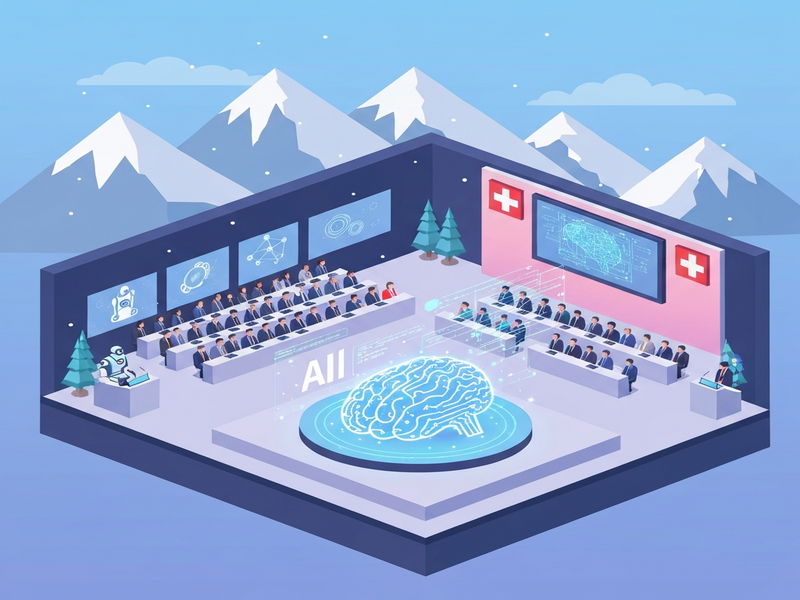
The image above captures the summit’s high‑tech ambience: holographic dashboards projected real‑time AI model performance metrics, while delegates interacted with AI‑powered translation kiosks. The visual underscores how AI has moved from back‑room labs to the public stage, reinforcing the Forum’s message that AI is now a mainstream economic lever.
Why UBOS Is Poised to Capitalise on Davos AI Momentum
Companies seeking to ride the AI wave can leverage UBOS’s ecosystem of tools and services designed for rapid deployment and governance:
- UBOS homepage – Your gateway to a unified AI development environment.
- UBOS platform overview – A low‑code canvas that integrates LLMs, data lakes, and workflow automation.
- AI marketing agents – Automate campaign creation, optimisation, and reporting with generative AI.
- UBOS partner program – Join a network of technology partners to co‑sell AI solutions.
- UBOS pricing plans – Flexible subscription tiers for startups to enterprises.
- UBOS portfolio examples – Real‑world case studies of AI‑driven transformation.
- UBOS templates for quick start – Pre‑built AI app templates that cut development time by up to 70%.
- AI trends – Stay ahead with curated insights on emerging AI technologies.
- Davos coverage – In‑depth analysis of the summit’s outcomes and how they affect your business.
For developers looking for ready‑made solutions, the UBOS Template Marketplace offers a suite of AI‑centric apps, such as the AI SEO Analyzer for content optimisation, the AI Article Copywriter for rapid content generation, and the GPT‑Powered Telegram Bot that showcases the power of ChatGPT and Telegram integration.
Future Outlook: From Davos to the Global AI Economy
As the snow melts on the Alpine slopes, the reverberations of Davos 2026 will shape AI policy and market dynamics for years to come. Key takeaways for tech‑savvy professionals, investors, and business leaders include:
- Regulatory alignment will be a competitive advantage. Early adopters of unified compliance frameworks will accelerate time‑to‑market.
- AI‑first product strategies are no longer optional. Companies that embed generative AI into core value propositions will capture disproportionate market share.
- Talent pipelines must evolve. Upskilling programs that blend AI literacy with domain expertise will be essential for sustainable growth.
- Partnership ecosystems will drive innovation. Platforms like UBOS that enable plug‑and‑play integrations (e.g., Chroma DB integration) will lower barriers for rapid experimentation.
In summary, Davos 2026 didn’t just add AI to its agenda—it re‑engineered the very fabric of global economic discourse. For organisations ready to act, the convergence of policy clarity, technological maturity, and market demand creates a once‑in‑a‑generation opportunity to lead the AI‑driven future.
Ready to Accelerate Your AI Journey?
Explore UBOS’s end‑to‑end AI platform, browse our template marketplace, or join the partner program to co‑create the next generation of AI solutions.