

- Updated: January 18, 2026
- 8 min read
Raspberry Pi AI Hat 2 Brings Affordable Edge AI to the Pi Ecosystem
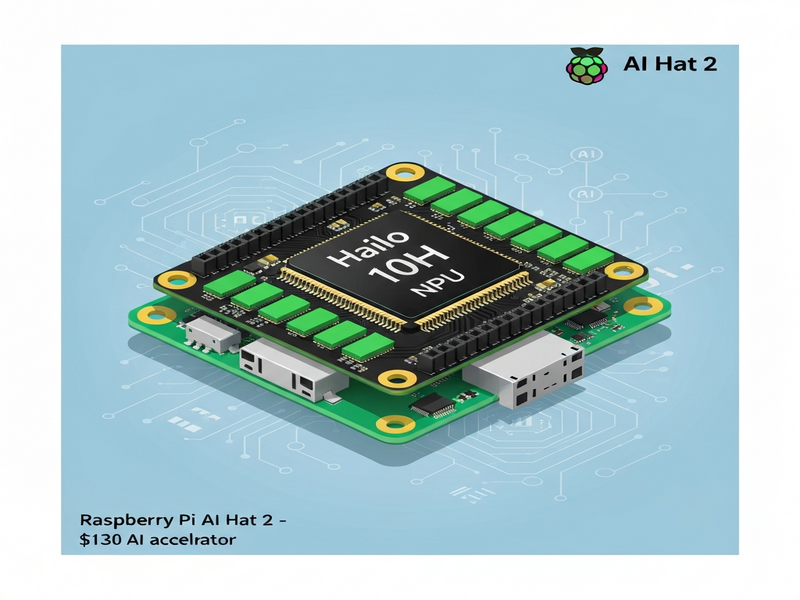
The Raspberry Pi AI Hat 2 is a $130 add‑on that pairs a Hailo 10H NPU with 8 GB of LPDDR4X RAM, delivering up to 40 TOPS of INT8 inference for on‑device AI workloads such as local LLMs and computer‑vision pipelines.
Why the AI Hat 2 matters for makers and developers
Raspberry Pi’s latest AI hardware release has instantly become a hot topic on forums, Discord channels, and the original Jeff Geerling post. The device promises to bring “AI inference on Pi” to a new level of accessibility, letting hobbyists run language models and vision algorithms without draining the main CPU or the limited system memory of a Pi 5. For anyone building edge‑AI projects—whether it’s a smart home assistant, a low‑power robot, or a prototype retail scanner—understanding the Hat’s capabilities, limits, and how it fits into a broader AI stack is essential.
Overview of the Raspberry Pi AI Hat 2
The AI Hat 2 is essentially a compact accelerator board that plugs directly onto the Pi’s 40‑pin header. Its headline feature is the integration of the Hailo 10H NPU, a purpose‑built neural‑processing unit designed for edge devices.
Key hardware specifications
- Hailo 10H NPU – up to 40 TOPS INT8 and 26 TOPS INT4 for machine‑vision workloads.
- 8 GB LPDDR4X RAM on the add‑on, isolated from the Pi’s main memory.
- Maximum power draw: 3 W (ideal for battery‑powered projects).
- PCIe‑compatible edge connector for future expansion.
- Compact form factor: 30 mm × 30 mm, fits under most Pi cases.
Power and thermal profile
The 3 W ceiling means the board stays cool under sustained loads, often requiring only a small heatsink. Compared with an eGPU that can draw 30‑50 W, the AI Hat 2 is a fraction of the power budget, making it perfect for AI hardware Raspberry Pi projects that run off a power bank or solar panel.
Performance in real‑world scenarios
Benchmarks from early adopters show a mixed picture. The NPU shines on computer‑vision tasks—object detection on a Camera Module 3 runs roughly ten times faster than the Pi 5 CPU alone. However, for large language model (LLM) inference, the 8 GB RAM ceiling becomes a bottleneck.
LLM inference on the AI Hat 2
When paired with a quantized 1.5 B‑parameter model (e.g., Qwen2.5‑Coder), the Hailo 10H can match the Pi’s CPU speed while consuming far less power. Larger models (30 B‑parameter) still require the Pi’s main RAM, so the Hat’s advantage diminishes. In practice, developers use the Hat for “tiny” LLMs that fit comfortably within the 8 GB limit, or they off‑load heavy reasoning to a cloud endpoint while keeping the inference edge‑local for privacy.
Computer‑vision pipelines
Using the built‑in hailo‑rpi5‑examples, the board processes 1080p video streams at 30 fps with object‑tracking accuracy comparable to desktop‑grade GPUs. This makes the Hat ideal for:
- Smart retail checkout scanners (e.g., Fujitsu shrink‑detection demos).
- Home security cameras that run person‑detection locally.
- Robotics vision where latency < 50 ms is critical.
How the AI Hat 2 compares with alternatives
| Device | NPU Power | RAM | Typical Use‑Case | Price (USD) |
|---|---|---|---|---|
| AI Hat 2 (Hailo 10H) | 3 W | 8 GB (on‑board) | Mixed vision + tiny LLM | $130 |
| Original AI Hat (Hailo 8) | 3 W | No extra RAM | Vision only | $110 |
| AI Camera (Vision‑only) | 2 W | N/A | Object detection | $70 |
| eGPU (e.g., RTX 3060) | 30‑50 W | VRAM 6‑12 GB | Full‑scale AI workloads | $400+ |
In short, the AI Hat 2 fills a niche: it offers more compute than the original AI Hat while staying far cheaper and more power‑efficient than an eGPU. If your project needs both vision and a modest LLM, the Hat is the only “single‑board” solution that does it without draining the Pi’s main CPU.
Integrating the AI Hat 2 with the UBOS ecosystem
UBOS provides a full‑stack UBOS platform overview that makes it trivial to attach new hardware accelerators to a Pi‑based AI service. Below are concrete ways to combine the AI Hat 2 with UBOS products, turning a hobby board into a production‑grade AI service.
Deploying AI models with the Workflow Automation Studio
The Workflow automation studio lets you create pipelines that route camera frames to the Hailo NPU, then feed the output into a language model running on the same Pi. A typical flow looks like:
- Capture image with Camera Module 3.
- Run object detection on the Hailo 10H.
- Pass detected labels to a tiny LLM for natural‑language summarisation.
- Publish the result via a Telegram bot or a web endpoint.
Connecting to messaging platforms
UBOS already ships ready‑made Telegram integration on UBOS and a ChatGPT and Telegram integration. By swapping the cloud‑based ChatGPT endpoint for a local LLM running on the AI Hat 2, you can keep all conversation data on‑device, satisfying privacy‑first use‑cases.
Leveraging OpenAI models when needed
For scenarios where the on‑device model is insufficient, the OpenAI ChatGPT integration can be invoked as a fallback. The workflow can automatically detect when the NPU’s confidence falls below a threshold and forward the request to the cloud, then cache the response for future offline use.
Storing embeddings with Chroma DB
When you need to perform semantic search over captured images or transcribed audio, the Chroma DB integration provides a lightweight vector store that runs on the same Pi. The AI Hat 2’s fast inference makes it feasible to generate embeddings in real time.
Adding voice capabilities via ElevenLabs
UBOS’s ElevenLabs AI voice integration can turn the text output of your LLM into natural‑sounding speech, all while staying on the edge device. This is perfect for kiosk‑style assistants that need to respond instantly without internet latency.
Rapid prototyping with UBOS templates
UBOS’s UBOS templates for quick start include ready‑made blueprints such as the AI SEO Analyzer and the AI Article Copywriter. By swapping the underlying model with one that runs on the AI Hat 2, you can create a fully offline SEO‑analysis service that runs on a Pi‑Zero or Pi 5.
Showcase projects in the UBOS portfolio
Once your solution is polished, add it to the UBOS portfolio examples to inspire other developers. Real‑world case studies boost credibility and help the community understand how to combine edge AI hardware with UBOS’s low‑code environment.
Monetizing through the UBOS partner program
If you plan to commercialize your AI Hat‑powered product, the UBOS partner program offers co‑marketing, revenue‑share, and technical support. It’s a fast track from prototype to market‑ready solution.
Practical use‑cases you can build today
- Smart inventory scanner: Combine vision (detect product shape) with a tiny LLM to generate natural‑language restock alerts. Use the Talk with Claude AI app as a conversational front‑end.
- Voice‑enabled home assistant: Capture voice via a microphone, transcribe locally, and respond with ElevenLabs voice synthesis. The AI Voice Assistant template can be adapted.
- Edge‑only content moderation: Run image‑to‑text conversion (Image to Text AI service) then feed the text to a local LLM for sentiment analysis, keeping user data on‑device.
- Real‑time code helper: Deploy the Python Bug Fixer AI on a Pi‑based dev board, letting developers get instant suggestions without internet.
Pricing, availability, and how to get started
The AI Hat 2 retails for $130 directly from Raspberry Pi’s official store. When paired with a Pi 5 (starting at $75) and a modest power supply, the total bill of materials stays under $250—well below the cost of a comparable eGPU setup.
UBOS offers a free tier that includes the UBOS pricing plans for hobbyists, and a paid tier for enterprises that need SLA‑backed support and advanced monitoring.
Take the next step with UBOS and the AI Hat 2
If you’re ready to turn the Raspberry Pi AI Hat 2 into a production‑grade AI service, start by exploring the UBOS homepage. The platform’s low‑code Web app editor on UBOS lets you drag‑and‑drop the NPU‑accelerated inference nodes, while the AI marketing agents can automatically generate product copy for your new device.
Whether you’re a startup (UBOS for startups), an SMB (UBOS solutions for SMBs), or an enterprise (Enterprise AI platform by UBOS), the combination of the AI Hat 2 and UBOS gives you a scalable, secure, and cost‑effective path to edge AI.
Explore the About UBOS page to learn more about the team behind the platform, then dive into the UBOS portfolio examples for inspiration. When you’re ready, join the UBOS partner program and start monetizing your AI‑powered creations today.