

- Updated: January 17, 2026
- 7 min read
Authority Boundary Ledger: A New Governance Framework for AI in Regulated Industries
The Authority Boundary Ledger is a blockchain‑backed governance primitive that records, enforces, and audits AI authority constraints in real‑time, giving regulated organizations a provable, tamper‑proof trail for every AI decision.
Why AI Trust Is the Biggest Hurdle for Regulated Industries
Healthcare providers, banks, law firms, and government agencies are all racing to embed generative AI into their core processes. Yet the institutional trust problem—the inability to prove that an AI system acted within legally mandated boundaries—remains a deal‑breaker. Decision‑makers ask a single question: “If something goes wrong, can I defend this choice?” Traditional AI safety metrics (e.g., 98 % accuracy) do not satisfy auditors, regulators, or board members who need concrete evidence of compliance.
Enter the Authority Boundary Ledger (ABL), a novel approach that combines open‑source blockchain technology with attribute‑based access control (ABAC) to create a persistent, auditable authority state for every AI interaction.
What Is the Authority Boundary Ledger?
The Authority Boundary Ledger is a ledger‑style record that stores every authority constraint applied to an AI agent, from constitutional policies (e.g., “Never exfiltrate data”) to session‑level preferences (e.g., “Explain like a 5‑year‑old”). By logging each constraint as an immutable transaction, the ledger guarantees that constraints survive across API calls, user sessions, and even system restarts.
ABL is built on three foundational ideas:
- Persistent Authority State: Constraints are not fleeting prompts; they become first‑class objects stored on a tamper‑proof chain.
- Hierarchical Tool Filtering: Before an AI model even sees a tool, the ledger removes any capability that exceeds the caller’s authority level.
- Comprehensive Audit Trails: Every constraint addition, modification, or violation attempt is recorded with timestamps, actor IDs, and cryptographic proofs.
Key Features That Redefine AI Governance
1. Persistent Constraint Tracking
Unlike ad‑hoc prompt engineering, ABL writes each rule to a Chroma DB integration that acts as a decentralized state store. The ledger’s hash‑linked blocks ensure that once a rule is set—such as “No PII in outputs”—it cannot be silently overridden without a signed transaction.
2. Mechanical Tool Filtering
Before the model generates a response, the ChatGPT and Telegram integration demonstrates the same principle: the system removes disallowed verbs from the tool list. If a finance analyst lacks “WRITE” permission, the sql_execute tool simply does not exist, eliminating the possibility of a hallucinated illegal transaction.
3. Ring‑Based Authority Hierarchy
ABL mirrors classic OS privilege rings:
- Ring 0 – Constitutional: Immutable policies (e.g., “Never self‑replicate”).
- Ring 1 – Organizational: Enterprise‑wide mandates (e.g., “HIPAA compliance”).
- Ring 2 – Session: User‑specific preferences (e.g., “Use layman’s terms”).
Higher rings cannot be overridden by lower ones, guaranteeing that a junior analyst cannot bypass a senior‑level compliance rule.
4. Domain‑Agnostic Application
Because the ledger works at the capability‑level rather than the data‑level, the same kernel can protect a medical diagnosis tool, a stock‑trading bot, or a legal document generator without code changes. This universality is why the Enterprise AI platform by UBOS can offer a single governance layer for all its SaaS customers.
Why Regulated Industries Should Adopt ABL Now
The ledger directly addresses the three pain points that keep compliance officers up at night:
- Defensible Audits: Every constraint change is cryptographically signed, making it trivial for auditors to verify that AI actions complied with policy at any point in time.
- Reduced Legal Exposure: By mechanically removing prohibited tools, the system eliminates the “hallucination” risk that often leads to regulatory breaches.
- Operational Efficiency: Teams no longer need to build custom logging pipelines; the ledger provides a ready‑made, searchable history of authority events.
For example, a hospital can prove to regulators that no AI‑driven prescription was ever generated without a signed “prescribe” token, while a bank can demonstrate that every trade‑execution request passed through a verified “trade‑approval” authority layer.
Real‑World Applications Across Sectors
Healthcare: Safe Clinical Decision Support
A large health system integrated ABL with its ElevenLabs AI voice integration to power a voice‑enabled symptom triage bot. The ledger enforced a Ring 1 rule that prohibited any recommendation involving medication dosage without a physician’s digital signature. All interactions were logged, enabling the compliance team to generate a HIPAA‑ready audit report in seconds.
Finance: Transparent Trading Assistants
A multinational bank deployed the OpenAI ChatGPT integration inside its internal risk‑analysis portal. Using ABL, the bank locked the sql_execute and trade_execute tools behind a Ring 1 “Compliance Officer” authority. Every trade suggestion generated by the AI was automatically accompanied by a ledger entry showing who authorized the request, satisfying both internal audit and external regulator (FINRA) requirements.
Legal: Controlled Document Drafting
A boutique law firm leveraged the Telegram integration on UBOS to let junior associates draft briefs via a chatbot. The Authority Boundary Ledger prevented the bot from issuing binding legal opinions by removing the “issue_opinion” tool for anyone below Ring 1. Senior partners could later review the ledger to confirm that only authorized personnel generated final filings.
Government: Secure Citizen Services
A provincial digital service used ABL to protect a public‑facing AI that answered tax‑related queries. The ledger ensured that the AI never accessed or disclosed personally identifiable information (PII) without a Ring 1 “Data Steward” token. When a user attempted to retrieve confidential records, the system logged the attempt and returned a safe, generic response, preserving public trust.
Start Building Trust‑First AI with UBOS
If your organization is ready to move from “probabilistic safety” to provable compliance, UBOS offers a complete stack that integrates the Authority Boundary Ledger out‑of‑the‑box.
- UBOS homepage – discover the platform’s core capabilities.
- About UBOS – learn how our team blends AI research with enterprise governance.
- UBOS platform overview – see the modular architecture that hosts the ledger.
- Enterprise AI platform by UBOS – scale secure AI across the whole organization.
- UBOS partner program – collaborate with us to embed ABL in your solutions.
- UBOS pricing plans – transparent pricing for startups to enterprises.
- UBOS templates for quick start – launch a compliant AI app in minutes.
- Workflow automation studio – orchestrate ledger‑aware processes without code.
- Web app editor on UBOS – build custom dashboards that surface ledger entries in real time.
- AI marketing agents – see how governance can coexist with creative automation.
- UBOS for startups – get early‑stage access to the Authority Boundary Ledger.
- UBOS solutions for SMBs – affordable governance for midsize firms.
- UBOS portfolio examples – explore case studies of ledger‑enabled deployments.
- AI SEO Analyzer – a ready‑made template that already logs every optimization decision.
- AI Article Copywriter – see how content generation can be made auditable.
- AI Video Generator – generate media with built‑in compliance logs.
- AI Chatbot template – start a conversational agent that respects authority boundaries from day one.
- GPT-Powered Telegram Bot – combine secure tool filtering with instant messaging.
- AI Email Marketing – ensure every outbound campaign complies with data‑privacy rules.
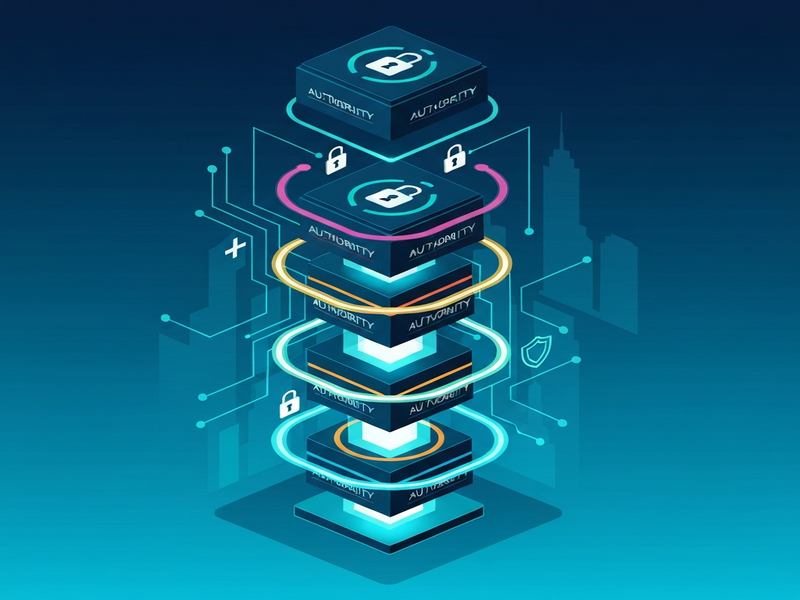
Image: Conceptual illustration of layered AI authority controls.
Conclusion: From Trust Deficit to Trust Certainty
The Authority Boundary Ledger transforms AI governance from a best‑effort checklist into a mathematically verifiable system. By persisting authority constraints, filtering tools mechanically, and providing an immutable audit trail, it gives technology leaders and compliance officers the evidence they need to approve AI deployments in the most regulated environments.
When paired with UBOS’s end‑to‑end AI platform, organizations can accelerate innovation without sacrificing accountability. The future of AI in healthcare, finance, law, and government hinges on trustworthy infrastructure—ABL is that infrastructure.