

- Updated: January 5, 2026
- 7 min read
LG Unveils CLOiD Robot Laundry Demo at CES 2026 – A Leap Toward Smart‑Home Automation
LG’s CLOiD robot, showcased at CES 2026, can autonomously load a washing machine, demonstrating a concrete step toward a “zero‑labor” smart home.
LG CLOiD Robot Laundry Demo at CES 2026: A New Era for Smart Home Appliances
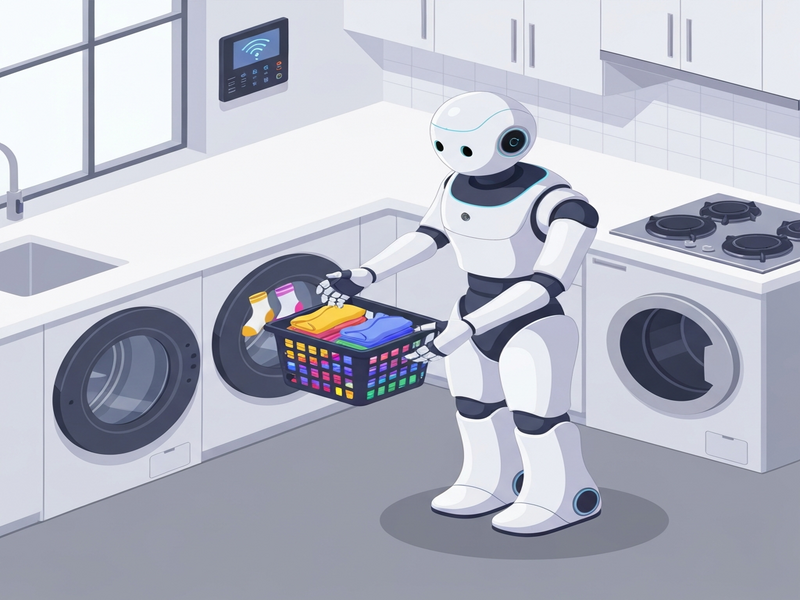
At this year’s Consumer Electronics Show, LG unveiled its most ambitious household assistant yet – the LG CLOiD robot. In a live demonstration, the robot approached a front‑loading washer, grasped a damp towel with its five‑fingered hands, and placed it inside the drum, all while speaking in a friendly, masculine voice. The entire sequence took just under 30 seconds, offering a tangible glimpse of how AI‑driven robotics could soon handle mundane chores like laundry loading, water fetching, and even breakfast preparation.
The demo aligns with LG’s broader vision of a “zero‑labor home,” where intelligent devices collaborate to eliminate repetitive tasks. For tech‑savvy consumers and early adopters, this moment signals that home automation is moving beyond voice‑controlled lights and thermostats toward fully autonomous physical agents.
What Is the LG CLOiD Robot?
The CLOiD robot is a bipedal platform equipped with dual five‑fingered manipulators, a 360° camera array, and an on‑board AI engine that processes natural‑language commands. LG describes its intelligence as “Affectionate Intelligence,” a blend of conversational AI and contextual awareness designed to anticipate user needs.
- Height: 1.2 m, weight: 30 kg – compact enough for most home environments.
- Mobility: omnidirectional wheels with obstacle‑avoidance LIDAR.
- Connectivity: Wi‑Fi 6, Bluetooth 5.2, and optional Zigbee/Matter bridge.
- Software stack: runs on a Linux‑based OS with support for OpenAI ChatGPT integration and Chroma DB integration for semantic memory.
By leveraging large‑language models, CLOiD can interpret spoken requests, translate them into motor actions, and even learn from repeated interactions, making it a true AI companion rather than a simple scripted robot.
Live Demo at CES 2026: Robot Laundry in Action
During LG’s keynote, Brandt Varner, VP of Sales for Home Appliances, handed a wet towel to CLOiD and asked, “Can you start the laundry?” The robot responded, “Sure, I’ll get the laundry started,” before rolling toward a front‑loading washer that opened automatically.
Step‑by‑Step Walkthrough
- Voice activation: CLOiD’s microphone array captured Varner’s request and sent it to the on‑board LLM.
- Path planning: Using its LIDAR map, the robot plotted a collision‑free route to the washer.
- Door interaction: The washer’s door opened automatically; future firmware updates aim for CLOiD to operate the latch itself.
- Object manipulation: The left arm extended, fingers curled around the towel, and gently released it into the drum.
- Confirmation: CLOiD announced, “Towel loaded, starting cycle,” before returning to its standby pose.
Performance Metrics and Speed
The entire loading process took approximately 30 seconds. While this is slower than a human hand, the robot’s consistency and ability to operate hands‑free are notable. LG estimates that with software refinements and a more powerful actuator suite, loading a full week’s worth of laundry could be reduced to under two minutes.
In addition to laundry, CLOiD later fetched a bottle of water for senior VP Steve Scarbrough, demonstrating multi‑tasking capabilities and contextual awareness (“I noticed by your voice and tone that you might want some water”).
Expert Commentary and Market Implications
Industry analysts see CLOiD as a pivotal moment for the smart home appliances sector. According to TechInsights, “Robotic manipulators have long been confined to industrial settings; bringing them into the consumer home marks a paradigm shift.”
Industry Analysts’ View
“The CLOiD demo proves that AI‑driven robotics can be safe, reliable, and user‑friendly enough for everyday households,” says Maya Patel, senior analyst at FutureTech Research.
Patel notes that the robot’s ability to understand natural language and execute physical tasks could accelerate adoption of “AI‑first” home ecosystems, where devices negotiate tasks among themselves without human prompting.
Potential Impact on the Smart‑Home Market
- New revenue streams: Appliance manufacturers may bundle robots with existing products, similar to LG’s Enterprise AI platform by UBOS that offers modular AI services.
- Competitive pressure: Companies like Samsung and Dyson are accelerating their own robotic initiatives, making rapid innovation essential.
- Consumer expectations: Early adopters will begin demanding fully autonomous chores, pushing the market toward integrated solutions rather than isolated smart plugs.
How the CLOiD Robot Fits Into a Connected Home Ecosystem
CLOiD is designed to be a hub‑agnostic companion. Its open API can communicate with major smart‑home standards, including Matter, Apple HomeKit, and Google Home. This flexibility enables seamless orchestration with existing devices such as smart lights, thermostats, and security cameras.
Integration with Existing Platforms
Developers can leverage the Web app editor on UBOS to create custom dashboards that trigger CLOiD actions based on sensor data. For example, a moisture sensor in the laundry room could automatically cue CLOiD to start a wash cycle when humidity spikes.
Future AI Capabilities and Open APIs
LG plans to expose a Workflow automation studio that lets power users chain together voice commands, robot actions, and third‑party services (e.g., ordering detergent via an e‑commerce API). This will turn the robot into a programmable “home concierge.”
Why Early Adopters Should Pay Attention
For tech‑savvy consumers, the CLOiD robot offers more than a novelty; it provides a platform for experimentation with AI‑driven automation. Early adopters can benefit from:
- Hands‑free convenience: Automate repetitive chores, freeing time for creative pursuits.
- Data‑driven insights: CLOiD can log usage patterns, helping homeowners optimize energy consumption.
- Customization: Through the UBOS templates for quick start, users can build bespoke voice‑activated routines without deep coding.
Comparison with Competing Solutions
While robot vacuums like iRobot Roomba have dominated the market, they lack dexterous manipulation. CLOiD’s five‑fingered hands give it an edge in tasks that require grasping, such as loading laundry or retrieving items from shelves. In contrast, most competing “smart assistants” remain confined to voice control without physical interaction.
Take the Next Step: Build Your Own AI‑Powered Home Automation
If the CLOiD demo sparked your imagination, explore how you can create similar AI‑driven experiences using the UBOS ecosystem. Whether you’re a startup, an SMB, or an enterprise, UBOS offers tools that accelerate the development of intelligent agents.
- Start with the UBOS platform overview to understand the modular AI services.
- Leverage the AI news feed for the latest breakthroughs in generative AI.
- Experiment with ready‑made templates like the AI Chatbot template or the AI SEO Analyzer to prototype voice‑controlled workflows.
- Integrate conversational intelligence using the ChatGPT and Telegram integration for remote monitoring.
- Enhance user interaction with the ElevenLabs AI voice integration, delivering natural‑sounding responses.
- Scale your solution with the UBOS pricing plans that fit any budget.
By combining UBOS’s low‑code environment with powerful AI models, you can prototype a robot‑like assistant that coordinates with existing smart appliances—just like LG’s CLOiD, but tailored to your unique needs.
Read the Original Coverage
For a full rundown of the CES 2026 showcase, see the original article on The Verge:
LG CLOiD robot laundry demo at CES 2026.