

- Updated: December 31, 2025
- 6 min read
Cloudflare’s tokio‑quiche brings QUIC and HTTP/3 to Rust back‑ends – Open‑Source Deep Dive

tokio‑quiche is an asynchronous Rust library that wraps Cloudflare’s battle‑tested quiche QUIC implementation with the Tokio runtime, delivering a production‑ready, high‑performance QUIC and HTTP/3 stack that eliminates the need for developers to write low‑level UDP and event‑loop code.
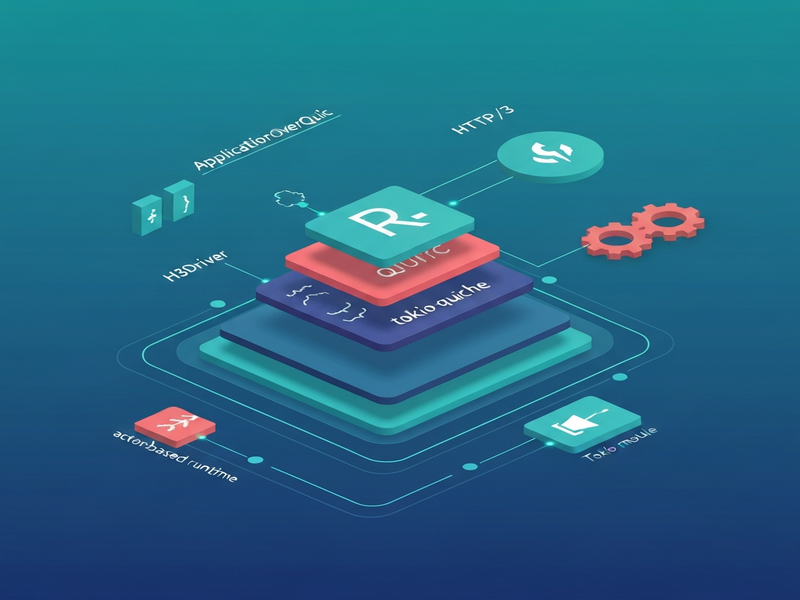
Why tokio‑quiche matters for modern Rust back‑ends
In the fast‑evolving world of internet protocols, QUIC and HTTP/3 have become the de‑facto standard for low‑latency, multiplexed communication. Cloudflare’s open‑source original announcement highlighted how the new tokio‑quiche crate turns the formerly “sans‑io” OpenAI ChatGPT integration model into a ready‑to‑use async solution. This article breaks down the library’s architecture, key abstractions, real‑world usage, and roadmap, while showing how you can combine it with UBOS’s AI‑powered platform for rapid prototyping.
Overview of tokio‑quiche and its significance
tokio‑quiche fuses two proven components:
- quiche – Cloudflare’s low‑level, sans‑io QUIC and HTTP/3 implementation written in Rust.
- Tokio – The most popular async runtime for Rust, providing task scheduling, I/O primitives, and a powerful actor model.
By marrying these, the crate delivers:
- Automatic UDP socket management.
- Built‑in timer handling for QUIC retransmissions.
- Message‑passing actors that isolate connection state.
- High‑throughput, low‑latency performance proven at Cloudflare edge scale.
The library is ideal for Rust teams that need QUIC/HTTP/3 without reinventing the networking plumbing, whether they are building micro‑services, edge proxies, or next‑gen VPNs.
Integration of quiche with Tokio: an actor‑based architecture
The core of tokio‑quiche is its actor model, which maps naturally onto Tokio’s task system. Each actor is a lightweight async task that owns its own state and communicates via channels, ensuring thread‑safe concurrency without locks.
Key actors
- InboundPacketRouter – Listens on the UDP socket, extracts the Destination Connection ID from each datagram, and forwards the packet to the appropriate per‑connection channel.
- IoWorker – Drives a single
quiche::Connectioninstance. It feeds incoming packets into the QUIC state machine, processes timers, and emits outbound packets back to the socket. - ApplicationOverQuic – An extensible trait that bridges the transport layer with higher‑level protocols (e.g., HTTP/3, DNS‑over‑QUIC).
The flow is simple yet powerful:
// Pseudo‑code of the main loop
loop {
    select! {
        // Receive a UDP datagram
        Some(pkt) = inbound_rx.recv() => {
            let conn_id = pkt.dest_conn_id();
            router.route(conn_id, pkt);
        }
        // Process a connection’s IO work
        Some(event) = io_worker_rx.recv() => {
            connection.handle(event);
        }
    }
}
This design isolates each QUIC connection, making it trivial to scale horizontally across cores or even across multiple machines.
Deep dive: ApplicationOverQuic abstraction and H3Driver
QUIC is a transport protocol; it can carry many application protocols. To avoid hard‑coding a single protocol, tokio‑quiche defines the ApplicationOverQuic trait. Implementors receive high‑level events (e.g., new stream opened, data received) while the library handles all low‑level packet processing.
H3Driver – the HTTP/3 bridge
The library ships a concrete implementation called H3Driver. It connects quiche’s HTTP/3 module to the actor system and translates raw HTTP/3 frames into async Rust streams that feel like ordinary tokio::io::AsyncRead/Write objects.
- ServerH3Driver – Handles inbound HTTP/3 requests, exposing
RequestandResponsefutures. - ClientH3Driver – Provides a client‑side API for sending HTTP/3 requests and receiving streamed responses.
Because the driver is generic, you can swap it for a custom ApplicationOverQuic implementation (e.g., a DNS‑over‑QUIC resolver) without touching the core I/O loop.
For developers already using UBOS’s Web app editor on UBOS, the H3Driver can be wrapped in a low‑code component, letting you spin up an HTTP/3 micro‑service in minutes.
Real‑world production usage and case studies
Before its public release, tokio‑quiche powered several high‑traffic Cloudflare services:
| Service | Role of tokio‑quiche | Scale |
|---|---|---|
| Apple iCloud Private Relay (Proxy B) | Edge proxy handling encrypted traffic over QUIC | Millions of requests/sec |
| Oxy‑based HTTP/3 servers | High‑throughput content delivery | Hundreds of Gbps |
| WARP MASQUE client | QUIC‑based VPN tunnels replacing WireGuard | Global edge deployment |
These deployments prove that the library can sustain millions of HTTP/3 requests per second with sub‑millisecond latency. For teams building similar workloads, the same patterns can be reused with UBOS’s Enterprise AI platform by UBOS, which already includes a ChatGPT and Telegram integration for real‑time monitoring of QUIC metrics.
Roadmap and future developments
Cloudflare has outlined a clear roadmap for tokio‑quiche:
- Native support for HTTP/3 server push – allowing proactive resource delivery.
- Zero‑RTT session resumption improvements – further reducing handshake latency.
- Pluggable congestion control algorithms – enabling custom tuning for specific network conditions.
- Integration with emerging Rust async ecosystems – such as Chroma DB integration for vector‑search over QUIC streams.
- Enhanced diagnostics UI – a web dashboard built with the Workflow automation studio for real‑time tracing.
The roadmap emphasizes extensibility, meaning developers can start building today and adopt new features as they land, without breaking existing code.
SEO meta description suggestions
- Discover how Cloudflare’s tokio‑quiche library brings QUIC and HTTP/3 to Rust developers with a production‑ready Tokio integration.
- Learn the actor‑based architecture, ApplicationOverQuic abstraction, and H3Driver that power millions of requests per second.
- Explore real‑world use cases, roadmap, and how to combine tokio‑quiche with UBOS AI tools for rapid prototyping.
Conclusion: Impact on the Rust networking ecosystem
By delivering a battle‑tested QUIC stack wrapped in Tokio’s async model, tokio‑quiche lowers the barrier for Rust teams to adopt next‑generation internet protocols. Its actor‑centric design guarantees safety and scalability, while the ApplicationOverQuic trait keeps the library protocol‑agnostic.
When paired with UBOS’s low‑code ecosystem—such as the UBOS templates for quick start, the AI Video Generator, or the AI SEO Analyzer—developers can spin up sophisticated QUIC‑enabled services in days rather than months.
Whether you are building a high‑throughput edge proxy, a secure VPN, or a next‑gen API gateway, tokio‑quiche provides the foundation. Keep an eye on the upcoming roadmap, and start experimenting now to stay ahead of the performance curve.
Next steps with UBOS
Ready to prototype your own QUIC service? Visit the UBOS homepage for a free trial, explore the UBOS solutions for SMBs, or dive into the UBOS for startups program. Need pricing details? Check the UBOS pricing plans. For a deeper look at the platform, see the UBOS platform overview.
Want to enrich your applications with AI? Try the AI marketing agents, integrate voice with ElevenLabs AI voice integration, or add vector search via Chroma DB integration. The possibilities are endless.