

- Updated: November 27, 2025
- 7 min read
Leaked AI Executive Order Aims to Preempt State Regulations – UBOS Analysis
The leaked AI executive order seeks to pre‑empt state‑level artificial‑intelligence regulations by tying federal funding and enforcement powers to compliance with a federal AI policy framework.
Why This Leak Matters for Every Tech Enthusiast and Policy Maker
When a draft executive order surfaces, it’s more than a bureaucratic curiosity—it’s a crystal ball showing how the next administration intends to shape the AI landscape. The recent leak, first reported by the original Verge article, reveals a sweeping strategy that could silence state‑level AI experiments, redirect billions of dollars, and reshape the power balance between Big Tech and the federal government.
For startups, SMBs, and enterprise AI teams, understanding the legal and financial levers embedded in this order is essential to avoid costly compliance missteps and to seize new opportunities that may arise from a more centralized AI policy.
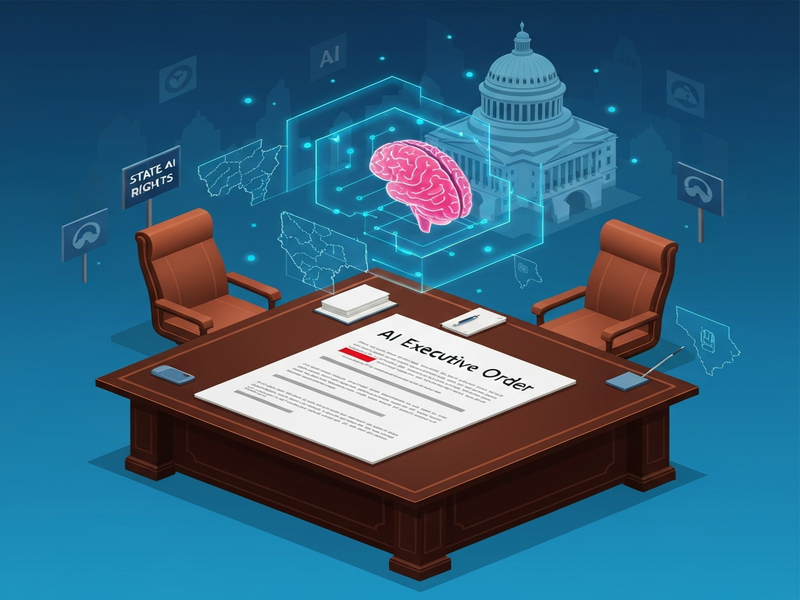
Executive Order at a Glance: Objectives and Core Provisions
The draft order, attributed to the Trump administration’s AI task force, outlines three primary objectives:
- Federal Preemption: Establish a legal framework that allows the federal government to override or discourage state AI statutes that conflict with national policy.
- Funding Leverage: Tie eligibility for major grant programs—most notably the Broadband Equity Access and Deployment (BEAD) fund—to compliance with the federal AI agenda.
- Enforcement Mechanisms: Empower the Department of Justice, the FTC, and the FCC to pursue litigation, fines, and regulatory actions against non‑compliant states.
The order also mandates that every relevant agency consult a “Special Advisor for AI and Crypto,” a role currently held by tech billionaire David Sacks, ensuring that private‑sector perspectives directly shape public policy.
Legal Strategy: How the Order Plans to Enforce Preemption
While an executive order cannot outright nullify state law, it can create a powerful chilling effect by threatening financial consequences. The legal blueprint includes:
1. Creation of a Federal AI Task Force
The Department of Justice will form a task force tasked with identifying “onerous” state AI statutes. Once flagged, these laws become subject to federal lawsuits alleging interference with interstate commerce and violation of the Commerce Clause.
2. Conditional Funding Restrictions
Section 5 of the order instructs the Commerce Department to withhold BEAD funding—over $42 billion in broadband subsidies—from any state whose AI laws appear on the “onerous list.” Moreover, the order expands this conditionality to all discretionary federal grants, potentially affecting education, transportation, and health‑care programs.
3. FTC and FCC Involvement
The FTC is empowered to treat state‑mandated algorithmic transparency requirements as “deceptive practices” under the FTC Act, opening the door to civil penalties. Simultaneously, the FCC is instructed to explore a federal reporting standard that could pre‑empt state disclosure rules, though its statutory authority in this arena remains uncertain.
Legal scholars warn that while the order’s tactics are aggressive, they may not survive judicial scrutiny. However, the immediate impact—delayed funding, costly litigation, and regulatory uncertainty—could be enough to deter many states from pursuing robust AI legislation.
State AI Regulation and Funding: What’s at Stake?
States like California, New York, and Massachusetts have already introduced comprehensive AI bills covering algorithmic bias, data privacy, and model transparency. The leaked order threatens to undercut these efforts in several ways:
- Financial Leverage: States heavily reliant on federal infrastructure grants may pause or water‑down AI bills to avoid losing billions.
- Legal Uncertainty: The prospect of a federal lawsuit creates a risk‑averse environment for state legislators and regulators.
- Policy Fragmentation: A de‑centralized approach to AI governance could be replaced by a single, federal‑centric rulebook, limiting local innovation.
For businesses, this shift could simplify compliance—one national standard versus a patchwork of state rules—but it also concentrates power in the hands of a few federal agencies and private advisors.
Companies looking to stay ahead can leverage UBOS’s UBOS templates for quick start to prototype AI‑compliant workflows that align with emerging federal guidelines.
Political Context: Big Tech, the White House, and Federal‑State Dynamics
The order arrives at a moment when Big Tech firms are simultaneously lobbying for deregulation and investing heavily in AI safety research. By embedding the Special Advisor role within the order, the administration effectively grants a private‑sector influencer a veto‑like power over state policy.
Critics argue this is a classic “regulatory capture” scenario, where industry expertise is used to shape rules that favor incumbents. Proponents, however, claim that a unified national policy will prevent a “race to the bottom” as states compete for AI innovation dollars.
The political calculus also reflects the administration’s broader agenda to assert federal authority over emerging technologies, echoing past attempts to pre‑empt state-level net neutrality and data‑privacy measures.
For developers and product teams, understanding this tug‑of‑war is crucial. UBOS’s AI policy guidance offers a roadmap for aligning product roadmaps with both current and anticipated federal expectations.
What This Means for the AI Landscape—and What You Should Do Next
Whether the executive order survives legal challenges or not, its mere existence reshapes the strategic calculus for every AI stakeholder:
- Audit Your Compliance Pipeline: Map existing state‑level obligations and identify which could be affected by federal funding restrictions.
- Leverage Centralized Platforms: Tools like the UBOS platform overview enable rapid deployment of AI services that adhere to a single policy framework.
- Invest in Explainability: Even if state laws are muted, consumer‑facing transparency will remain a competitive differentiator.
- Engage in Policy Dialogues: Join the UBOS partner program to stay informed and influence future regulatory drafts.
- Prototype with Ready‑Made Templates: The AI SEO Analyzer and AI Article Copywriter can accelerate compliance‑first content creation.
In a rapidly evolving regulatory environment, agility is the new competitive advantage. By aligning your AI initiatives with a centralized, federally‑endorsed framework—while keeping an eye on state‑level nuances—you can mitigate risk and capture market share.
Stay ahead of the curve by exploring UBOS’s Enterprise AI platform by UBOS, which offers built‑in governance controls, audit trails, and compliance dashboards designed for the post‑order era.
Further Reading and UBOS Resources
To deepen your understanding of how AI policy intersects with product development, consider the following UBOS assets:
- UBOS homepage – Overview of AI‑enabled solutions.
- About UBOS – Our mission and leadership in AI governance.
- AI marketing agents – Automate campaign creation while staying compliant.
- UBOS for startups – Fast‑track AI product launches.
- UBOS solutions for SMBs – Scalable compliance tools for smaller teams.
- Web app editor on UBOS – Drag‑and‑drop UI builder with policy checks.
- Workflow automation studio – Orchestrate AI pipelines with built‑in audit logs.
- UBOS pricing plans – Transparent pricing for compliance‑first AI.
- UBOS portfolio examples – Real‑world case studies of regulated AI deployments.
- Technology news – Stay updated on policy shifts.
Bottom Line
The leaked AI executive order is a bold attempt to centralize AI governance, using funding and enforcement as levers to curb state‑level innovation. While its legality remains uncertain, the strategic signal is clear: federal oversight will intensify, and businesses must adapt quickly.
By leveraging robust, policy‑aware platforms like UBOS, you can future‑proof your AI initiatives, maintain compliance, and continue to innovate in a landscape that is rapidly being reshaped from the top down.