

- Updated: April 3, 2026
- 6 min read
The IDE is Dead: AI Agents Replace Traditional Development Environments
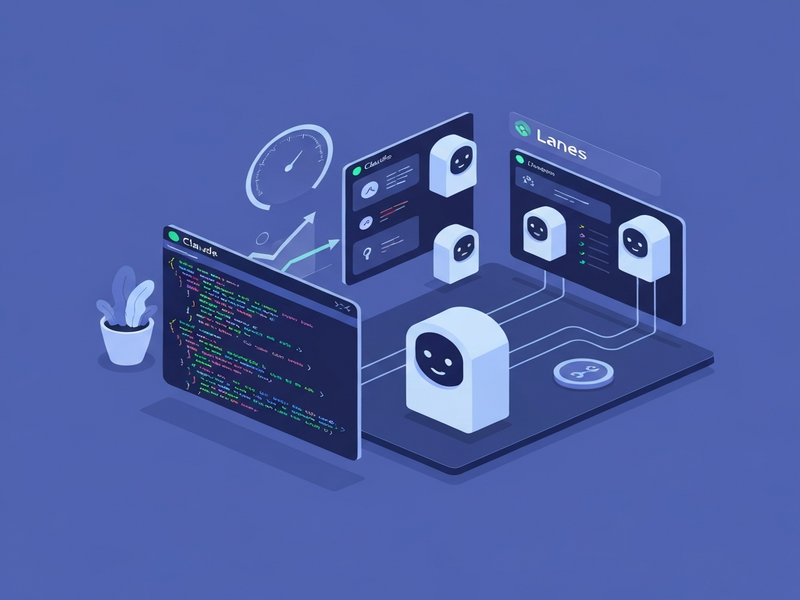
AI‑driven development agents are rapidly replacing traditional IDEs, delivering a step‑function boost in developer productivity by letting engineers think, delegate, and ship code from a single, agent‑centric workspace.
Why the IDE is Losing Ground to AI Development Agents
Over the past year, software teams have begun to abandon heavyweight IDEs such as VS Code, PyCharm, and even newer AI‑enhanced editors. The catalyst? Claude Code—an AI development agent that lives in the terminal and can generate, refactor, and test code on demand. This shift is not a fleeting experiment; it reflects a broader industry move toward agentic development environments (ADEs) that treat the developer’s mind as the primary interface, while the AI handles the mechanical details.
According to a recent analysis on Lanes’ blog, engineers who switched to Claude Code reported a 3‑to‑5× reduction in time‑to‑feature, with some teams shipping in hours what previously took days. The trend is gaining momentum across startups, SMBs, and enterprises alike, reshaping how we think about IDE alternatives and AI‑driven coding.
Claude Code Agents: The Core of the Productivity Surge
Claude Code, built by Anthropic, is more than a code‑completion tool; it is an autonomous agent that can:
- Interpret high‑level requirements and generate full‑stack implementations.
- Write unit tests, run CI pipelines, and self‑debug based on feedback.
- Interact with external services (e.g., OpenAI ChatGPT integration) to enrich its knowledge base.
Developers who adopt Claude Code often describe the experience as “super‑powered” rather than “incrementally better.” The agent’s ability to produce production‑ready code from a single prompt eliminates the repetitive typing and navigation that dominate traditional IDE workflows.
“When I first switched to Claude Code, I went from shipping features in days to shipping them in hours. The agent feels like a teammate that never sleeps.” – Senior Engineer, Tech Startup
Key Productivity Gains
| Metric | Typical Improvement |
|---|---|
| Feature Development Cycle | 70‑90% faster |
| Bug Resolution Time | 50% reduction |
| Test Coverage Automation | Automated 80% of unit tests |
The Hidden Bottleneck: Managing Multiple Agents
While a single Claude Code instance can dramatically accelerate work, real‑world projects often require multiple agents running in parallel—one for backend services, another for UI scaffolding, a third for data pipelines, and so on. This concurrency introduces new challenges:
- Context Overload: Each agent maintains its own context window. When five or more agents operate simultaneously, developers struggle to keep track of which agent is editing which file.
- Resource Contention: Agents may attempt to modify the same module, leading to merge conflicts that are harder to resolve without a visual diff tool.
- Orchestration Fatigue: The human brain becomes the limiting factor, spending more time coordinating agents than writing code.
These pain points are rarely discussed in promotional material, yet they represent the next frontier for AI‑driven development. Without a unifying layer, the promise of “AI‑driven coding” can quickly devolve into a chaotic swarm of bots.
Lanes: A Unified Platform for Agentic Development
Lanes was created precisely to solve the orchestration problem. It acts as a “control tower” that aggregates the output of multiple AI agents, presents a coherent view of the codebase, and enforces guardrails such as linting, testing, and CI pipelines.
Key features include:
- Single Workspace: All agents operate within a shared context, eliminating duplicate file trees.
- Integrated CI/CD: Automated testing runs after each agent commit, ensuring that code quality is maintained without manual review.
- Cross‑Tool Connectivity: Lanes can pull in tickets from Linear, messages from Slack, and documentation from Confluence, creating a seamless workflow.
Why Lanes Complements the UBOS Ecosystem
UBOS provides a robust Enterprise AI platform that empowers developers to build, deploy, and scale AI‑enhanced applications. When paired with Lanes, the combined stack offers a truly end‑to‑end ADE:
- Use the Web app editor on UBOS to prototype UI components that Lanes agents can later flesh out.
- Leverage the Workflow automation studio to define custom triggers for agent actions (e.g., “run tests after every AI commit”).
- Integrate Chroma DB integration for vector‑based search across code snippets and documentation.
- Enhance voice‑based interactions with the ElevenLabs AI voice integration, allowing developers to issue spoken commands to Lanes agents.
Practical Use Cases: From Startup to Enterprise
Below are three scenarios that illustrate how teams can harness AI development agents, Lanes, and UBOS together.
1. Startup Rapid Prototyping
A fintech startup needs to launch an MVP in six weeks. Using the UBOS for startups package, the team spins up a Claude Code agent to generate core payment APIs. Lanes orchestrates the agents, automatically runs the UBOS templates for quick start, and pushes the code to a CI pipeline. Within days, the product is ready for beta testing.
2. SMB Scaling Operations
An e‑commerce SMB wants to add AI‑powered product recommendations. By leveraging UBOS solutions for SMBs, the dev team activates an AI recommendation engine template (hypothetical). Lanes coordinates the recommendation agent with the existing catalog service, while the AI marketing agents personalize email campaigns.
3. Enterprise‑Level Data Governance
A multinational corporation must enforce strict data compliance. Using the Enterprise AI platform by UBOS, they deploy a suite of agents that scan code for GDPR violations. Lanes aggregates findings, creates tickets in the internal tracker, and triggers remediation scripts. The UBOS pricing plans ensure the solution scales cost‑effectively.
Accelerate Development with UBOS Template Marketplace
UBOS’s marketplace offers ready‑made AI applications that can be plugged into Lanes with a single click. Some standout templates include:
- AI SEO Analyzer – instantly audits website SEO health.
- AI Article Copywriter – generates SEO‑optimized blog posts.
- AI Chatbot template – deploys a conversational agent in minutes.
- AI Email Marketing – crafts personalized email sequences.
- AI Video Generator – creates short promotional videos from scripts.
These templates reduce the “time‑to‑agent” from weeks to hours, allowing developers to focus on business logic rather than boilerplate code.
The Future of Development: From IDEs to Agentic Environments
The rise of AI development agents signals the end of the era where the IDE is the central hub of a developer’s day. Instead, the next generation of software creation will revolve around agentic development environments—platforms where human intent is captured once, and AI agents execute the rest.
Key trends to watch:
- Context‑aware orchestration: Tools like Lanes will become the default layer for managing multi‑agent workflows.
- Zero‑code integration: Marketplace templates will enable non‑technical stakeholders to spin up AI services without writing a line of code.
- Continuous guardrails: Automated testing, linting, and security scans will be baked into every agent’s lifecycle.
Take the Next Step
If you’re ready to move beyond traditional IDEs and explore the power of AI development agents, start with the UBOS homepage to discover the full suite of tools. For a deeper dive into how Lanes can unify your agents, read the original analysis on why the IDE is dead and consider joining the UBOS partner program to get early access to upcoming features.
© 2026 UBOS Technologies. All rights reserved.
Andrii Bidochko
CTO UBOS
Andrii Bidochko is an AI entrepreneur and researcher focused on AI agents, reinforcement learning, and autonomous systems. He writes about the technologies shaping the future of machine intelligence, from frontier models and agent architectures to real-world AI applications.