

- Updated: February 3, 2026
- 6 min read
Space Data Centers: Transforming Edge Computing and Cloud Services
Space data centers are orbital facilities that host computing, storage, and AI workloads in low‑Earth orbit, delivering ultra‑low latency, unparalleled scalability, and resilience against terrestrial disruptions.
Why Space‑Based Infrastructure Is the Next Frontier
Imagine a data hub that never experiences power outages, earthquakes, or geopolitical shutdowns. That vision is becoming reality as engineers and cloud providers explore space data centers—satellite‑borne servers that operate beyond the atmosphere. For technology enthusiasts, data‑center professionals, and AI researchers, this emerging paradigm promises to reshape cloud computing, AI model training, and global connectivity.
Overview of Space Data Centers and Their Advantages
Space data centers differ from traditional ground‑based facilities in three fundamental ways:
- Latency Reduction: By positioning compute nodes in low‑Earth orbit (LEO), data travels a fraction of the distance compared to trans‑continental fiber, cutting round‑trip times to under 10 ms for many regions.
- Scalability & Redundancy: Satellite constellations can be expanded incrementally, offering near‑infinite capacity while providing built‑in redundancy against single‑point failures.
- Environmental Resilience: Space‑based platforms are immune to terrestrial disasters, power grid failures, and political restrictions, ensuring continuous service.
These benefits translate into concrete use cases such as real‑time AI inference for autonomous vehicles, global edge computing for IoT, and secure data storage for mission‑critical applications.
Key Technologies and Innovations Driving the Concept
1. Radiation‑Hardened Hardware
Operating beyond Earth’s protective magnetosphere exposes electronics to high‑energy particles. Manufacturers now produce Chroma DB integration‑compatible storage modules and processors built with silicon‑on‑insulator (SOI) technology, which can tolerate radiation doses far beyond commercial standards.
2. Inter‑Satellite Laser Links
Laser‑based optical communication enables terabit‑per‑second data exchange between satellites, forming a mesh network that rivals terrestrial fiber. This mesh reduces bottlenecks and supports dynamic workload migration across the constellation.
3. AI‑Driven Orchestration
Intelligent orchestration layers allocate compute tasks based on real‑time telemetry, power availability, and latency requirements. For example, the AI solutions suite on UBOS provides predictive scaling algorithms that automatically shift AI model training to the most optimal satellite node.
4. Advanced Power Systems
High‑efficiency multi‑junction solar panels coupled with next‑generation battery technology supply continuous power, even during eclipse periods. Energy‑aware scheduling ensures workloads run when solar input peaks, minimizing reliance on onboard reserves.
5. Vacuum‑Based Thermal Management
Space’s natural vacuum acts as an excellent heat sink. Engineers use heat‑pipe radiators that radiate excess thermal energy directly into space, eliminating the need for bulky cooling infrastructure typical of terrestrial data centers.
6. Seamless Integration with Existing Cloud Ecosystems
Through APIs such as the OpenAI ChatGPT integration, developers can extend their cloud workloads to space‑based nodes without rewriting code, enabling hybrid deployments that blend ground and orbital resources.
Potential Industry Impact and Future Outlook
Space data centers are poised to disrupt several sectors. Below is a MECE‑structured snapshot of the most compelling opportunities:
A. Artificial Intelligence & Machine Learning
- Accelerated Model Training: Massive parallelism across a satellite fleet can reduce training times for large language models.
- Edge AI Inference: Real‑time processing for autonomous drones, maritime vessels, and remote sensors without relying on distant ground data centers.
B. Global Connectivity & Edge Computing
- Low‑Latency Content Delivery: Video streaming and gaming services can serve users from the nearest orbital node, bypassing congested terrestrial networks.
- IoT Aggregation: Billions of devices can offload compute to nearby space nodes, reducing bandwidth consumption on ground networks.
C. Disaster Recovery & Business Continuity
- Resilient Backups: Critical data mirrored in orbit remains accessible even when Earth‑based infrastructure is compromised.
- Rapid Re‑deployment: In the aftermath of natural disasters, services can be re‑instantiated from space without waiting for ground repairs.
D. Scientific Research & Space Exploration
- On‑Orbit Data Processing: Satellite imagery, climate models, and astrophysics data can be processed in situ, reducing downlink volume.
- Support for Deep‑Space Missions: Space‑based compute can assist navigation and autonomous decision‑making for interplanetary probes.
Analysts predict that by 2035, a network of 1,000 LEO data nodes could provide up to 10 exabytes of storage and exaflop‑scale compute, rivaling today’s largest terrestrial hyperscale facilities.
Illustration of the Concept
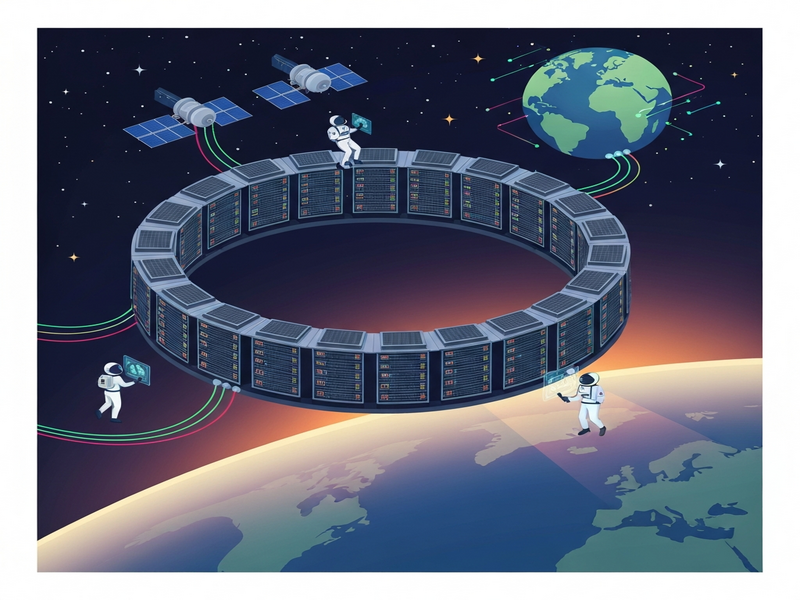
The diagram visualizes a constellation of orbital servers linked by laser interconnects, powered by solar arrays, and managed through AI‑driven orchestration.
Further Reading
For a deeper dive into the technical foundations and market forecasts, see the original analysis published by CIVAI:
Space Data Centers – The Future of Cloud Computing
Explore UBOS Solutions for Space‑Enabled AI
UBOS offers a suite of tools that can seamlessly extend your workloads to orbital environments:
- UBOS platform overview – A unified console for managing hybrid cloud resources, including satellite nodes.
- Enterprise AI platform by UBOS – Scalable AI pipelines that can offload compute to space‑based clusters.
- Workflow automation studio – Drag‑and‑drop orchestration for multi‑region and orbital workloads.
- Web app editor on UBOS – Build and deploy web interfaces that interact with space data centers in minutes.
- AI marketing agents – Automate campaign analytics using low‑latency edge compute.
- UBOS partner program – Collaborate with UBOS to integrate your satellite services into a global marketplace.
- UBOS pricing plans – Transparent pricing models for hybrid and space‑based deployments.
- UBOS templates for quick start – Pre‑built templates such as the AI SEO Analyzer that can be adapted for orbital data processing.
- UBOS for startups – Accelerate innovation with low‑cost access to space‑grade compute.
- UBOS solutions for SMBs – Bring enterprise‑level resilience to small and medium businesses.
- UBOS portfolio examples – Real‑world case studies of AI workloads running on hybrid infrastructures.
- About UBOS – Learn about the team pioneering the convergence of AI and space tech.
- ChatGPT and Telegram integration – Deploy conversational agents that operate from orbit and reach users worldwide.
- Telegram integration on UBOS – Real‑time alerts from your space data center delivered directly to your messaging app.
- ElevenLabs AI voice integration – Add natural‑language voice interfaces to orbital services.
- AI Video Generator – Create video content at the edge of space for ultra‑low‑latency streaming.
- AI Article Copywriter – Generate documentation for space‑based services on the fly.
- AI YouTube Comment Analysis tool – Process massive comment streams using orbital compute for instant sentiment insights.
- AI Image Generator – Render high‑resolution graphics directly from space‑based GPUs.
- AI Email Marketing – Personalize campaigns with real‑time data processed in orbit.
Conclusion: Embrace the Sky‑High Future of Cloud Computing
Space data centers are no longer a sci‑fi fantasy; they are an emerging reality that promises to democratize access to ultra‑low‑latency, resilient, and scalable compute. By integrating UBOS’s flexible platform, AI‑driven orchestration, and a growing ecosystem of templates, organizations can experiment today and position themselves for the orbital cloud era of tomorrow.
Ready to launch your workloads into space? Visit the UBOS homepage and start building the next generation of AI‑powered services.
Andrii Bidochko
CTO UBOS
Andrii Bidochko is an AI entrepreneur and researcher focused on AI agents, reinforcement learning, and autonomous systems. He writes about the technologies shaping the future of machine intelligence, from frontier models and agent architectures to real-world AI applications.