

- Updated: March 29, 2026
- 6 min read
Solar Power Wins the Energy Race – UBOS News
Solar Power’s Rapid Global Expansion: Key Facts & Future Outlook
Solar power is now the fastest‑growing source of electricity worldwide, delivering roughly 10 % of global demand in 2025 and projected to surpass 20 % by 2030 if current trends continue.
Why Solar Is the Story of the Decade
Since the turn of the millennium, solar energy has leapt from a niche technology used in remote outposts and calculators to a mainstream power source that powers cities, factories, and electric cars. The DW article on solar power expansion highlights that the sector’s growth has outpaced every other energy source, driven by falling module costs, massive manufacturing scale, and supportive policies across continents.
For sustainability‑focused professionals and tech enthusiasts, understanding the data behind this surge is essential for making informed investment, policy, or product decisions. Below we break down the numbers, regional leaders, cost dynamics, cross‑sector impacts, and the challenges that lie ahead.
Key Facts & Figures on Solar Growth
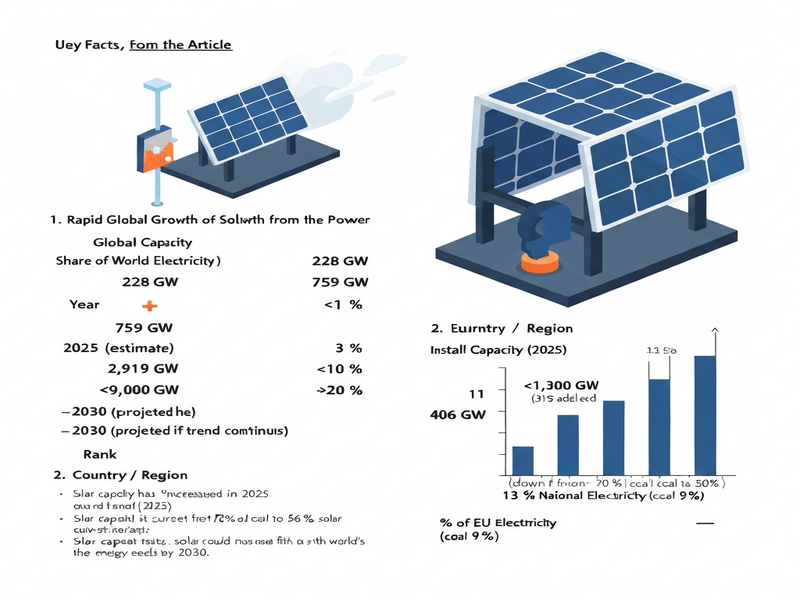
The following table captures the most striking milestones from 2015 to the projected 2030 horizon:
| Year | Global Solar Capacity (GW) | Share of World Electricity |
|---|---|---|
| 2015 | 228 | ~1 % |
| 2020 | 759 | ~3 % |
| 2025 (estimate) | 2,919 | ~10 % |
| 2030 (projection) | ≈9,000 | >20 % |
Key takeaways:
- Solar capacity has increased ~13‑fold from 2015 to 2025.
- The growth curve is exponential; at the current pace, solar could meet a fifth of global electricity demand by 2030.
- Solar already outpaces nuclear (9 % share) and is closing the gap with coal and gas.
Regional Leaders & Cost Trends
China – The Manufacturing Powerhouse
China remains the undisputed leader with an estimated 1,300 GW of installed capacity, including a record 315 GW added in 2025 alone. Over 80 % of the world’s photovoltaic panels are produced in Chinese factories, a factor that drives the steep cost declines seen globally.
Solar now supplies about 11 % of China’s electricity, pushing coal’s share down from 70 % to 56 % in a decade.
European Union – Sun‑Rich Yet Policy‑Driven
The EU’s total solar capacity stands at 406 GW**, delivering roughly **13 %** of the bloc’s electricity. Nations with abundant sunshine—Greece, Cyprus, Spain, and Hungary—each exceed **20 %** solar share, while Germany, despite modest insolation, reaches **18 %** thanks to aggressive feed‑in tariffs and rooftop‑solar incentives.
Germany’s 119 GW of solar installations make it the EU’s single‑country leader.
United States – Growth Amid Policy Shifts
With 267 GW** installed, the United States supplies about **8 %** of its electricity from solar. The sector has surged from 1 % in 2015, even as federal policy faced headwinds under the previous administration.
Emerging Leaders: India, Brazil, Pakistan & South Africa
India’s 136 GW translates to an 8 % share for a population of 1.45 bn. Brazil, Brazil’s renewable mix already hits 88 % of total generation, with solar contributing ~10 % of national electricity. Pakistan and South Africa have leapt from <1 % in 2015 to **20 %** and **10 %** respectively.
Cost Competitiveness – Solar Beats Fossil Fuels
Cost data (2024) shows solar’s levelized cost of electricity (LCOE) as low as €0.01/kWh (≈1 ¢/kWh) in sun‑rich regions, compared with nuclear (14‑49 ¢/kWh), coal (15‑29 ¢/kWh) and natural gas (15‑33 ¢/kWh). Even in Germany, solar sits at 4‑5 ¢/kWh, still cheaper than most conventional sources.
Battery storage adds only 2‑3 ¢/kWh, preserving solar’s cost advantage for night‑time use.
Solar’s Ripple Effect on Electricity, Heating & Transport
Solar’s expansion is reshaping three core energy‑consumption domains:
Electricity Generation
In 2024, 632 GW of new power capacity was added globally; 72 % of that was solar. This shift has already reduced the average grid price in many markets, making rooftop and utility‑scale solar the cheapest option for new capacity.
Heating – The Rise of Solar‑Powered Heat Pumps
Heat‑pump adoption in the EU is accelerating because the electricity that runs them can now be sourced from cheap solar. Households report **>30 %** savings on heating bills when solar powers their heat pumps.
Transport – Solar‑Charged EVs
Electric vehicles (EVs) charged with rooftop solar can cut operating costs by **>80 %** compared with diesel or gasoline, as demonstrated in German case studies. The synergy between solar, EVs, and smart charging creates a virtuous loop that further depresses electricity demand peaks.
“Solar’s cost advantage is no longer a future promise; it is the present reality reshaping how we power homes, factories, and mobility.” – International Energy Agency (IEA)
Future Outlook: Projections, Opportunities, and Hurdles
Analysts now view the 2020 IEA forecast (120 GW added in 2024) as a massive underestimate. The actual 597 GW installed that year was nearly **5×** higher, underscoring the sector’s acceleration.
Projected Capacity by 2030
- ≈9,000 GW global solar capacity → >20 % of world electricity.
- Solar could become the dominant primary energy source within two decades if storage and grid upgrades keep pace.
Key Enablers
- Grid Digitalization: Smart‑charging, demand‑response, and AI‑driven forecasting are essential for matching supply with variable solar output.
- Battery Scale‑Up: Repurposed EV batteries and utility‑scale storage will bridge the night‑time gap.
- Policy Continuity: Long‑term renewable targets and stable incentives sustain investor confidence.
Challenges to Overcome
- Transmission Bottlenecks: Massive new lines are required to move solar power from deserts to load centers.
- Material Supply Chains: While China dominates panel production, geopolitical tensions could affect raw‑material availability.
- Land Use & Environmental Concerns: Large‑scale solar farms must balance ecological impacts with energy goals.
What You Can Do Today
For businesses and developers eager to ride the solar wave, integrating AI‑driven automation can accelerate project delivery, optimize performance, and unlock new revenue streams.
Explore the UBOS platform overview to build custom solar‑monitoring dashboards, or leverage the Workflow automation studio to orchestrate data pipelines from weather APIs to battery‑management systems.
Need a ready‑made solution? Check out the UBOS templates for quick start, such as the AI SEO Analyzer to fine‑tune your solar‑project website, or the AI Article Copywriter for generating market‑ready content at scale.
Looking to embed conversational assistants that can answer solar‑related queries in real time? The ChatGPT and Telegram integration lets you field stakeholder questions instantly, while the OpenAI ChatGPT integration powers natural‑language analytics on production data.
For voice‑enabled monitoring, pair the ElevenLabs AI voice integration with your solar‑farm SCADA system, delivering audible alerts and status updates.
Ready to partner? Join the UBOS partner program and co‑create next‑generation renewable‑energy solutions.
Whether you’re a startup, an SMB, or an enterprise, the Enterprise AI platform by UBOS offers the scalability you need to manage megawatt‑scale solar assets.
Take the first step today: visit the UBOS homepage and discover how AI can accelerate the clean‑energy transition.
Conclusion
Solar power’s meteoric rise—from 228 GW in 2015 to a projected 9,000 GW by 2030—signals a decisive shift in the global energy landscape. The technology is now the cheapest source of electricity, reshaping electricity markets, heating, and transport while driving unprecedented opportunities for AI‑enabled automation and data analytics.
Realizing the full potential of solar will require coordinated action: massive grid upgrades, scalable storage, and continued policy support. By leveraging platforms like Web app editor on UBOS and the rich ecosystem of AI integrations, businesses can turn solar data into actionable intelligence, accelerate deployment, and stay ahead in the clean‑energy race.
Stay informed, act now, and be part of the solar revolution that will power the planet for generations to come.
Andrii Bidochko
CTO UBOS
Andrii Bidochko is an AI entrepreneur and researcher focused on AI agents, reinforcement learning, and autonomous systems. He writes about the technologies shaping the future of machine intelligence, from frontier models and agent architectures to real-world AI applications.