

- Updated: February 18, 2026
- 5 min read
Sarvam Unveils 30B and 105B Open‑Source AI Models, Boosting India’s AI Landscape
Sarvam has just released two new open‑source large language models—30 billion and 105 billion parameters—plus dedicated text‑to‑speech, speech‑to‑text, and vision models, positioning India at the forefront of affordable, multilingual AI.
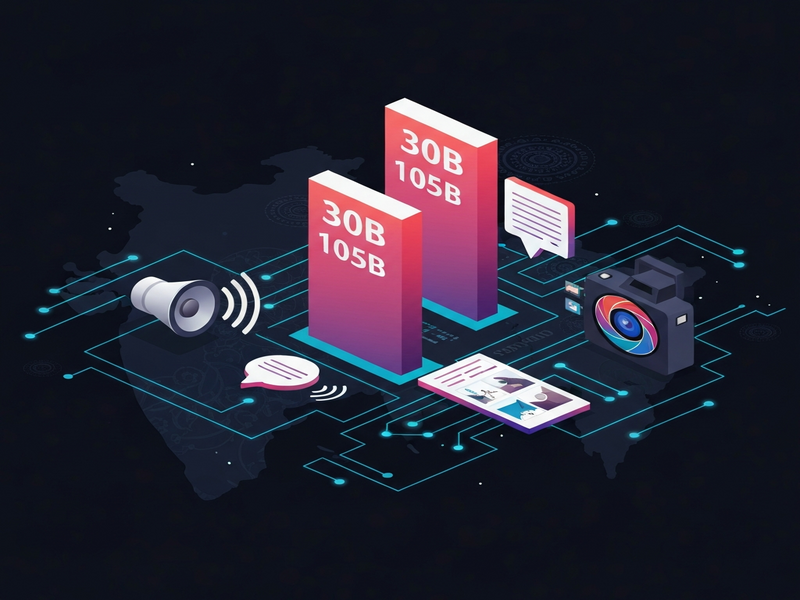
The announcement, made at the India AI Impact Summit in New Delhi, was covered by TechCrunch, which highlighted Sarvam’s bold bet on open‑source AI as a viable alternative to the dominant U.S. and Chinese offerings.
Sarvam’s New Model Line‑up: 30B and 105B Parameters
Sarvam, founded in 2023, has quickly become a flagship AI startup in India. After the modest success of its 2‑billion‑parameter Sarvam‑1 model, the company accelerated development with two flagship models:
- 30‑billion‑parameter model – optimized for real‑time conversational AI with a 32,000‑token context window.
- 105‑billion‑parameter model – designed for deep reasoning tasks, supporting a 128,000‑token context window.
Both models employ a mixture‑of‑experts (MoE) architecture, activating only a subset of parameters per inference, which dramatically cuts compute costs while preserving performance.
30B Model – The Conversational Workhorse
The 30B model targets applications that demand low latency and high throughput, such as voice assistants, chatbots, and customer‑support bots. Key specifications include:
| Feature | Specification |
|---|---|
| Parameters | 30 B |
| Context Window | 32,000 tokens |
| Architecture | Mixture‑of‑Experts (8 experts active per request) |
| Training Data | ~16 trillion tokens, multilingual (English + 12 Indian languages) |
The model’s token limit enables it to hold entire conversation histories, making it ideal for “always‑on” assistants that remember context across multiple turns.
105B Model – The Reasoning Giant
Designed for enterprise‑grade workloads, the 105B model excels at complex, multi‑step reasoning, code generation, and large‑scale document analysis. Highlights include:
- 128,000‑token context window – supports processing of long documents, legal contracts, and research papers in a single pass.
- Training corpus – trillions of tokens spanning 20+ Indian languages, technical manuals, and open‑source code repositories.
- Performance – benchmarks place it on par with OpenAI’s GPT‑OSS‑120B and Alibaba’s Qwen‑3‑Next‑80B while consuming ~30 % less GPU hours per inference thanks to MoE.
Sarvam plans to release the model under an Apache‑2.0 license, inviting the global community to fine‑tune and extend its capabilities.
Beyond Text: Speech & Vision Extensions
To complement the language models, Sarvam introduced three specialized services:
- Text‑to‑Speech (TTS) – a neural vocoder trained on 12 Indian languages, delivering natural prosody and low latency for voice‑enabled apps.
- Speech‑to‑Text (STT) – an automatic speech recognition engine that achieves ≤5 % word error rate on benchmark datasets for Hindi, Tamil, and Bengali.
- Vision Model – a multimodal encoder that extracts structured data from scanned documents, invoices, and handwritten forms, enabling end‑to‑end AI pipelines.
All three services share the same MoE backbone, allowing developers to spin up a unified AI stack with consistent latency and cost profiles.
Why This Matters for Open‑Source AI and India
Open‑source AI has traditionally lagged behind proprietary offerings due to limited compute resources and fragmented data. Sarvam’s launch changes that narrative in several ways:
- Democratization of Power – By open‑sourcing 30B and 105B models, Indian developers can build sophisticated applications without paying for expensive API calls.
- Multilingual Focus – Training data includes a broad spectrum of Indian languages, addressing a critical gap left by Western‑centric models.
- Cost‑Effective MoE Architecture – The mixture‑of‑experts design reduces inference cost by up to 70 % compared to dense models of similar size.
- Government Backing – The models were trained on infrastructure provided by the IndiaAI Mission and Yotta data centers, showcasing public‑private synergy.
For a deeper dive into the open‑source landscape, see our open‑source LLM hub where we track the latest community‑driven projects.
Funding, Partnerships, and the Road Ahead
Sarvam has raised over $50 million from Lightspeed Venture Partners, Khosla Ventures, and Peak XV Partners (formerly Sequoia Capital India). The fresh capital will fund:
- Scaling the MoE infrastructure to support 200 B‑parameter experiments.
- Building domain‑specific extensions (e.g., legal‑AI, healthcare‑AI).
- Expanding the multilingual corpus to cover 30+ regional languages.
- Launching “Sarvam for Work,” a suite of enterprise tools for code assistance, document summarization, and AI‑augmented workflows.
Co‑founder Pratyush Kumar emphasized a “task‑first” scaling philosophy: “We will only grow model size when a concrete use‑case demands it, ensuring that every extra parameter translates into real‑world value.”
How UBOS Can Accelerate Your Sarvam‑Powered Projects
Developers looking to embed Sarvam’s models into production can leverage the UBOS platform overview, which offers:
- One‑click deployment of open‑source LLMs via the Workflow automation studio.
- Pre‑built connectors for the Telegram integration on UBOS, enabling rapid creation of voice‑enabled bots powered by Sarvam’s TTS and STT services.
- AI marketing agents that can automatically generate multilingual copy using the AI marketing agents suite.
By combining Sarvam’s open‑source models with UBOS’s low‑code environment, businesses can slash time‑to‑market from months to days.
What’s Next for You?
If you’re an AI enthusiast, startup founder, or tech journalist, now is the perfect moment to explore these models. Visit our AI news hub for the latest updates, tutorials, and community showcases.
Ready to experiment? Grab a pre‑configured template from the UBOS templates for quick start and spin up a multilingual chatbot in under an hour.
Stay tuned—Sarvam’s roadmap promises even larger models, tighter integration with Indian language corpora, and a thriving ecosystem of open‑source contributors.
Andrii Bidochko
CTO UBOS
Andrii Bidochko is an AI entrepreneur and researcher focused on AI agents, reinforcement learning, and autonomous systems. He writes about the technologies shaping the future of machine intelligence, from frontier models and agent architectures to real-world AI applications.