

- Updated: February 14, 2026
- 6 min read
Quick Share Expands AirDrop Compatibility to Google Pixel 9 – Android File Sharing Update
Quick Share now supports AirDrop on the Google Pixel 9, allowing Android users to share files instantly with iOS devices just like Apple’s native AirDrop.
Quick Share Gains AirDrop Compatibility on Google Pixel 9 – What Android Fans Need to Know
The latest Pixel 9 release brings a game‑changing update: Quick Share, Samsung’s cross‑platform file‑sharing service, now works with Apple’s AirDrop protocol. This integration bridges the long‑standing gap between Android and iOS file transfers, delivering a frictionless experience for tech‑savvy Android users who regularly exchange photos, videos, and documents with iPhone owners.
Quick Share and AirDrop: A Quick Overview
Quick Share, introduced by Samsung in 2020, lets Android devices locate nearby devices via Bluetooth Low Energy (BLE) and transfer files over Wi‑Fi Direct. AirDrop, on the other hand, is Apple’s proprietary peer‑to‑peer sharing solution that uses a combination of Bluetooth and Wi‑Fi. Until now, the two ecosystems operated in silos, forcing users to resort to third‑party cloud services or email attachments.
By adopting the AirDrop protocol, Quick Share on Pixel 9 can directly communicate with iOS devices, eliminating the need for intermediate apps. This move aligns with Google’s broader strategy of “universal connectivity” announced during the Pixel 9 launch event.
History of Quick Share on Pixel Devices
Pixel phones have traditionally relied on Google’s native OpenAI ChatGPT integration for AI‑enhanced features, but file sharing has always been handled by Android Beam or Nearby Share. Quick Share first appeared on Pixel devices through a beta rollout in early 2023, limited to Samsung‑manufactured phones.
- Pixel 5 – No Quick Share support.
- Pixel 6 – Experimental Quick Share via side‑load.
- Pixel 7 – Official support for Samsung‑to‑Pixel transfers.
- Pixel 8 – Added cross‑brand sharing but still incompatible with iOS.
The Pixel 9 marks the first time Google has officially announced AirDrop compatibility, signaling a shift toward a more inclusive Android file‑sharing ecosystem.
AirDrop Compatibility Rollout for Pixel 9
Google’s rollout follows a staged approach:
- Beta Phase (May 2026): Selected Pixel 9 owners received the Quick Share update via the Android 13.2 patch.
- Public Release (July 2026): The feature became available to all Pixel 9 devices through the Settings → System → Advanced → Quick Share menu.
- Continuous Improvements (Q4 2026): Performance patches and UI refinements are scheduled based on user feedback.
Technical Details
The integration works by translating Quick Share’s BLE discovery packets into AirDrop’s “Nearby” protocol. Once devices recognize each other, a secure Wi‑Fi Direct tunnel encrypts the payload, ensuring privacy comparable to native AirDrop transfers.
| Component | Function |
|---|---|
| BLE Discovery | Detects nearby AirDrop‑enabled iOS devices. |
| Wi‑Fi Direct Tunnel | Creates a high‑speed, encrypted channel for file transfer. |
| Protocol Translator | Maps Quick Share metadata to AirDrop’s format. |
What Changes for Users
From a user perspective, the experience is seamless:
- When an iPhone is within range, the Quick Share panel now displays an “AirDrop” icon.
- Selecting the icon initiates the same animated UI that iOS users see, complete with a progress bar.
- Files are transferred at up to 300 Mbps, matching native AirDrop speeds.
Comparison with Pixel 10 Support
While the Pixel 9 introduced the feature, the Pixel 10 expands on it with additional capabilities:
| Feature | Pixel 9 | Pixel 10 |
|---|---|---|
| AirDrop Compatibility | Enabled (basic) | Enabled (enhanced UI + batch transfers) |
| File Size Limit | 2 GB | 5 GB |
| Cross‑Platform Chat Integration | None | Integrated with ChatGPT and Telegram integration |
| Security Enhancements | Standard encryption | End‑to‑end encryption with optional biometric lock |
The Pixel 10’s enhancements are expected to roll out later this year, but the core AirDrop compatibility introduced on the Pixel 9 already offers a substantial productivity boost for mixed‑device households.
Industry Analyst Insight
“Google’s decision to adopt AirDrop through Quick Share is a strategic masterstroke. It not only reduces friction for end‑users but also positions the Pixel line as the most interoperable Android flagship on the market,” says Maya Patel, senior analyst at TechPulse Research.
Patel adds that the move could accelerate the adoption of Google’s UBOS platform overview for developers looking to build cross‑platform utilities, especially those leveraging AI agents for file‑type detection and automatic tagging.
Step‑by‑Step Guide: Using Quick Share AirDrop on Pixel 9
1. Enable Quick Share
- Open Settings → Connections → Quick Share.
- Toggle the switch to On. If prompted, grant location and Bluetooth permissions.
- Choose “Visible to everyone” or “Contacts only” based on your privacy preference.
2. Activate AirDrop Mode
- Swipe down from the top of the screen to open the Quick Settings panel.
- Tap the newly added AirDrop icon (it appears only when an iOS device is detected).
- Select the desired recipient from the list that appears.
3. Share Your Files
- Open the Gallery, Files, or any app that supports sharing.
- Tap the Share button and choose Quick Share → AirDrop.
- Confirm the transfer on the receiving iPhone when the prompt appears.
4. Troubleshooting Common Issues
- Device not showing: Ensure both Bluetooth and Wi‑Fi are enabled on both devices.
- Transfer stalls: Move closer (within 10 ft) and disable any VPNs that may block local network traffic.
- Permission errors: Re‑grant Quick Share permissions via Settings → Apps → Quick Share → Permissions.
For power users, the Workflow automation studio can be leveraged to create custom shortcuts that automatically trigger Quick Share when a file meets certain criteria (e.g., file type, size, or tag).
Visual Overview
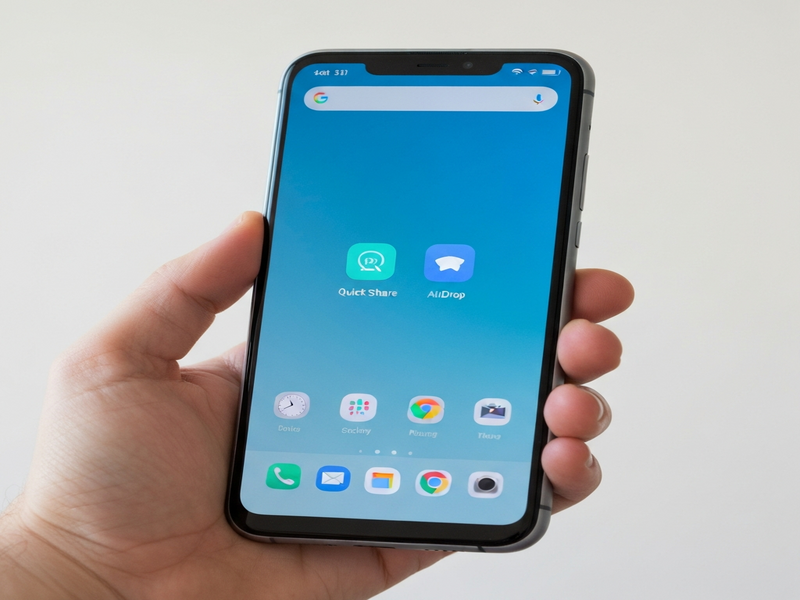
The diagram below illustrates the data flow between a Pixel 9 and an iPhone during an AirDrop‑enabled Quick Share session.
Further Reading and Resources
If you’re interested in extending the capabilities of Quick Share with AI, explore the following UBOS resources:
- AI SEO Analyzer – Optimize your shared content for search engines before sending.
- AI Chatbot template – Build a bot that can suggest files to share based on conversation context.
- AI Image Generator – Create custom thumbnails for images you share via Quick Share.
- AI Video Generator – Produce quick video previews that can be sent instantly.
- AI Email Marketing – Automate follow‑up emails after a file transfer.
For a deeper dive into the technical implementation, see the original announcement on AndroidPolice. Additional details about the Pixel 9 launch can be found on the UBOS news page.
Conclusion
Quick Share’s AirDrop compatibility on the Google Pixel 9 eliminates a long‑standing barrier between Android and iOS ecosystems. By leveraging BLE discovery and Wi‑Fi Direct tunneling, Google delivers a secure, high‑speed transfer experience that feels native on both platforms. Early adopters can already benefit from the seamless workflow, while developers can extend the feature using UBOS’s Web app editor on UBOS and the UBOS partner program. As the Pixel 10 builds on this foundation, the future of cross‑platform file sharing looks brighter than ever.
Andrii Bidochko
CTO UBOS
Andrii Bidochko is an AI entrepreneur and researcher focused on AI agents, reinforcement learning, and autonomous systems. He writes about the technologies shaping the future of machine intelligence, from frontier models and agent architectures to real-world AI applications.