

- Updated: March 13, 2026
- 7 min read
Productivity Paradox and Capital Lockup: Unlocking Growth with UBOS
The Productivity Paradox & Capital Lockup: Why Tech Gains Aren’t Making Everyone Richer
The productivity paradox and capital lockup describe why soaring technological efficiency has not translated into broader wealth growth, leaving most households feeling financially squeezed despite record‑breaking AI advances.
Imagine a world where computers cost 92 % less than they did two decades ago, streaming services deliver every movie for a few dollars, and a single click can order groceries to your doorstep within hours. Yet, real GDP growth has slowed from 4.5 % in the 1960s to just 2.4 % in the 2010s, and the median American household reports tighter budgets. Read the original deep‑dive here.
This article unpacks the paradox, explains the capital lockup mechanism, and shows how modern AI platforms—especially UBOS—are uniquely positioned to break the cycle.
1. Understanding the Productivity Paradox
The paradox rests on two seemingly contradictory observations:
- Technology dramatically boosts output per hour.
- Overall economic growth and household incomes have plateaued.
1.1 Why Efficiency Doesn’t Expand the Consumption Pie
Consumer spending as a share of U.S. GDP rose modestly from 61 % in 1980 to 68 % today and has essentially flat‑lined since 2010. Physical limits—time, housing, biological needs—cap the total amount people can consume. When Netflix replaced cable, households didn’t spend more on entertainment; they simply shifted the margin from cable providers to streaming platforms. The same pattern repeats with Uber vs. taxis, Spotify vs. album purchases, and Amazon vs. brick‑and‑mortar retailers.
1.2 Money Flow: From Labor to Capital
A $100 book purchase in 2000 allocated roughly 60 % to labor (store staff, authors) and 30 % to capital (owner profit, rent). Today, the same $100 on Amazon distributes about 25 % to labor and 55 % to capital. Across the economy, the labor share of GDP fell from 64 % in 1980 to 58 % now—an annual shift of roughly $1.7 trillion that now enriches shareholders rather than workers.
1.3 Why Prices Aren’t Falling
Four mechanisms keep consumer prices from reflecting productivity gains:
- Monopoly Power: Dominant platforms (Amazon, Google) face little competitive pressure to pass savings to consumers.
- Baumol’s Cost Disease: Goods become cheaper, but services (healthcare, education, housing) become more expensive, offsetting deflation.
- Asset‑Based Gains: Profits flow into stocks and real estate, inflating asset prices while wages stay flat.
- Monetary Expansion: Central banks inject liquidity to avoid deflation, neutralizing price‑cutting pressure.
2. The Capital Lockup Problem
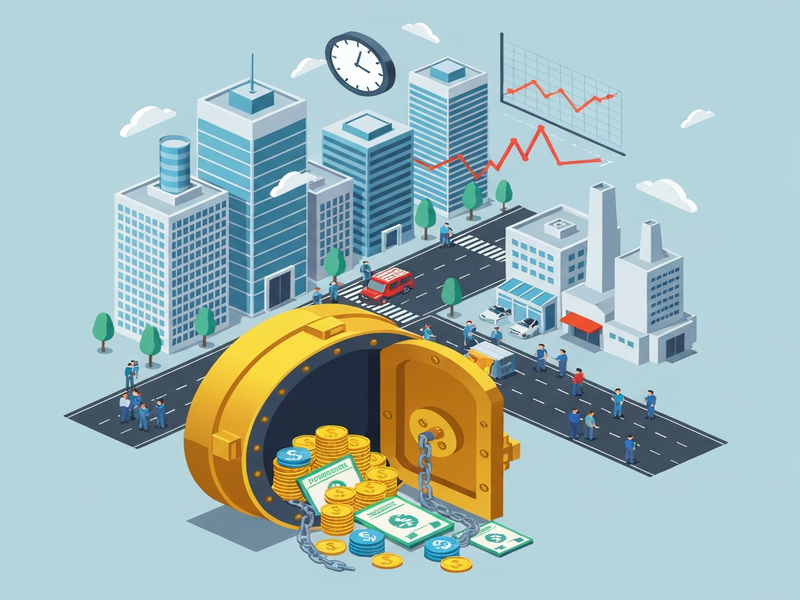
When productivity gains accrue to capital, firms hoard cash in treasuries, buy back shares, or invest in capital‑intensive infrastructure that creates few jobs. This “lockup” creates a feedback loop that throttles broader economic dynamism.
2.1 Where the Money Goes
- Stock Buybacks: Companies return cash to shareholders, inflating equity prices without expanding payrolls.
- Data‑Center Expansion: Tech giants plan $350 billion in capex for 2025, a spend that yields high‑margin assets but limited labor.
- Government Bonds & Cash Reserves: Safe‑haven assets that generate modest returns but do not spur consumption.
2.2 The Multiplier Breakdown
In the manufacturing era, each $200,000 of capital created roughly one new job. Modern AI‑driven infrastructure can consume the same amount while creating far fewer positions, eroding the traditional Keynesian multiplier that turns wages into consumer demand.
2.3 Macro‑Economic Consequences
The result is a secular stagnation trap:
- Higher productivity → higher corporate profit → lower labor share.
- Lower wages → weaker consumer demand.
- Weaker demand → fewer productive investment opportunities.
- Capital recycles into financial assets → wealth concentration.
- Stagnant GDP growth (≈2 % annually) persists despite technological breakthroughs.
3. What This Means for Wealth Distribution and Economic Growth
The paradox and lockup together reshape the economic landscape in three critical ways:
3.1 Rising Inequality
Asset inflation benefits shareholders and high‑skill tech workers, while middle‑class wages stagnate. The Gini coefficient has nudged upward each decade since the 1990s, reflecting a widening wealth gap.
3.2 Slower Aggregate Demand
With a smaller share of income flowing to the majority, consumption‑driven sectors (retail, hospitality) experience muted growth, reinforcing the low‑growth equilibrium.
3.3 Policy & Innovation Pressure
Governments face a dilemma: stimulate demand without inflating debt, or encourage competition to break platform monopolies. Simultaneously, innovators must design business models that share AI‑generated surplus more broadly.
4. Leveraging UBOS to Unlock Capital and Democratize Productivity
The UBOS platform overview offers a low‑code, AI‑first environment that lets businesses of any size build, deploy, and monetize intelligent applications without massive upfront capital. Below are concrete ways UBOS addresses the paradox:
4.1 AI‑Powered Automation That Expands the Consumption Pie
By automating repetitive tasks, UBOS frees human talent for higher‑value activities, effectively increasing the “real” consumption capacity. The Workflow automation studio lets teams create end‑to‑end processes in minutes, reducing operational costs and allowing savings to be redirected toward employee benefits or new product lines.
4.2 Democratized AI Marketplaces
UBOS’s UBOS templates for quick start and its thriving UBOS portfolio examples empower startups and SMBs to launch AI‑driven services—like the AI SEO Analyzer or the AI Article Copywriter—without the massive R&D budgets of the tech giants. This spreads productivity gains across the economy.
4.3 Integrated AI Agents for Revenue Diversification
The AI marketing agents can run hyper‑personalized campaigns that boost conversion rates, turning efficiency into top‑line growth rather than just margin expansion. Companies can then reinvest profits into hiring, R&D, or community initiatives.
4.4 Seamless Third‑Party Integrations
UBOS connects directly to leading AI services:
- OpenAI ChatGPT integration for conversational interfaces.
- Chroma DB integration for vector search.
- ElevenLabs AI voice integration to add natural‑sounding speech.
- Telegram integration on UBOS for real‑time notifications.
- ChatGPT and Telegram integration to build interactive bots.
4.5 Partner Ecosystem and Pricing Transparency
The UBOS partner program encourages agencies and consultants to co‑create solutions, spreading the economic upside. Meanwhile, the UBOS pricing plans are subscription‑based, avoiding large capital expenditures that lock up cash.
4.6 Real‑World Use Cases from the Template Marketplace
Below are a few standout templates that illustrate how UBOS turns productivity into profit:
- Talk with Claude AI app – a conversational assistant that can be monetized via subscription.
- Your Speaking Avatar template – creates personalized video content for marketing agencies.
- Before-After-Bridge copywriting template – accelerates ad copy creation, increasing agency billable hours.
- AI YouTube Comment Analysis tool – offers creators data‑driven insights as a SaaS product.
- Image to Text AI service – enables niche OCR SaaS for legal and medical firms.
- AI Survey Generator – helps market researchers launch paid surveys faster.
- Web Scraping with Generative AI – a data‑collection service for fintech startups.
- AIDA Marketing Template – boosts conversion rates for e‑commerce sites.
- Elevate Your Brand with AI – a branding suite that can be sold as a retainer.
- AI Video Generator – creates short ads for SMBs on a per‑video fee.
By lowering the barrier to AI‑driven productization, UBOS helps redistribute the productivity surplus from capital‑heavy tech giants to a broader base of entrepreneurs, freelancers, and midsize firms.
5. Looking Ahead – Policy, Innovation, and the Role of AI
Solving the productivity paradox will require coordinated action:
- Antitrust Enforcement: Breaking platform monopolies can restore competitive price pressure.
- Inclusive AI Investment: Grants and tax incentives for AI adoption in SMEs.
- Education & Reskilling: Public‑private programs to upskill workers for AI‑augmented roles.
- Data‑Sharing Frameworks: Open APIs that let smaller firms plug into large‑scale models without massive compute costs.
Platforms like UBOS are already embodying many of these principles—open integrations, low‑cost deployment, and a marketplace that fuels a vibrant ecosystem of AI‑powered micro‑services.
Conclusion
The productivity paradox and capital lockup illustrate a structural mismatch: technology creates surplus value, but the current economic architecture channels that surplus into the hands of a few, leaving the broader workforce with stagnant wages. By democratizing AI development, reducing capital barriers, and fostering a competitive ecosystem, platforms such as UBOS can help unlock the hidden wealth embedded in today’s digital productivity gains.
For tech‑savvy professionals, investors, and business leaders, the takeaway is clear: the next wave of economic growth will belong to those who can translate AI efficiency into inclusive, revenue‑generating products—not merely to the owners of massive data centers. Leveraging low‑code AI platforms, participating in vibrant template marketplaces, and advocating for policies that spread the gains will be essential steps toward a more equitable, high‑growth future.
Andrii Bidochko
CTO UBOS
Andrii Bidochko is an AI entrepreneur and researcher focused on AI agents, reinforcement learning, and autonomous systems. He writes about the technologies shaping the future of machine intelligence, from frontier models and agent architectures to real-world AI applications.