

- Updated: February 5, 2026
- 6 min read
PostgreSQL Postmaster Scaling Challenges: Causes and Mitigation Strategies
Answer: The PostgreSQL postmaster process, which runs a single‑threaded main loop, can become a severe scaling bottleneck under high connection churn, leading to connection delays of 10‑15 seconds and reduced overall database performance.
Recall.ai Uncovers a Hidden PostgreSQL Scaling Bottleneck
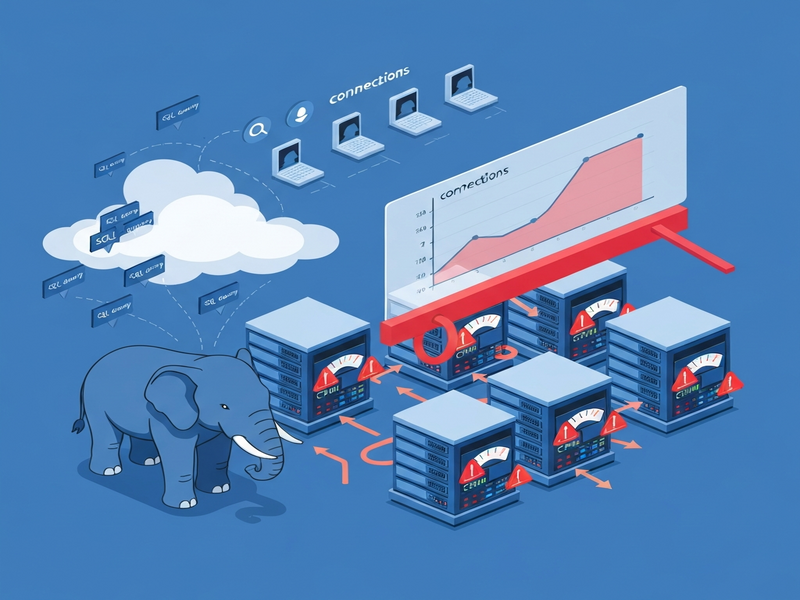
Recall.ai recently published a deep‑dive analysis of why their PostgreSQL postmaster does not scale under extreme load. The investigation, original Recall.ai post, reveals that the postmaster’s single‑threaded design can consume an entire CPU core when faced with thousands of simultaneous connection attempts, causing noticeable latency spikes.
What Is the Postmaster Bottleneck?
Every PostgreSQL instance starts with a postmaster process. Its responsibilities include:
- Accepting new client connections.
- Spawning child back‑end processes for each connection.
- Launching and managing background workers for parallel queries.
Crucially, the postmaster runs a single‑threaded event loop. When connection churn surges—such as during the start of thousands of meetings that Recall.ai records each hour—this loop becomes a contention point. The result: new connections wait for the postmaster to fork a backend, extending the handshake from milliseconds to seconds.
Symptoms Observed by Recall.ai
Recall.ai’s engineers noticed the following patterns during peak periods:
- TCP three‑way handshake completed instantly, but the PostgreSQL startup message received an
AuthRequestonly after ~10 seconds. - CPU usage on the database host appeared normal, yet connection latency spiked.
- Delays were intermittent—appearing only when thousands of EC2 instances booted simultaneously.
Initial investigations ruled out classic resource constraints (CPU, memory, I/O). The root cause was traced back to the postmaster’s inability to keep up with the flood of fork requests.
Technical Deep‑Dive: Why the Postmaster Struggles to Scale
Single‑Threaded Main Loop
The postmaster’s main loop processes events sequentially:
while (true) {
    AcceptConnection();   // spawn new backend
    ChildReaper();        // reap finished children
    LaunchBackgroundWorkers();
    // …other housekeeping…
}
When the arrival rate of new connections approaches the loop’s processing capacity (≈ 1 k‑1.5 k connections per second on a typical r8g.8xlarge instance), the loop becomes saturated. Each fork() call, despite copy‑on‑write optimizations, still incurs kernel overhead for page‑table duplication.
Fork Overhead and Huge Pages
Linux’s fork() duplicates the parent’s page tables. Even with copy‑on‑write, the kernel must allocate new page‑table entries (PTEs). Reducing the number of PTEs—by enabling huge pages—lowers this overhead. Recall.ai measured a ~20 % increase in connection throughput after configuring huge pages for PostgreSQL.
Background Worker Churn
Beyond client connections, the postmaster also launches background workers for parallel query execution. When an application issues many parallel queries (e.g., analytics on meeting transcripts), the postmaster must repeatedly fork workers, further stressing the single‑threaded loop. Recall.ai reproduced the issue by running a PL/pgSQL function that forced 512 parallel workers, observing a sharp drop in connection throughput.
Optimization Strategies to Mitigate Postmaster Contention
1. Adopt Connection Pooling with Jitter
Pooling reduces the frequency of new backend creation. Adding a small random delay (jitter) to instance start‑up times spreads connection spikes over a wider window, preventing the postmaster from being flooded.
2. Enable Huge Pages
Configure the OS and PostgreSQL to use huge pages:
# Enable 2 MiB huge pages
echo 1024 > /proc/sys/vm/nr_hugepages
# PostgreSQL config
huge_pages = on
This change reduces PTE allocation cost, delivering up to a 20 % boost in connection handling capacity.
3. Limit Parallel Query Churn
Adjust PostgreSQL settings to cap parallel workers during peak periods:
max_parallel_workers = 64
max_parallel_workers_per_gather = 16
Couple this with application‑level throttling of heavy analytics jobs during known traffic spikes.
4. Scale Horizontally with Multiple Postmasters
Running several PostgreSQL instances (or containers) on the same host distributes the connection load across multiple postmaster loops. Each instance gets its own CPU core, effectively multiplying the throughput.
5. Leverage Managed Proxies (e.g., PgBouncer, RDS Proxy)
Proxies keep a pool of persistent back‑ends, shielding the postmaster from rapid connection churn. They also provide automatic failover and load‑balancing, which is essential for high‑availability architectures.
How UBOS Helps You Overcome PostgreSQL Scaling Challenges
UBOS offers a suite of tools that simplify the implementation of the strategies above, allowing DBAs and DevOps teams to focus on business logic rather than low‑level tuning.
- UBOS platform overview – Deploy PostgreSQL clusters with built‑in connection pooling and automated huge‑page configuration.
- Workflow automation studio – Orchestrate jittered instance start‑ups and background‑worker throttling without writing custom scripts.
- Web app editor on UBOS – Build monitoring dashboards that surface postmaster CPU usage and fork latency in real time.
- Enterprise AI platform by UBOS – Integrate AI‑driven query optimizers that automatically adjust parallel worker settings based on workload patterns.
- UBOS pricing plans – Choose a tier that includes dedicated postmaster instances for mission‑critical workloads.
- UBOS solutions for SMBs – Get a pre‑configured, cost‑effective PostgreSQL environment with built‑in scaling safeguards.
- UBOS for startups – Accelerate time‑to‑market by leveraging ready‑made templates that embed connection‑pooling best practices.
- UBOS portfolio examples – See real‑world case studies where companies eliminated postmaster bottlenecks using UBOS.
- UBOS templates for quick start – Deploy a PostgreSQL cluster with one click, pre‑tuned for high‑concurrency environments.
- AI marketing agents – Offload analytics workloads to specialized agents that respect your PostgreSQL scaling limits.
- OpenAI ChatGPT integration – Use AI assistants to automatically suggest configuration tweaks when postmaster latency spikes.
- Chroma DB integration – Pair vector search workloads with PostgreSQL without overloading the postmaster.
- ElevenLabs AI voice integration – Streamline audio transcription pipelines that would otherwise generate excessive parallel workers.
- AI SEO Analyzer – Run SEO audits on your database queries to spot inefficient patterns before they hit production.
- AI Article Copywriter – Generate documentation for your PostgreSQL tuning procedures automatically.
Conclusion & Call‑to‑Action
The Recall.ai case study proves that even a battle‑tested DBMS like PostgreSQL can hit a hard ceiling when its postmaster is forced to handle massive, bursty connection loads. By understanding the single‑threaded nature of the postmaster, enabling huge pages, throttling background‑worker churn, and employing connection pooling or multiple postmaster instances, you can reclaim lost performance.
UBOS streamlines these optimizations, offering a unified platform that automates configuration, provides real‑time observability, and scales horizontally with minimal operational overhead. Ready to eliminate postmaster bottlenecks and future‑proof your PostgreSQL workloads? Explore the UBOS homepage today, request a demo, and let our AI‑powered tools do the heavy lifting for you.
Andrii Bidochko
CTO UBOS
Andrii Bidochko is an AI entrepreneur and researcher focused on AI agents, reinforcement learning, and autonomous systems. He writes about the technologies shaping the future of machine intelligence, from frontier models and agent architectures to real-world AI applications.