

- Updated: March 27, 2026
- 6 min read
Orloj: Open‑Source AI Orchestration Runtime Revolutionizes Multi‑Agent Systems
Orloj is an open‑source orchestration runtime that lets developers declare, schedule, and govern multi‑agent AI systems using simple YAML manifests, bringing production‑grade reliability to AI workflows.
What Is Orloj and Why It Matters Today
Named after the legendary Prague astronomical clock, Orloj synchronizes complex mechanisms—only this time the gears are AI agents, language models, and tool runtimes. In a landscape where AI agents are often cobbled together with ad‑hoc scripts, Orloj introduces a declarative, observable, and secure layer that mirrors the rigor of container orchestration platforms.
Enterprises, startups, and SMBs alike are racing to embed generative AI into products, but they face three recurring challenges:
- Scattered codebases that make governance a nightmare.
- Lack of built‑in observability for debugging multi‑step AI pipelines.
- Vendor lock‑in that forces costly rewrites when switching LLM providers.
Orloj solves these pain points by treating agents as infrastructure‑as‑code, enabling Agents‑as‑Code, DAG‑based orchestration, and policy‑driven governance out of the box.
Core Features That Set Orloj Apart
Agents‑as‑Code
Define agents, their models, tools, and constraints in version‑controlled YAML. This makes roll‑backs, audits, and CI/CD pipelines trivial.
DAG‑Based Orchestration
Build pipelines, hierarchical workflows, or swarm‑loop topologies with fan‑out/fan‑in support, ensuring deterministic execution order.
Model Routing & Provider Agnosticism
Bind agents to OpenAI, Anthropic, Azure OpenAI, Ollama, or any OpenAI ChatGPT integration without touching the YAML definition.
Tool Isolation & Sandboxing
Run external tools in containers, WASM sandboxes, or isolated processes with configurable timeouts and retries.
Built‑In Governance
Enforce policies, roles, and tool permissions at execution time. Unauthorized calls fail closed, protecting data and compliance.
Production‑Ready Reliability
Lease‑based task ownership, idempotent replay, exponential back‑off with jitter, and dead‑letter queues keep pipelines robust under load.
Architecture Overview
The Orloj stack consists of a central server (orlojd) and a fleet of workers (orlojworker). The server exposes a REST API, stores resources in memory or PostgreSQL, and schedules tasks. Workers claim tasks, route model requests through a Model Gateway, and execute tools in isolated runtimes.
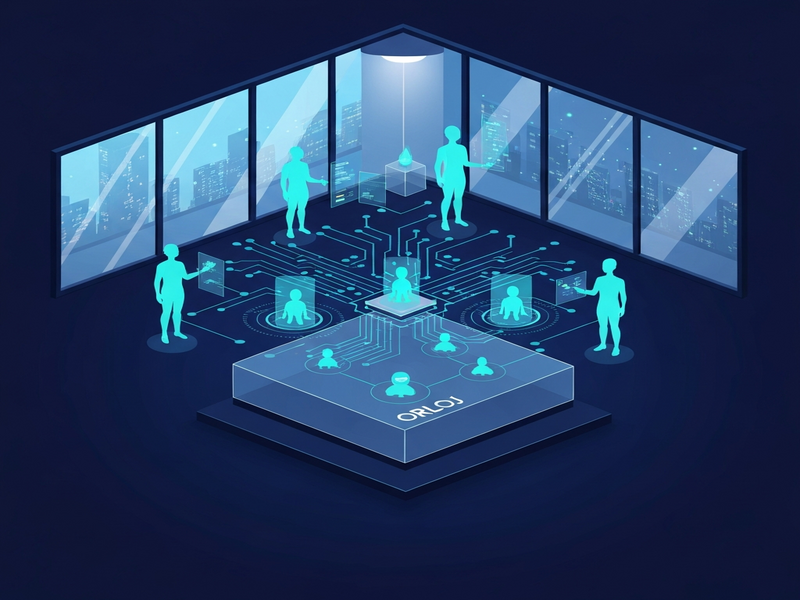
Key components include:
- API Server – Handles CRUD for agents, policies, and tasks.
- Resource Store – In‑memory for dev, PostgreSQL for production.
- Task Scheduler – Cron‑based and webhook‑triggered task creation.
- Message Bus – NATS JetStream for durable, distributed messaging.
- Tool Runtime – Container, WASM, or process isolation.
Getting Started in Minutes
Orloj’s quick‑start mirrors the frictionless experience of modern low‑code platforms. Follow these steps:
- Download the server binary and CLI from the GitHub releases page.
- Run the server locally with an in‑memory store:
./orlojd --storage-backend=memory --task-execution-mode=sequential --embedded-worker - Open the built‑in console at
http://127.0.0.1:8080to explore topology views. - Apply a starter blueprint (e.g., planner → researcher → writer):
./orlojctl apply -f examples/blueprints/pipeline/ - Inspect the resulting task with
orlojctl get task bp-pipeline-task.
When you’re ready to scale, switch to message‑driven mode with PostgreSQL persistence and NATS JetStream for distributed workers. The UBOS platform overview provides a comparable low‑code experience, letting you drag‑and‑drop AI agents without writing a line of code.
Real‑World Use Cases
Enterprise‑Scale Knowledge Management
Large organizations can orchestrate document ingestion, vector embedding (via Chroma DB integration), and LLM‑driven Q&A bots—all governed by strict role‑based policies. The Enterprise AI platform by UBOS showcases a similar capability set, but Orloj adds native task‑level retries and dead‑letter handling.
Startup Product Prototyping
Founders can spin up a UBOS for startups style MVP in days: define a research agent, a content generation agent, and a publishing agent. The UBOS templates for quick start accelerate this process, and Orloj’s YAML manifests keep the prototype reproducible.
SMB Marketing Automation
Small businesses can automate social media copy, SEO analysis, and email campaigns using Orloj pipelines. Pair the AI marketing agents with the AI SEO Analyzer and AI Email Marketing templates for a fully automated growth loop. The UBOS solutions for SMBs echo this philosophy, but Orloj adds fine‑grained governance for compliance‑heavy industries.
Extensible Integration Ecosystem
Orloj’s design embraces plug‑and‑play integrations, many of which already exist on the UBOS marketplace:
- Telegram integration on UBOS – Enables agents to push notifications or collect user feedback via chat.
- ChatGPT and Telegram integration – Turns a Telegram bot into a real‑time LLM assistant.
- ElevenLabs AI voice integration – Adds natural‑sounding speech synthesis to any agent output.
- OpenAI ChatGPT integration – Directly route requests to the latest GPT models.
These integrations are declared as Tool resources in Orloj YAML, inheriting the same timeout, retry, and permission semantics as native tools.
Marketplace Templates That Accelerate Development
UBOS’s Template Marketplace offers pre‑built agents that can be imported into Orloj with a single command. Highlights include:
- Talk with Claude AI app – A conversational interface powered by Anthropic’s Claude.
- AI Article Copywriter – Generates SEO‑optimized blog posts from brief outlines.
- AI Video Generator – Turns scripts into short videos using generative diffusion models.
- AI Image Generator – Produces custom visuals for marketing assets.
By importing these templates into Orloj, teams instantly gain a production‑ready pipeline: data ingestion → LLM reasoning → media generation → distribution.
Pricing, Support, and Community
Orloj itself is open source under the Apache‑2.0 license, meaning you can run it on‑premise or in any cloud without licensing fees. For organizations that prefer a managed experience, the UBOS pricing plans include hosted runtimes, SLA‑backed support, and dedicated onboarding.
Need inspiration? Browse the UBOS portfolio examples to see how other companies have leveraged AI orchestration for sales enablement, customer support, and content creation.
Join the Ecosystem: Partner Program & Contributions
Developers and system integrators can extend Orloj’s capabilities through the UBOS partner program. Partners receive co‑marketing, technical enablement, and early access to new integrations.
Open‑source contributors are welcomed via the GitHub repository. The project follows a transparent roadmap, and every contribution is reflected in the About UBOS page, highlighting the community’s impact.
Original Announcement
The official launch announcement can be read on the original news site: Orloj launch press release. The article details the initial roadmap, early adopters, and the vision behind naming the project after the Prague clock.
Why Orloj Is a Game‑Changer for AI‑First Companies
By abstracting agents, tools, and policies into declarative YAML, Orloj gives development teams the same confidence they have when deploying containers with Kubernetes. Its built‑in governance, observability, and provider‑agnostic routing make it a future‑proof foundation for any AI‑driven product.
Whether you’re a startup building a prototype, an SMB automating marketing, or an enterprise modernizing knowledge management, Orloj provides the scaffolding to move from experimental scripts to production‑grade AI pipelines—fast, secure, and cost‑effective.
Ready to orchestrate your AI agents? Explore the UBOS homepage for a unified view of low‑code AI development, or dive straight into Orloj’s GitHub repository to start building today.
Andrii Bidochko
CTO UBOS
Andrii Bidochko is an AI entrepreneur and researcher focused on AI agents, reinforcement learning, and autonomous systems. He writes about the technologies shaping the future of machine intelligence, from frontier models and agent architectures to real-world AI applications.