

- Updated: December 15, 2025
- 7 min read
Orbital Data Centers: Cost, Challenges, and Strategic Benefits
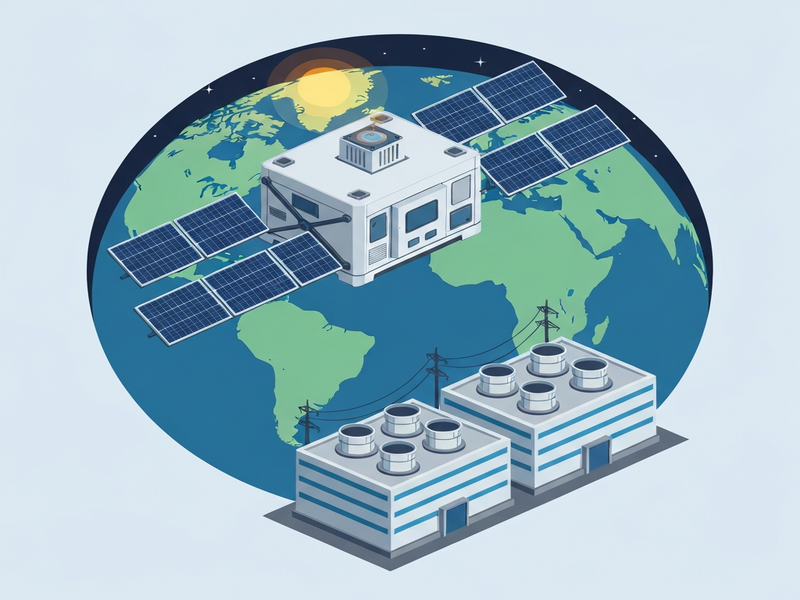
Orbital data centers are a nascent technology that aims to deliver solar‑powered compute in low Earth orbit, but they face steep economic and technical hurdles compared with traditional terrestrial facilities.
Why the Buzz Around Space‑Based Data Centers?
The idea of placing servers among the stars sounds like science‑fiction, yet a recent analysis by Andrew McCalip (source) shows that the conversation is grounded in real engineering, finance, and strategic questions. Tech‑savvy decision‑makers are asking: can a watt of solar‑generated power 250 miles up be cheaper, greener, or faster than a megawatt from a ground‑based plant? This article breaks down the core arguments, compares orbital and terrestrial models, and shows how UBOS is already providing the tools you need to experiment with edge‑computing concepts today.
Orbital Solar‑Powered Compute vs. Terrestrial Data Centers
At a high level, orbital data centers rely on three pillars:
- Solar arrays that harvest uninterrupted sunlight in low Earth orbit (LEO).
- Radiators that dump waste heat as infrared radiation, because convection is impossible in vacuum.
- Launch logistics that deliver the hardware to space at a cost that is rapidly falling thanks to reusable rockets.
Terrestrial facilities, by contrast, draw power from the grid (often a mix of fossil, nuclear, and renewables), use water or air‑based cooling, and benefit from decades of supply‑chain optimization. The UBOS platform overview already supports hybrid edge‑cloud deployments, letting you prototype the same workloads on‑premise before you consider a lift‑off.
The key performance metric that both models compete on is cost per usable watt. In the space‑based scenario, the cost includes satellite hardware, launch, on‑orbit operations, and eventual de‑orbiting. On Earth, it includes power generation, cooling infrastructure, real‑estate, and ongoing maintenance. Below we quantify each side.
Cost Analysis and Economic Viability
A simplified 5‑year total‑cost‑of‑ownership (TCO) model reveals a stark contrast:
| Component | Orbital (USD) | Terrestrial (USD) |
|---|---|---|
| Capital Expenditure (CapEx) | $31.2 B | $14.8 B |
| Operating Expenditure (OpEx, 5 yr) | $3.1 B | $5.3 B |
| Cost per Watt | $31.20/W | $14.80/W |
| Levelized Cost of Energy (LCOE) | $891/MWh | $398/MWh |
The numbers above are derived from publicly available data and first‑principles modeling, mirroring the methodology used in the original analysis. Even with aggressive launch‑cost reductions (e.g., $1,000 /kg), orbital compute remains roughly double the cost per watt of a conventional data center.
However, cost is not the only driver. UBOS pricing plans illustrate how subscription‑based pricing can smooth out capital spikes, making it easier for startups to experiment with “pay‑as‑you‑grow” models. For a company evaluating edge‑compute workloads that must be physically close to a satellite‑ground station, the marginal cost difference may be offset by latency gains and regulatory freedom.
Technical Challenges and Thermal Management
The most visible engineering hurdle is heat rejection. On Earth, a server rack can dump gigawatts of waste heat into the atmosphere or a cooling tower. In space, the only path is radiation, governed by the Stefan‑Boltzmann law:
Qrad = εσAT⁴
Where ε is emissivity, σ is the Stefan‑Boltzmann constant, A is radiator area, and T is temperature in Kelvin. To keep modern GPUs below 85 °C, a satellite must allocate a large fraction of its surface to high‑emissivity radiators. This reduces the available area for solar panels, creating a classic power‑vs‑heat trade‑off.
Chroma DB integration can help you model these thermal constraints in real time, feeding telemetry into a cloud‑native analytics pipeline. Meanwhile, ElevenLabs AI voice integration demonstrates that even voice‑enabled services can be run on low‑power edge nodes, reducing the overall thermal budget.
Other technical concerns include:
- Radiation hardening – high‑energy particles degrade silicon and cause bit‑flips.
- Launch vibration – hardware must survive G‑forces up to 8 g.
- On‑orbit servicing – currently limited to a handful of agencies.
- Latency to ground stations – while LEO offers sub‑100 ms round‑trip, coverage gaps require a constellation.
The Workflow automation studio lets you orchestrate data pipelines that automatically shift workloads between terrestrial and orbital nodes based on temperature thresholds, ensuring continuous service.
Strategic Motivations and Future Outlook
Even if the pure economics look unfavorable today, several strategic incentives keep the concept alive:
- Regulatory freedom – Space offers a jurisdiction‑free environment for data that must avoid national data‑sovereignty constraints.
- Latency for remote sensing – Real‑time processing of satellite imagery can be done on‑board, reducing downlink bandwidth.
- Brand differentiation – Early adopters can claim “first‑in‑orbit AI” as a marketable advantage.
- Scalability of solar power – In theory, a constellation can harvest gigawatts of clean energy without land use.
Companies like Enterprise AI platform by UBOS are already building hybrid stacks that combine on‑premise, cloud, and edge resources. By leveraging the UBOS templates for quick start, developers can spin up a “space‑ready” microservice in minutes, then attach it to a satellite‑ground link when the hardware becomes available.
The UBOS partner program encourages system integrators to co‑develop launch‑ready containers, making the path from code to orbit shorter. In the next 3‑5 years, as launch costs approach $500 /kg and radiator materials improve, the cost gap could narrow to within 20‑30 %.
Real‑World Use Cases Enabled by UBOS
Below are three practical scenarios where a hybrid orbital‑terrestrial architecture can deliver immediate value:
1. Global AI‑Powered Video Analytics
A media company streams live events worldwide. By deploying AI Video Generator on ground stations and off‑loading frame‑level inference to an orbital node, they reduce bandwidth by 40 % while keeping sub‑second latency for live captions.
AI SEO Analyzer can then auto‑optimize the generated metadata in real time.
2. Edge AI for Disaster Response
During a hurricane, ground networks are unreliable. An AI Chatbot template hosted on a LEO satellite can field citizen reports, run language translation via OpenAI ChatGPT integration, and push actionable insights to first‑responders.
The AI Survey Generator helps agencies quickly design post‑event questionnaires.
3. Real‑Time Financial Modeling
A fintech startup uses AI Article Copywriter to generate market briefs. By routing compute‑intensive Monte Carlo simulations to an orbital node, they achieve deterministic latency unaffected by terrestrial network congestion.
The AI Email Marketing module then personalizes outreach based on the latest model outputs.
4. Voice‑Enabled Satellite Services
Using ChatGPT and Telegram integration together with ElevenLabs AI voice integration, operators can offer multilingual voice assistants directly from orbit, useful for remote maritime or aviation customers.
Conclusion: Is the Sky the New Data Center?
The short answer: orbital data centers are technically feasible but currently more expensive than their ground‑based counterparts. Their true value lies in niche strategic advantages—regulatory freedom, ultra‑low latency for remote sensing, and brand differentiation. As launch economics improve and thermal‑radiator technology matures, the cost gap will shrink, making hybrid architectures a realistic option for forward‑thinking enterprises.
If you’re a startup or SMB looking to experiment with edge‑compute concepts, start today with the UBOS for startups program. Leverage the Web app editor on UBOS to prototype a microservice, then connect it to a ground‑station that could later be mirrored to an orbital node.
Ready to explore? Browse the UBOS portfolio examples for inspiration, or jump straight into a ready‑made template like the Talk with Claude AI app. For a deeper dive into pricing, visit our UBOS pricing plans. And don’t forget to join the UBOS partner program to stay ahead of the next wave of space‑enabled AI.
The future of compute may be written among the stars—your next breakthrough could start with a line of code on the UBOS platform.
Andrii Bidochko
CTO UBOS
Andrii Bidochko is an AI entrepreneur and researcher focused on AI agents, reinforcement learning, and autonomous systems. He writes about the technologies shaping the future of machine intelligence, from frontier models and agent architectures to real-world AI applications.