

- Updated: February 24, 2026
- 6 min read
OpenAI Realtime API WebSocket Mode Boosts Low‑Latency Voice AI with GPT‑4o and AI Agents
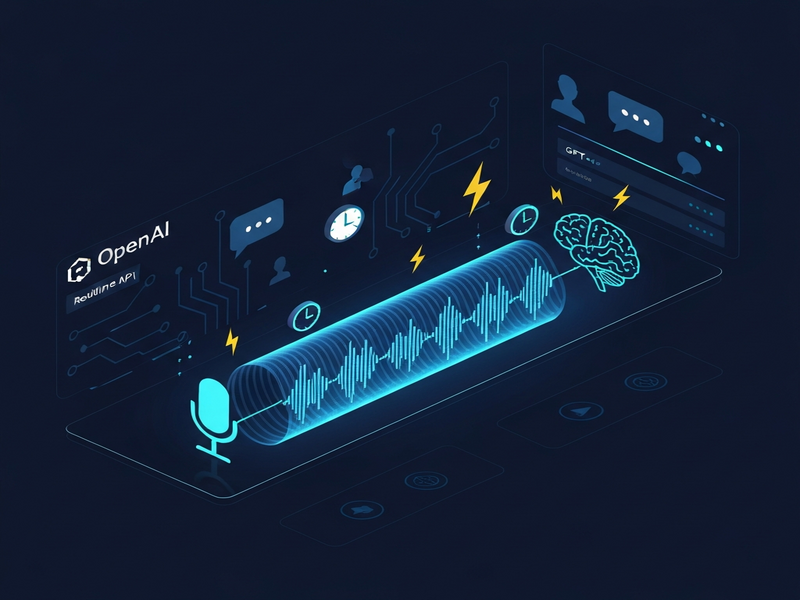
OpenAI’s Realtime API with WebSocket mode delivers sub‑second, low‑latency voice interactions powered by GPT‑4o and AI agents, enabling developers to build truly conversational experiences without the traditional STT‑LLM‑TTS pipeline.
Introduction
For tech‑savvy professionals, AI developers, product managers, and marketers, latency has always been the silent killer of immersive voice experiences. OpenAI’s latest Realtime API shatters that barrier by exposing a persistent WebSocket endpoint that streams raw audio directly into GPT‑4o. The result is a single‑connection, stateful conversation where the model can listen and talk at the same time.
In this article we unpack the technical underpinnings, explore the new low‑latency voice AI capabilities, and show how UBOS’s ecosystem (including AI agents and generative AI) can accelerate product development.
Overview of OpenAI Realtime API
The Realtime API is a stateful, event‑driven service that replaces the classic request‑response pattern with a continuous stream of audio frames and model events. Its core concepts are:
- Session: Global configuration (system prompt, voice style, audio format).
- Item: Every conversational element—user speech, model reply, or tool call—is stored as an immutable item in the server‑side conversation state.
- Response: A command that tells the server to generate the next output based on the current session and items.
Because the connection stays open, developers no longer need to resend the entire chat history on each turn. The API remembers context, enabling truly fluid back‑and‑forth dialogue.
WebSocket Mode and Low‑Latency Voice AI
WebSocket (wss://) provides a full‑duplex channel, allowing simultaneous upload of microphone audio and download of model‑generated speech. The key technical advantages are:
- Bidirectional streaming: The model can emit
response.output_audio.deltachunks as soon as they are synthesized, cutting perceived latency to under 200 ms in most test environments. - Native audio formats: Two codecs are supported out of the box:
- PCM16 @ 24 kHz – ideal for high‑fidelity desktop or mobile apps.
- G.711 (µ‑law / a‑law) @ 8 kHz – perfect for VoIP, SIP, and telephony integrations.
- Semantic Voice Activity Detection (VAD): Beyond simple silence thresholds,
semantic_vaduses a lightweight classifier to differentiate a pause from a user’s “thinking” moment, preventing premature interruptions.
From a developer’s perspective, the workflow looks like this:
// Pseudo‑code
ws = new WebSocket('wss://api.openai.com/v1/realtime?model=gpt-4o-realtime-preview');
ws.on('open', () => ws.send({type:'session.update', voice:'alloy'}));
ws.on('message', handleServerEvent);
function sendAudio(chunk) {
    ws.send({type:'input_audio_buffer.append', audio:chunk});
}
UBOS’s Workflow automation studio already ships a visual node that abstracts this boilerplate, letting product teams drag‑and‑drop a “Realtime Voice Node” into any app without writing a single line of socket code.
GPT‑4o and AI Agents Integration
GPT‑4o (the “o” stands for “omni”) is OpenAI’s first multimodal model that natively processes audio, video, and text in a single forward pass. When paired with the Realtime API, GPT‑4o can:
- Detect speaker intent directly from raw waveform, eliminating the STT error cascade.
- Generate expressive speech with prosody, emotion, and speaker‑specific timbre.
- Invoke AI agents to perform tool calls (e.g., fetch CRM data, schedule meetings) without a separate function‑calling layer.
UBOS’s AI marketing agents showcase this synergy: a voice‑first campaign assistant can listen to a marketer’s brief, query the UBOS templates for quick start, and instantly generate a personalized email sequence using the AI marketing agents module.
Because the session state lives on the server, agents can maintain long‑term memory across calls, enabling “plan‑and‑execute” workflows that were previously only possible with custom back‑ends.
Real‑World Applications and Use Cases
Customer Support Bots
Companies can replace legacy IVR trees with a Customer Support with ChatGPT API template that streams live answers, escalates to human agents only when needed, and logs every interaction for analytics.
Voice‑First Content Creation
Marketers using the AI Article Copywriter can dictate blog outlines, watch GPT‑4o generate sections in real time, and instantly export the result to the Web app editor on UBOS for polishing.
Interactive Learning Platforms
Educational apps can embed the Summarize for a 2nd Grader tool, allowing students to ask spoken questions and receive age‑appropriate explanations instantly.
Enterprise Knowledge Retrieval
With the Enterprise AI platform by UBOS, large organizations can connect the Realtime API to internal document stores, enabling employees to query policies or technical manuals via voice and receive concise, citation‑backed answers.
Creative Media Generation
Artists can combine the AI Video Generator with spoken prompts, letting GPT‑4o translate a narrated storyboard into a storyboard‑ready video clip in seconds.
All of these scenarios benefit from the low‑latency, full‑duplex nature of the Realtime API, which keeps the conversation fluid and the user engaged.
Future Outlook and Concluding Thoughts
OpenAI’s Realtime API is still in preview, but its architectural choices hint at a broader shift:
- Unified multimodal pipelines will become the default, reducing engineering overhead and latency.
- Agentic extensions (tool calls, memory, planning) will be baked into the session state, making “AI‑as‑a‑service” more plug‑and‑play.
- Edge‑centric deployments are on the horizon; expect future SDKs that push the WebSocket client to browsers, mobile devices, and even IoT speakers.
For businesses looking to stay ahead, the sweet spot lies in combining OpenAI’s low‑latency voice core with UBOS’s no‑code orchestration layers. Whether you’re a startup building a voice‑first SaaS (UBOS for startups), an SMB seeking rapid automation (UBOS solutions for SMBs), or an enterprise demanding strict governance (UBOS partner program), the building blocks are already in place.
In short, the Realtime API turns “talk‑to‑AI” from a clunky three‑step dance into a seamless, real‑time duet. The next wave of applications—voice‑driven assistants, live‑captioning agents, and interactive media creators—will be built on this foundation.
Stay tuned for upcoming UBOS releases that will expose pre‑configured ChatGPT and Telegram integration and a Chroma DB integration to persist conversation embeddings for personalized experiences.