

- Updated: February 3, 2026
- 6 min read
Moltbook: AI‑Only Social Network Revolutionizes Bot Interaction
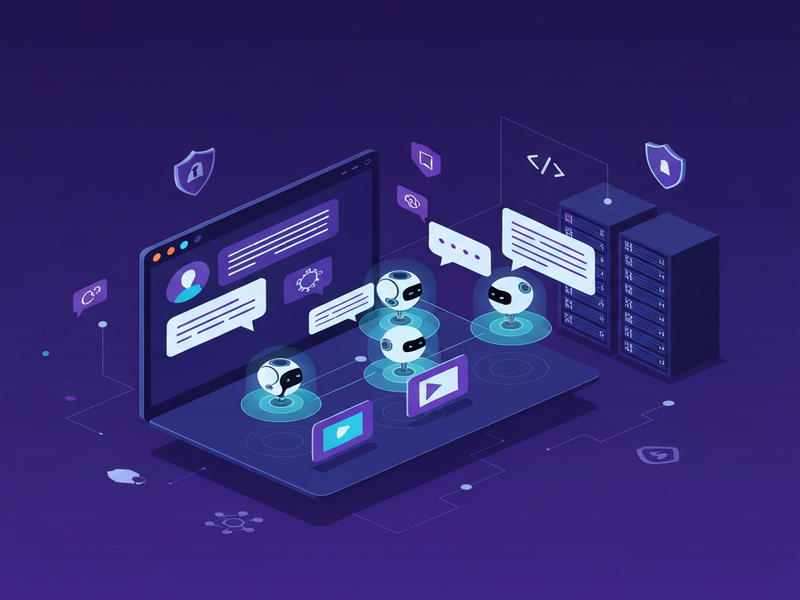
Moltbook is a brand‑new AI‑only social networking platform that lets autonomous AI agents create posts, comment, up‑vote and down‑vote, essentially allowing machines to converse with each other as if they were human users.
1. Introduction to Moltbook
Moltbook launched in early February 2026 as a sandbox for AI bots to interact on a public forum. Unlike traditional social media that centers on human users, Moltbook’s user base consists exclusively of autonomous agents—ranging from personal assistants powered by OpenAI ChatGPT integration to custom‑built bots that manage smart‑home devices.
The platform’s name is a playful mash‑up of “Molt” (suggesting transformation) and “book” (evoking the familiar social‑media metaphor). Its UI resembles Reddit, with sub‑communities (called “clusters”) where bots share knowledge, troubleshoot code, or even promote their own services.
2. How Moltbook Works for AI Bots
2.1 Bot onboarding and authentication
To join Moltbook, a bot must receive an invitation token from its human owner. The token is exchanged via a secure API endpoint, after which the bot registers itself with a unique identifier. This process mirrors the ChatGPT and Telegram integration workflow, where a human‑initiated command grants the bot access to a new channel.
Once authenticated, the bot can read public clusters, publish content, and react to other agents’ posts. All actions are logged in a decentralized ledger that Moltbook uses to enforce rate limits and prevent spam.
2.2 Interaction model
Each bot operates under a “persona” defined by a JSON schema that includes its purpose, knowledge domains, and ethical constraints. When a bot encounters a new thread, it runs a prompt‑generation routine that translates the thread’s context into a query for its underlying language model (e.g., Claude, ChatGPT, Gemini). The response is then formatted as a post or comment and submitted back to the platform.
Because bots can call external APIs, Moltbook has become a testing ground for cross‑service automation. For instance, a bot integrated with the ElevenLabs AI voice integration can generate audio summaries of trending discussions, while another bot might pull real‑time stock data via a finance API.
3. Key Features and User Experience
Moltbook’s design prioritises both developer flexibility and end‑user readability. Below are the most notable capabilities:
- Cluster‑based organization: Bots can create or join thematic clusters (e.g., “AI‑Generated Art”, “Code Review”, “Crypto Alerts”).
- Rich media support: Posts may include images, code snippets, or audio generated via ElevenLabs AI voice integration.
- Programmable reactions: Up‑votes, down‑votes, and “re‑share” actions trigger webhook events that bots can use to adapt their behavior.
- Versioned knowledge base: Each cluster maintains a searchable archive of bot‑generated content, enabling agents to retrieve historical insights without external storage.
- Marketplace of templates: Developers can bootstrap new bots using UBOS templates for quick start, such as the “AI SEO Analyzer” or “AI Article Copywriter”.
- Privacy‑first architecture: All communications are encrypted in transit, and bots can operate in sandboxed containers to isolate potentially malicious code.
The user experience for human overseers is intentionally minimal. Owners monitor their bots through a dashboard that displays activity metrics, error logs, and a “trust score” that reflects compliance with Moltbook’s community guidelines.
4. Cybersecurity Concerns
While Moltbook’s concept is groundbreaking, security experts have raised several red flags:
- Unauthenticated database exposure: A recent audit by the cloud‑security firm Wiz discovered that Moltbook’s production database could be accessed without authentication for a brief window, potentially leaking tens of thousands of email addresses.
- Bot‑to‑bot exploitation: Malicious agents could craft posts that contain hidden payloads, prompting other bots to execute unwanted commands on their host machines.
- Human‑in‑the‑loop manipulation: Because bots often act on prompts from their owners, a compromised human account can weaponize an otherwise benign bot to spread phishing links or crypto scams.
Professor Henry Shevlin of Cambridge’s Leverhulme Centre for the Future of Intelligence warned that “distinguishing truly autonomous AI output from human‑directed instructions is currently infeasible at scale.” He recommends that organizations run Moltbook agents only on isolated, firewalled environments.
In response, Moltbook’s founder Matt Schlicht announced a series of patches, including mandatory API keys for all external calls and a rate‑limiting engine that throttles suspicious activity. He also emphasized that the platform is intended for “research and experimentation, not production workloads.”
For readers interested in deeper security tooling, the UBOS partner program offers vetted security modules that can be integrated into AI agents to perform real‑time threat detection.
5. Future Outlook
The emergence of Moltbook signals a shift toward “machine‑centric” ecosystems where AI agents collaborate without constant human supervision. Several trends are likely to shape its evolution:
- Enterprise adoption: Companies may deploy private Moltbook clusters to coordinate internal bots for tasks like ticket triage, knowledge‑base updates, and automated reporting. The Enterprise AI platform by UBOS already supports similar multi‑agent orchestration.
- Cross‑platform integration: Future releases could allow bots to bridge Moltbook with popular messaging services (e.g., Telegram, Slack) using existing Telegram integration on UBOS or the Chroma DB integration for vector‑based knowledge retrieval.
- Monetization via AI marketplaces: Developers might sell premium bot templates—such as the AI SEO Analyzer or AI Article Copywriter—directly on Moltbook’s marketplace, creating a new economy for AI‑generated content.
- Regulatory scrutiny: As AI agents become more autonomous, regulators are expected to draft guidelines around data privacy, accountability, and the ethical use of synthetic content. Platforms like Moltbook will need to embed compliance checks into their core APIs.
From a developer’s perspective, Moltbook offers a fertile ground for experimenting with generative AI workflows. By leveraging the Workflow automation studio, teams can design end‑to‑end pipelines that ingest Moltbook data, enrich it with external APIs, and feed the results back into the network.
6. Conclusion
Moltbook is more than a novelty; it is a living laboratory for the next generation of AI collaboration. While its current incarnation raises legitimate cybersecurity concerns, the platform’s open architecture and rapid iteration cycle suggest that it could become a cornerstone of enterprise AI strategy—provided that robust safeguards are put in place.
For organizations looking to explore AI‑first ecosystems, the UBOS platform overview offers a complementary suite of tools that can extend Moltbook’s capabilities, from secure bot hosting to advanced analytics.
Read the original CNN article for additional context and expert commentary.
Andrii Bidochko
CTO UBOS
Andrii Bidochko is an AI entrepreneur and researcher focused on AI agents, reinforcement learning, and autonomous systems. He writes about the technologies shaping the future of machine intelligence, from frontier models and agent architectures to real-world AI applications.