

- Updated: April 5, 2026
- 6 min read
Intestinal Bacteria Linked to Boosted Muscle Strength – New Scientific Discovery
A recent peer‑reviewed study demonstrates that the gut bacterium Roseburia inulinivorans can significantly increase muscle strength in both humans and mice, opening new avenues for probiotic‑based fitness and anti‑aging interventions.
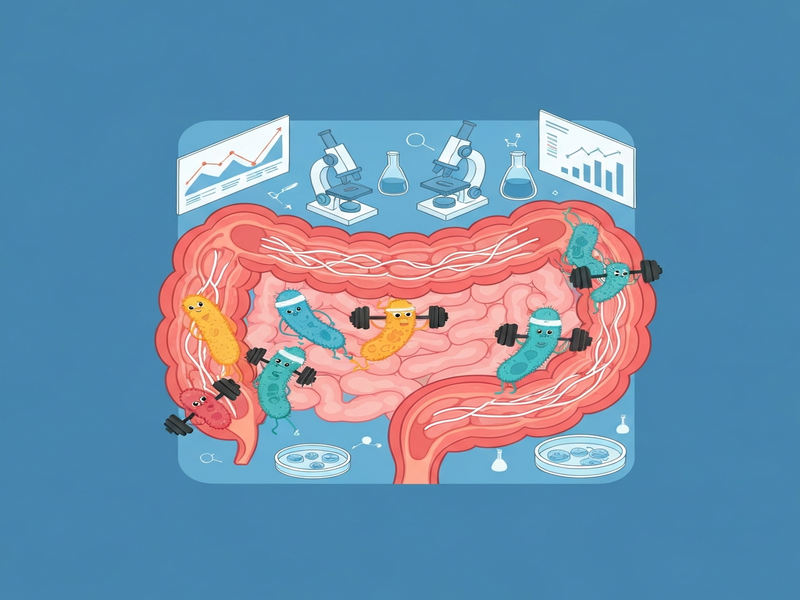
Gut microbiome meets muscle health: a paradigm shift
For decades, scientists have known that the trillions of microbes living in our intestines influence digestion, immunity, and even mood. The emerging concept of an intestine‑muscle axis suggests that specific bacterial species can modulate muscle metabolism, endurance, and strength. This new discovery adds a concrete, experimentally validated member—Roseburia inulinivorans—to that axis, providing a tangible target for future probiotic products.
The study, published in the high‑impact journal Gut, combined human cohort analysis with controlled mouse experiments. Researchers from the University of Granada, University of Almería, and Leiden University Medical Center collaborated to answer a simple yet profound question: Can a single intestinal bacterium boost physical performance?
Why the gut microbiome matters for muscle health
The gut microbiome produces short‑chain fatty acids (SCFAs), vitamins, and signaling molecules that travel through the bloodstream to distant organs. SCFAs such as butyrate have been shown to improve mitochondrial function and reduce systemic inflammation—both critical factors for muscle growth and recovery.
Among the dozens of bacterial genera, Roseburia stands out for its robust butyrate‑producing capacity. Prior research linked Roseburia abundance to lower body‑mass index and better insulin sensitivity, but its direct impact on muscle fibers remained speculative—until now.
Understanding this link is especially relevant for aging populations. Sarcopenia, the age‑related loss of muscle mass, affects up to 30% of adults over 60. If a gut‑derived probiotic can mitigate that decline, the public health implications are massive.
The groundbreaking Roseburia inulinivorans study
Study design and participant profile
Researchers recruited 90 healthy young adults (18‑25 years) and 33 older adults (≥65 years). Each participant provided a stool sample for 16S rRNA sequencing and completed a battery of fitness tests, including hand‑grip dynamometry, leg press strength, and VO₂max measurement.
The bacterial composition was correlated with performance metrics using multivariate regression, controlling for diet, physical activity, and body‑mass index. The analysis highlighted a single species—Roseburia inulinivorans—as the strongest predictor of both muscular and aerobic capacity.
Key findings in humans
- Older adults harboring R. inulinivorans exhibited 29% higher hand‑grip strength than those without the bacterium.
- In the young cohort, higher relative abundance of R. inulinivorans correlated with greater hand‑grip force and a 12% increase in VO₂max.
- The bacterium’s prevalence declined sharply with age, suggesting a natural depletion that may contribute to sarcopenia.
Mouse model confirms causality
To test causation, researchers first depleted the native gut flora of C57BL/6 mice using a broad‑spectrum antibiotic cocktail. Over eight weeks, the mice received weekly oral gavage of a human‑derived R. inulinivorans strain. Control mice received a placebo solution.
The treated group displayed a 30% increase in forelimb grip strength and a notable shift toward larger, type‑II (fast‑twitch) muscle fibers in the soleus muscle. Proteomic analysis revealed up‑regulation of enzymes involved in glycolysis and oxidative phosphorylation, indicating enhanced muscular energy metabolism.
Importantly, the introduced strain did not permanently colonize the mouse gut, underscoring the need for repeated dosing or engineered delivery systems for lasting effects.
Potential probiotic applications and biotech opportunities
The data suggest that a targeted probiotic supplement containing R. inulinivorans could become a novel adjunct to resistance training, especially for older adults seeking to preserve muscle mass. Biotech firms are already exploring encapsulation technologies that protect anaerobic gut microbes through the acidic stomach environment.
Beyond direct supplementation, the discovery fuels interest in Chroma DB integration for personalized microbiome‑fitness dashboards, where users can upload stool‑test results and receive AI‑generated training and nutrition plans.
Companies developing AI‑driven health platforms can also leverage the finding to enrich their recommendation engines. For instance, integrating the AI marketing agents with microbiome data could personalize product messaging for fitness supplements.
Expert commentary and study limitations
“Our results provide solid evidence for a gut‑muscle axis, but we must be cautious before translating mouse data into commercial probiotics,” says Prof. Jonatan Ruiz, University of Granada.
The authors acknowledge several constraints:
- Human‑derived strains did not achieve permanent colonization in mice, raising questions about dosing frequency.
- The study did not dissect inflammatory or neuromuscular signaling pathways that could mediate the observed effects.
- Long‑term safety and efficacy in diverse populations remain untested.
Future trials should incorporate larger, multi‑ethnic cohorts and explore synergistic effects with resistance training programs.
What this means for fitness enthusiasts and aging adults
If subsequent clinical trials confirm these findings, a daily R. inulinivorans supplement could become a low‑cost, low‑risk strategy to:
- Boost hand‑grip and overall muscular strength.
- Enhance fast‑twitch fiber recruitment, benefiting power‑based sports.
- Potentially improve aerobic capacity via SCFA‑mediated mitochondrial efficiency.
For now, readers can support their gut microbiome by consuming fiber‑rich foods (e.g., chicory root, whole grains) that naturally promote Roseburia growth.
Explore AI‑powered health solutions on UBOS
Curious how AI can accelerate your wellness journey? Visit the UBOS platform overview to discover tools that integrate microbiome data with personalized training regimens.
Start a project with our Web app editor on UBOS and prototype a probiotic‑tracking dashboard in minutes.
Need automation? The Workflow automation studio lets you sync lab results, user inputs, and AI‑generated recommendations without writing code.
Check out our UBOS templates for quick start, including a pre‑built “Microbiome‑Fitness Tracker” template that you can customize for your brand.
For startups aiming to commercialize a gut‑muscle probiotic, the UBOS for startups program offers mentorship, cloud credits, and go‑to‑market support.
Larger enterprises can explore the Enterprise AI platform by UBOS to scale personalized health services across millions of users.
Ready to see AI in action? Try the AI Article Copywriter for generating health‑focused content, or experiment with the GPT‑Powered Telegram Bot to deliver daily microbiome tips directly to your phone.
Stay ahead of the science—subscribe to UBOS updates and be the first to integrate cutting‑edge microbiome discoveries into your digital health products.
For the full scientific report, see the original University of Granada publication: Roseburia inulinivorans increases muscle strength (Gut, 2026).
Andrii Bidochko
CTO UBOS
Andrii Bidochko is an AI entrepreneur and researcher focused on AI agents, reinforcement learning, and autonomous systems. He writes about the technologies shaping the future of machine intelligence, from frontier models and agent architectures to real-world AI applications.