

- Updated: February 28, 2026
- 6 min read
India Blocks Supabase Access Under IT Act Section 69A – Impact on Developers
India Blocks Supabase Under IT Act Section 69A – What Developers Need to Know
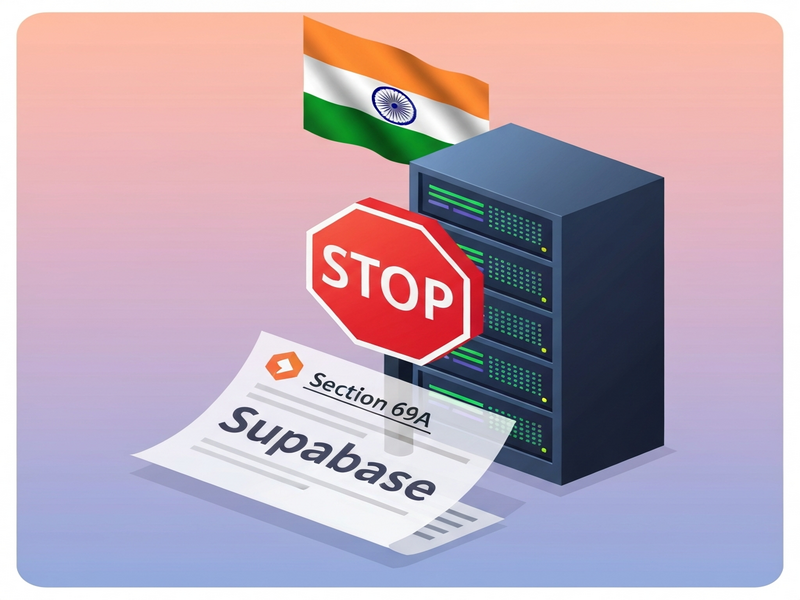
Answer: On February 24 2026, the Indian government ordered ISPs to block access to Supabase, a leading open‑source developer platform, invoking Section 69A of the Information Technology Act. The move has disrupted thousands of Indian developers, halted new sign‑ups, and raised concerns about the stability of cloud‑based services in the country.
1. Introduction – Why the Supabase Block Matters
Supabase has become a cornerstone for startups, SMBs, and enterprise teams building real‑time applications without managing complex infrastructure. When India, the world’s second‑largest internet market, blocks the service, the ripple effect touches:
- Indian developers who rely on Supabase for rapid prototyping.
- Global SaaS companies that host Indian users on Supabase’s managed PostgreSQL.
- Investors watching regulatory risk in emerging tech hubs.
Understanding the legal basis, the technical impact, and the possible workarounds is essential for anyone building on cloud databases in the region.
2. Background – Supabase’s Rise in the Developer Ecosystem
Founded in 2020, Supabase markets itself as an open‑source alternative to Firebase, offering instant APIs, authentication, and real‑time subscriptions on top of PostgreSQL. Its growth metrics are impressive:
- Over 4.2 million global monthly visits in January 2026 (a 111 % YoY increase).
- India contributed roughly 365,000 visits, representing 9 % of total traffic.
- Funding of $380 million across three rounds, pushing its valuation to $5 billion.
These numbers illustrate why the platform is a strategic asset for Indian startups and why its sudden unavailability is a headline‑making event.
3. Legal Action – Section 69A of the IT Act Explained
Section 69A empowers the Indian Ministry of Electronics and Information Technology (MeitY) to direct intermediaries to block public access to any online content deemed a threat to sovereignty, security, or public order. The order issued on February 24 did not disclose a specific reason, leaving the tech community to speculate about possible triggers:
- Potential cybersecurity concerns.
- Intellectual property or copyright disputes.
- Political or social content deemed sensitive.
Because the provision is broad, it has been used previously to block platforms such as GitHub (2014) and various streaming services. The lack of transparency fuels uncertainty for developers who need predictable access to their tooling.
4. Immediate Impact on Indian Developers
Since the block, developers have reported:
- Inability to create new Supabase projects via the web console.
- Intermittent failures when accessing existing databases, especially on major ISPs like JioFiber, Airtel, and ACT Fibernet.
- Drop in new sign‑ups from India, with some founders noting a 30‑40 % decline over a three‑day window.
One anonymous founder told TechCrunch that their startup’s onboarding pipeline stalled because the API keys could not be fetched, forcing the team to consider alternative back‑ends such as Firebase or self‑hosted PostgreSQL.
“You don’t know where you can safely run projects without the danger that something might get blocked, and suddenly you’re scrambling to find a way.” – Raman Jit Singh Chima, Asia‑Pacific Policy Director, Access Now
5. Workarounds and Their Limitations
Supabase suggested temporary measures:
- Changing DNS settings to public resolvers (e.g., Cloudflare 1.1.1.1).
- Using VPN services to tunnel traffic outside Indian jurisdiction.
- Deploying self‑hosted Supabase instances on local cloud providers.
While technically viable, these solutions pose challenges:
- DNS changes can be overridden by ISP‑level filtering.
- VPNs add latency and may violate corporate security policies.
- Self‑hosting requires expertise and incurs additional operational costs.
For many Indian developers, especially those in early‑stage startups, the friction of setting up a self‑hosted stack outweighs the benefits of staying on Supabase.
6. Reactions from Supabase and Industry Experts
Supabase publicly acknowledged the issue on X (formerly Twitter), tagging India’s IT minister Ashwini Vaishnaw and requesting an urgent review. The tweet was later removed, but the company confirmed ongoing dialogue with regulators.
Industry analysts see this as a test case for the broader “website blocking regime” in India. The TechCrunch report notes that similar blocks have previously affected GitHub and Vimeo, creating a chilling effect on open‑source collaboration.
7. How UBOS Helps Developers Navigate Regulatory Uncertainty
For teams looking for a resilient alternative, UBOS homepage offers a suite of tools designed to stay operational under varying regulatory environments:
- UBOS platform overview – a low‑code environment that abstracts away infrastructure dependencies.
- AI marketing agents that can auto‑generate campaign assets without relying on external APIs.
- UBOS pricing plans tailored for startups and SMBs, ensuring cost predictability.
- UBOS templates for quick start, including an AI SEO Analyzer and an AI Article Copywriter that help maintain content visibility even when platforms are blocked.
- Integrations such as ChatGPT and Telegram integration and OpenAI ChatGPT integration enable seamless communication without relying on a single endpoint.
- The Enterprise AI platform by UBOS provides on‑premise deployment options, mitigating the risk of external blocks.
By leveraging these capabilities, Indian developers can reduce reliance on any single cloud provider and maintain continuity even amid regulatory turbulence.
8. Future Outlook – What Might Restore Supabase Access?
Several scenarios could lead to the reinstatement of Supabase services in India:
- Regulatory clarification: If MeitY publishes a detailed rationale, Supabase can address the specific compliance gaps.
- Legal challenge: Companies may file petitions in Indian courts arguing that the block violates the right to conduct business.
- Technical mitigation: Deploying a CDN edge node within India that complies with local policies while still serving Supabase’s API.
- Policy shift: A broader amendment to Section 69A that narrows the scope of blocking powers.
Until one of these pathways materializes, developers should adopt a multi‑cloud strategy, keep backups of critical data, and monitor official communications from both Supabase and Indian authorities.
9. Practical Checklist for Indian Teams
Use the following actionable list to safeguard your projects:
- Audit all third‑party services for potential blocking risk.
- Implement automated health checks that alert you when an endpoint becomes unreachable.
- Maintain a secondary database provider (e.g., self‑hosted PostgreSQL or another BaaS).
- Document fallback DNS and VPN configurations for rapid deployment.
- Engage with local legal counsel to understand compliance obligations under Section 69A.
- Explore UBOS’s Workflow automation studio to create automated switch‑over processes.
- Leverage the Web app editor on UBOS for rapid prototyping of alternative front‑ends.
10. Conclusion – Stay Informed, Stay Resilient
The Supabase block underscores a growing reality: regulatory actions can instantly disrupt cloud‑native development. By staying informed, diversifying infrastructure, and leveraging platforms like UBOS that prioritize flexibility, Indian developers can continue to innovate without being hostage to a single service.
For more guidance on building resilient AI‑enhanced applications, explore our UBOS for startups and UBOS solutions for SMBs. Join the UBOS partner program to receive early access to compliance‑focused features and dedicated support.
© 2026 UBOS. All rights reserved.
Andrii Bidochko
CTO UBOS
Andrii Bidochko is an AI entrepreneur and researcher focused on AI agents, reinforcement learning, and autonomous systems. He writes about the technologies shaping the future of machine intelligence, from frontier models and agent architectures to real-world AI applications.