

- Updated: February 23, 2026
- 5 min read
Google Cloud AI Targets Three Frontiers: Intelligence, Latency, and Cost Efficiency
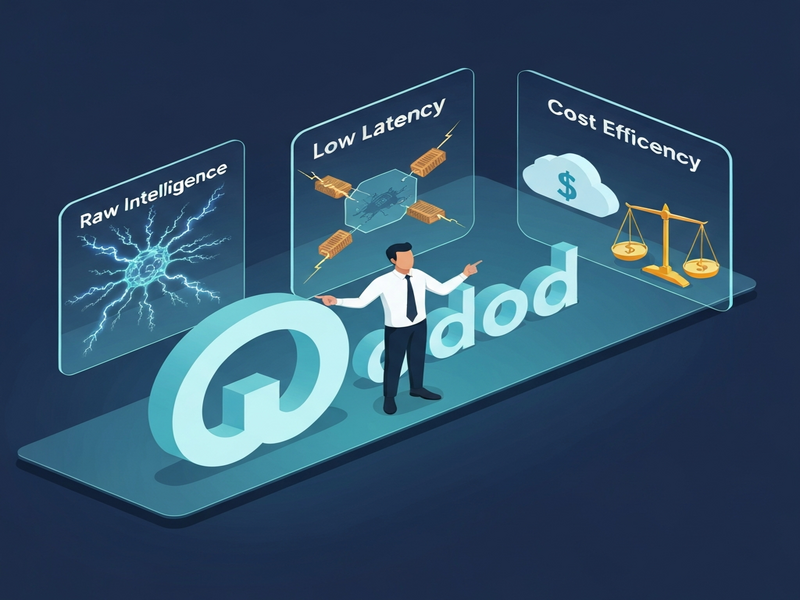
Answer: Google Cloud AI lead Michael Gerstenhaber identifies three frontiers that define modern AI model capability—raw intelligence, latency, and cost efficiency—each shaping how enterprises adopt and scale AI solutions.
Why the AI Landscape Is Shifting Now
In a candid interview with TechCrunch, Google Cloud’s Vertex product VP Michael Gerstenhaber revealed a fresh framework for evaluating AI models. This perspective goes beyond the usual “bigger is better” mantra and pinpoints the three critical frontiers that every AI‑first organization must navigate.
For tech professionals, AI developers, and cloud architects, understanding these frontiers is essential to making informed decisions about model selection, deployment strategies, and budgeting.
The Three Frontiers of Model Capability
1️⃣ Raw Intelligence
Raw intelligence measures a model’s ability to understand, reason, and generate high‑quality outputs. In practice, this translates to:
- Complex code generation (e.g., Gemini Pro’s ability to write production‑ready code).
- Deep contextual comprehension for research‑grade summarization.
- Advanced multi‑modal reasoning that blends text, images, and audio.
Enterprises that prioritize precision—such as fintech firms building algorithmic trading bots—often opt for the most intelligent models, even if they incur higher latency or cost.
2️⃣ Latency
Latency is the time it takes for a model to return a response. For real‑time user interactions, speed can be more valuable than raw power.
- Customer‑support chatbots that must answer within seconds.
- Edge‑deployed AI for IoT devices where network round‑trip adds overhead.
- Interactive gaming AI where delays break immersion.
Gerstenhaber notes that “once the user hangs up, the intelligence of the answer no longer matters.” This highlights the need for a balanced model that fits within a predefined latency budget.
3️⃣ Cost Efficiency
Cost efficiency determines whether a model can be scaled to massive, unpredictable workloads without breaking the budget.
- Social‑media platforms moderating billions of posts daily.
- Large‑scale recommendation engines serving millions of users.
- Enterprise data pipelines that run nightly batch jobs.
Even the smartest model is useless if it cannot be deployed at scale within a reasonable cost structure.
Adoption Challenges Across the Frontiers
While the three frontiers provide a clear decision matrix, organizations still face practical hurdles when moving from prototype to production.
🔧 Missing Infrastructure for Agentic AI
Gerstenhaber points out that “the technology is only two years old, and there’s still a lot of missing infrastructure.” Key gaps include:
- Robust auditing frameworks for AI agents.
- Standardized authorization models for data access.
- Production‑ready monitoring and observability tools.
👥 Human‑in‑the‑Loop (HITL) Requirements
Enterprises such as Google enforce dual‑review processes before releasing AI‑driven features. This reduces risk but adds latency to the development cycle.
💰 Budget Predictability
Scaling AI models to billions of requests demands predictable cost models. Companies often resort to UBOS pricing plans that offer transparent usage tiers, helping finance teams forecast expenses.
“We need patterns for auditing what the agents are doing and for authorizing data to an agent. Those patterns will take time to mature before we see widespread adoption.” – Michael Gerstenhaber
Key Takeaways from Michael Gerstenhaber
- “Models like Gemini Pro are tuned for raw intelligence. Think about writing code. You just want the best code you can get, doesn’t matter if it takes 45 minutes.”
- “Latency matters when you’re handling a customer support call—if the answer takes too long, the user hangs up.”
- “Cost becomes the decisive factor for platforms that need to moderate the entire internet; they must balance intelligence with scalability.”
- “Two years isn’t long enough to see what the intelligence supports in production, and that’s where people are struggling.”
What This Means for Your Business
Strategic Model Selection
Use the three‑frontier framework to match model capabilities with business objectives:
| Use‑Case | Priority Frontier | Recommended Approach |
|---|---|---|
| Enterprise code generation | Raw Intelligence | Deploy Gemini Pro or similar high‑capacity LLMs via UBOS platform overview. |
| Live chat support | Latency | Choose low‑latency endpoints; consider ChatGPT and Telegram integration for rapid response. |
| Social‑media moderation at scale | Cost Efficiency | Leverage cost‑optimized models; explore Enterprise AI platform by UBOS for bulk processing. |
Accelerating Adoption with UBOS Tools
UBOS offers a suite of low‑code tools that help bridge the gap between model capability and production readiness:
- Workflow automation studio – design end‑to‑end pipelines without writing extensive code.
- Web app editor on UBOS – quickly prototype AI‑driven interfaces.
- UBOS templates for quick start – pre‑built solutions like AI SEO Analyzer or AI Video Generator that illustrate cost‑effective deployment patterns.
Future Outlook: Agentic AI at Scale
As the three frontiers converge, we can expect:
- Hybrid models that dynamically trade off intelligence for latency based on real‑time SLAs.
- Pricing innovations (e.g., per‑token vs. per‑inference) that make cost a configurable knob.
- Standardized governance frameworks that embed auditing and authorization directly into the model serving stack.
Companies that adopt these emerging patterns early will gain a competitive edge in delivering AI‑enhanced products at scale.
Conclusion
The three frontiers—raw intelligence, latency, and cost efficiency—form a practical lens for evaluating AI models in today’s cloud‑first world. By aligning model selection with business priorities and leveraging UBOS’s low‑code ecosystem, tech professionals can accelerate adoption while keeping budgets predictable.
Ready to experiment with AI models that respect these frontiers? Explore the UBOS AI models, join the UBOS partner program, or start a free trial from the UBOS homepage. Your next AI‑driven product is just a few clicks away.
Andrii Bidochko
CTO UBOS
Andrii Bidochko is an AI entrepreneur and researcher focused on AI agents, reinforcement learning, and autonomous systems. He writes about the technologies shaping the future of machine intelligence, from frontier models and agent architectures to real-world AI applications.