

- Updated: March 3, 2026
- 5 min read
GitHub Service Disruption on March 3 2026 – Full Analysis
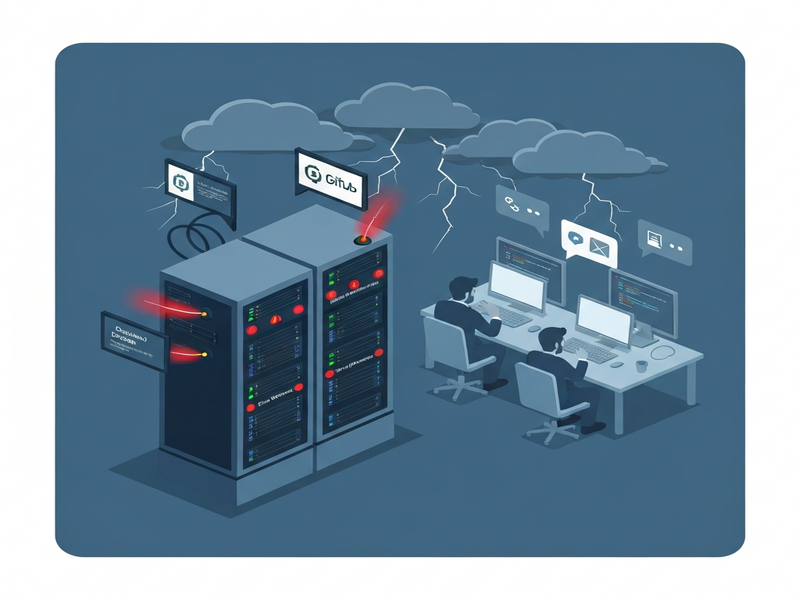
The GitHub incident on March 3 2026 caused a multi‑hour outage that degraded Copilot, Actions, API requests, and core Git operations, but full service was restored by 20:09 UTC.
Overview of the March 3 2026 GitHub Outage
On March 3 2026, developers worldwide experienced a sudden loss of functionality on GitHub, the leading platform for source‑code collaboration. The disruption spanned critical services such as Git operations, Pull Requests, Issues, Actions, Codespaces, and the AI‑powered Copilot assistant. For DevOps engineers and technical decision‑makers, the outage highlighted the fragility of even the most robust cloud‑native ecosystems.
UBOS, a leading UBOS platform overview provider, closely monitors such incidents because they directly affect the reliability expectations of its own Workflow automation studio and the broader AI‑driven tooling ecosystem.
Chronological Timeline of the Incident
- 18:59 UTC – GitHub’s status team begins investigating reports of degraded availability affecting Actions, Copilot, and Issues.
- 19:00 UTC – API Requests and Pull Requests show latency spikes; the incident is escalated to the Site Reliability Engineering (SRE) squad.
- 19:03 UTC – Widespread degradation observed across Git operations, Webhooks, and Codespaces.
- 19:17 UTC – Root cause identified: a mis‑routed internal load‑balancer rule that throttled traffic to the Copilot inference cluster.
- 19:24 UTC – 19:36 UTC – Services fluctuate; Webhooks intermittently fire, Issues experience timeouts, and Git push/pull operations stall.
- 19:54 UTC – 19:55 UTC – Load‑balancer rule corrected; Git Operations and Actions begin to recover.
- 20:06 UTC – 20:09 UTC – Full restoration confirmed across all services; the incident is declared resolved.
Technical Impact on Key GitHub Services
Copilot AI Code Suggestions
Copilot, powered by OpenAI models, became unavailable for roughly 70 minutes. Developers reported “no suggestions” errors in VS Code and the web editor, forcing them to revert to manual coding. The outage underscored the dependency on real‑time AI inference services for modern development workflows.
GitHub Actions & CI/CD Pipelines
Automated workflows stalled as the Actions runner fleet could not fetch job definitions. Build times increased dramatically, and several production releases were delayed. Teams that had Enterprise AI platform by UBOS integrations reported smoother fallback because of pre‑configured redundancy.
API Rate Limits & Webhooks
API endpoints returned HTTP 503 responses, causing third‑party integrations (e.g., CI tools, monitoring dashboards) to hit rate‑limit thresholds. Webhook payloads were dropped, breaking notification pipelines for issue tracking and deployment alerts.
Core Git Operations (Push/Pull)
Developers experienced timeouts when pushing commits or pulling the latest changes. The latency was traced back to the same load‑balancer misconfiguration that affected Copilot, illustrating how a single networking error can cascade across unrelated services.
Codespaces & Development Environments
While not completely offline, Codespaces suffered degraded performance, with increased container start‑up times and occasional disconnections. Users relying on cloud‑based dev environments felt the impact most acutely.
GitHub’s Immediate Response and Mitigation Steps
GitHub’s incident communication followed a transparent, step‑by‑step approach:
- Real‑time Status Updates – The GitHub status page displayed live incident banners and timestamps.
- Root‑Cause Identification – Within 18 minutes, the SRE team pinpointed the load‑balancer rule error.
- Rollback & Patch Deployment – Engineers rolled back the faulty configuration and applied a corrective patch across all affected clusters.
- Post‑Incident Review – A detailed post‑mortem is promised, covering the chain of events, mitigation effectiveness, and preventive actions.
- Customer Outreach – Affected organizations received email notifications and guidance on how to verify the integrity of their CI/CD pipelines after restoration.
GitHub also highlighted the importance of observability and announced upcoming enhancements to its incident‑response tooling, which aligns with the automation capabilities offered by Web app editor on UBOS.
Recommendations for Developers and DevOps Teams
To mitigate the impact of similar outages, consider the following best practices:
- Implement Redundant CI/CD Runners – Use self‑hosted runners or multi‑cloud pipelines to avoid single‑point failures.
- Cache Critical Dependencies – Store frequently used libraries and Docker layers in a private registry to reduce reliance on external fetches.
- Monitor API Health Proactively – Integrate status‑page APIs (e.g., GitHub’s
/statusendpoint) into your monitoring stack. - Graceful Degradation for AI Features – Design fallback logic when Copilot or other AI assistants are unavailable, similar to the approach used in AI Chatbot template.
- Leverage Workflow Automation – Automate incident‑response playbooks with tools like AI SEO Analyzer or AI Article Copywriter to generate rapid status updates.
- Adopt Multi‑Region Deployments – Distribute critical services across geographic regions to reduce latency spikes caused by localized network issues.
- Regularly Review Load‑Balancer Configurations – Conduct automated audits of routing rules, especially after major platform upgrades.
Future Reliability Measures and Industry Lessons
The GitHub incident serves as a case study for the broader SaaS ecosystem. Key takeaways include:
- Observability as a First‑Class Citizen
- End‑to‑end tracing, real‑time metrics, and automated alerting must be baked into the platform’s core, not bolted on after the fact.
- AI Service Isolation
- AI inference workloads (e.g., Copilot) should run in isolated clusters with dedicated load‑balancers to prevent cross‑service contamination.
- Customer‑Facing Transparency
- Clear, timestamped communication reduces panic and enables teams to make informed decisions during an outage.
- Strategic Use of Low‑Code Platforms
- Platforms like UBOS templates for quick start empower organizations to spin up backup automation pipelines within minutes.
- Investment in Redundancy
- Building multi‑cloud redundancy, as advocated by the UBOS partner program, can dramatically reduce mean‑time‑to‑recovery (MTTR).
Conclusion
The March 3 2026 GitHub outage reminded the developer community that even the most mature platforms can experience cascading failures. By adopting robust monitoring, redundancy, and automated response playbooks—principles championed by solutions such as the AI marketing agents and the UBOS solutions for SMBs—organizations can safeguard productivity and maintain confidence in their toolchains.
For a full technical post‑mortem, refer to GitHub’s official incident report on the GitHub status page. Stay informed with UBOS for the latest analyses, templates, and AI‑driven automation strategies.
Andrii Bidochko
CTO UBOS
Andrii Bidochko is an AI entrepreneur and researcher focused on AI agents, reinforcement learning, and autonomous systems. He writes about the technologies shaping the future of machine intelligence, from frontier models and agent architectures to real-world AI applications.