

- Updated: February 27, 2026
- 6 min read
Emuko: High‑Performance Rust‑Based RISC‑V Emulator Now Available
Emuko is a high‑performance, Rust‑written RISC‑V emulator that can fully boot Linux, offers JIT compilation for ARM64 and x86_64 hosts, snapshot/restore capabilities, and an HTTP API for remote control.
Why Emuko Matters to Modern RISC‑V Developers
RISC‑V is rapidly becoming the open‑source hardware ISA of choice for startups, research labs, and large enterprises. Yet, developers often struggle to find an emulator that balances speed, accuracy, and ease of use. Emuko fills that gap by delivering a pure‑Rust solution that runs on mainstream x86_64 and ARM64 machines, making it possible to prototype, test, and debug Linux kernels without needing physical hardware.
Key differentiators
- JIT compilation for near‑native execution speed.
- Full Linux boot with BusyBox userland and interactive shell.
- Snapshot and restore for instant state recovery.
- Daemon mode with an HTTP API and live UART injection.
- Minimal dependencies – only
zstdfor compression.
Feature Deep‑Dive
Architecture Support
Emuko implements the RV64IMAFDC ISA with full M/S/U privilege levels and Sv39 virtual memory. This coverage ensures that developers can run complex OS workloads, from simple initramfs shells to full Debian images.
Just‑In‑Time (JIT) Compilation
The JIT engine automatically selects the optimal backend for the host CPU—either ARM64 or x86_64—delivering up to 10× speed improvements over pure interpretation. An adaptive selection algorithm chooses the best path at runtime, so you never have to manually tune the emulator.
Linux Boot Capability
With a single command, Emuko downloads a verified Debian RISC‑V kernel and initrd, then boots straight into a BusyBox shell. The built‑in console provides full UART access, allowing you to interact with the guest OS as if you were connected to a physical serial port.
Snapshot & Restore
Emuko’s snapshot feature captures the entire machine state—including CPU registers, memory, and peripheral registers—into a compressed file. Restoring a snapshot is instantaneous, making it ideal for regression testing, CI pipelines, or educational demos.
Daemon Mode & HTTP API
Running Emuko as a daemon exposes a RESTful HTTP API (default http://127.0.0.1:7788/v1/api/) for programmatic control. You can start, stop, snapshot, or inject UART commands from any language that can issue HTTP requests. A WebSocket endpoint (ws://127.0.0.1:7788/v1/ws/uart) streams live console output, enabling web‑based front‑ends.
Differential Checker
To guarantee JIT correctness, Emuko runs a differential checker that compares JIT‑generated results against the interpreter on a per‑instruction basis. Any divergence is logged, providing developers with confidence that performance gains never compromise functional accuracy.
Peripheral Emulation
Emuko supports a suite of essential RISC‑V peripherals:
- UART 16550 for serial console I/O.
- CLINT (Core Local Interruptor) for timer and inter‑processor interrupts.
- PLIC (Platform‑Level Interrupt Controller) for external interrupt handling.
- SBI 1.0 (Supervisor Binary Interface) for boot‑loader services.
- FDT (Flattened Device Tree) generation for automatic hardware description.
Benefits for Developers, Start‑ups, and Enterprises
Accelerated Development Cycles
Because Emuko runs entirely in software, you can spin up a RISC‑V Linux environment on a laptop in seconds. This eliminates the need for costly FPGA boards or cloud‑based hardware rentals, dramatically shortening prototyping timelines.
CI/CD Integration
Snapshot/restore and the HTTP API make Emuko a natural fit for continuous integration pipelines. Tests can launch an emulator, run a suite of kernel or driver tests, snapshot the state, and compare results across commits—all without leaving the build server.
Educational Platforms
Instructors can use Emuko to demonstrate low‑level concepts such as privilege level transitions, virtual memory paging, and interrupt handling. The web‑based console (via WebSocket) enables remote classrooms where each student interacts with their own isolated RISC‑V instance.
Research & Simulation
Researchers exploring new ISA extensions or custom hardware accelerators can quickly prototype their changes in Emuko, leveraging the differential checker to ensure functional parity before moving to silicon.
Enterprise‑Scale Testing
Large organizations can deploy Emuko clusters behind a load balancer, using the HTTP API to orchestrate thousands of parallel Linux boots for stress testing, security hardening, or firmware validation.
Visual Overview of Emuko’s Architecture
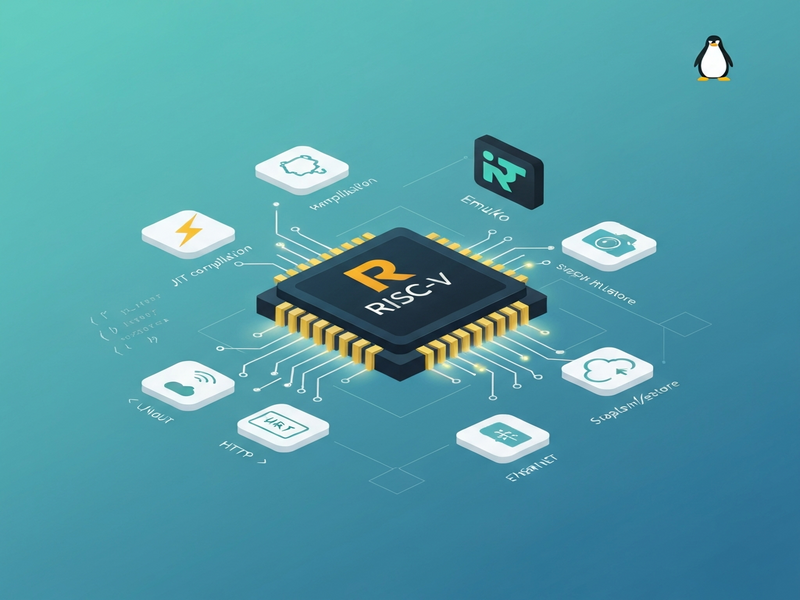
The illustration highlights the modular Rust core (green), the JIT backends for ARM64 and x86_64 (blue), and the peripheral stack (orange). The thin orange line at the bottom represents the HTTP/WS API that bridges external tools with the emulator’s internal state.
Get Started with Emuko Today
Ready to experiment with the fastest open‑source RISC‑V emulator? Clone the repository, build with Cargo, and launch your first Linux boot in under a minute:
git clone https://github.com/wkoszek/emuko.git
cd emuko
cargo build --release
./target/release/emuko dow   # download Debian kernel & initrd
./target/release/emuko start # boot Linux
For detailed documentation, visit the official site emuko.dev or explore the GitHub repository. The community welcomes contributions, bug reports, and feature requests.
How Emuko Fits Into the UBOS Ecosystem
UBOS provides a unified platform for building AI‑enhanced applications, and Emuko can serve as a powerful backend for RISC‑V‑based AI workloads. For instance, you can combine the OpenAI ChatGPT integration with a RISC‑V emulator to test edge‑AI models on simulated hardware before deployment.
Developers looking for rapid prototyping can leverage the UBOS templates for quick start, which include pre‑configured Dockerfiles and CI pipelines that call Emuko’s HTTP API for automated testing.
Our Workflow automation studio lets you orchestrate Emuko snapshots as part of a larger data‑processing workflow, enabling seamless hand‑off between hardware simulation and AI model inference.
For startups, the UBOS for startups program offers credits that can be applied to cloud resources needed for large‑scale Emuko simulations, while SMBs can explore the UBOS solutions for SMBs to integrate RISC‑V emulation into their product testing pipelines.
Enterprises seeking a comprehensive AI stack can adopt the Enterprise AI platform by UBOS, which includes monitoring, security, and governance layers that complement Emuko’s open‑source nature.
To understand the broader capabilities of the UBOS platform, check the UBOS platform overview. It outlines how Emuko can be combined with other integrations such as ChatGPT and Telegram integration for remote debugging via chat bots.
Explore the UBOS portfolio examples to see real‑world cases where hardware emulation and AI agents drive business value.
When you’re ready to scale, the UBOS pricing plans provide flexible options that align with your simulation workload intensity.
Finally, developers interested in contributing to the UBOS ecosystem can join the UBOS partner program, which offers co‑marketing, technical support, and early access to new features.
Conclusion
Emuko stands out as a lean, high‑performance RISC‑V emulator written in Rust, delivering JIT acceleration, snapshot capabilities, and a programmable HTTP API—all while keeping the dependency footprint to a single compression library. Whether you are a solo developer, a startup building the next AI‑enabled edge device, or an enterprise needing massive parallel Linux boots for validation, Emuko provides the speed and flexibility that traditional emulators lack.
By integrating Emuko with UBOS’s AI‑centric tooling, you can create end‑to‑end pipelines that move from hardware simulation to AI inference without leaving a single platform. Start experimenting today, and let the open‑source community accelerate your RISC‑V journey.
Andrii Bidochko
CTO UBOS
Andrii Bidochko is an AI entrepreneur and researcher focused on AI agents, reinforcement learning, and autonomous systems. He writes about the technologies shaping the future of machine intelligence, from frontier models and agent architectures to real-world AI applications.