

- Updated: February 1, 2026
- 7 min read
Doom Comes to Earbuds: Portable Gaming Revolution
Doom has been successfully ported to a pair of smart earbuds, turning the classic first‑person shooter into a truly portable, on‑the‑go gaming experience.
A New Frontier for Classic Gaming
Imagine slipping on a set of earbuds, tapping a few virtual buttons, and instantly being thrust into the demon‑infested corridors of Doom. This isn’t a futuristic fantasy—it’s happening right now thanks to an ingenious hack that runs the 1993 legend on a tiny, Bluetooth‑enabled earbud. The project, showcased at Doombuds, demonstrates how earbud gaming can redefine portable gaming and spark fresh waves of tech innovation.
For tech enthusiasts, gamers, and early adopters, this breakthrough raises a simple yet powerful question: how far can we push the limits of everyday hardware? The answer lies in clever software engineering, open‑source firmware, and a dash of nostalgia.
Project Overview: Doom on an Earbud
The earbud gaming initiative centers on a pair of Pinebuds Pro—earbuds that run open‑source firmware and expose UART pins for high‑speed data transfer. By compiling the original Doom engine for the ARM Cortex‑M4F processor inside the earbuds, developers created a self‑contained game client that streams video frames to a companion web app.
Key components of the system include:
- A stripped‑down Doom binary optimized for 300 MHz CPU and limited RAM.
- A JPEG encoder that compresses each frame into an MJPEG stream, keeping bandwidth under 2.4 Mbps.
- A lightweight web server that queues players, forwards keyboard input, and renders the video feed in the browser.
- Open‑source repositories (
DOOMBudsandDOOMBUDS‑JS) that let anyone replicate the setup.
The result is a playable Doom experience at roughly 15‑18 FPS, with responsive controls mapped to standard WASD keys and mouse‑like look controls via arrow keys. While the frame rate isn’t console‑level, the novelty of gaming from a single earbud is undeniable.
This project also demonstrates the power of community‑driven hardware hacking. All source code is publicly available, inviting developers to experiment, improve performance, or even port other retro titles.
Under the Hood: Architecture & Performance
Hardware Constraints
The Pinebuds Pro provide:
- CPU: ARM Cortex‑M4F, upgradable to 300 MHz.
- RAM: 768 KB (expandable to ~992 KB after disabling the co‑processor).
- Flash: 4 MB (just enough for a trimmed Doom WAD).
- UART interface delivering up to 2.4 Mbps of raw bandwidth.
Video Pipeline
Because earbuds lack a display, the video must travel to a host device. The pipeline works as follows:
- The Doom engine renders a 320 × 200, 8‑bit framebuffer (≈96 KB per frame).
- A lightweight JPEG encoder compresses each frame to ~11‑13 KB.
- Compressed frames are streamed over UART as an MJPEG sequence.
- The host web server receives the stream, decodes it, and pushes it to the browser via WebSocket.
Theoretical maximum FPS ranges from 22 to 27, but real‑world performance settles around 15‑18 FPS due to CPU load from JPEG encoding and network jitter.
Control Pathway
Player input travels in the opposite direction:
- Keyboard events captured by the web client are sent to the server.
- The server forwards them over UART to the earbud, where a tiny driver injects them into Doom’s input buffer.
Software Optimizations
To fit within the tight memory budget, developers applied several tricks:
- Removed unused Doom subsystems (e.g., networking, high‑resolution textures).
- Stored lookup tables in flash and marked static data as
const. - Used a trimmed WAD file (Your Speaking Avatar template) that shrinks the original 4.2 MB to 1.7 MB.
These optimizations showcase how classic software can be resurrected on ultra‑constrained devices, a lesson that resonates across the tech innovation landscape.
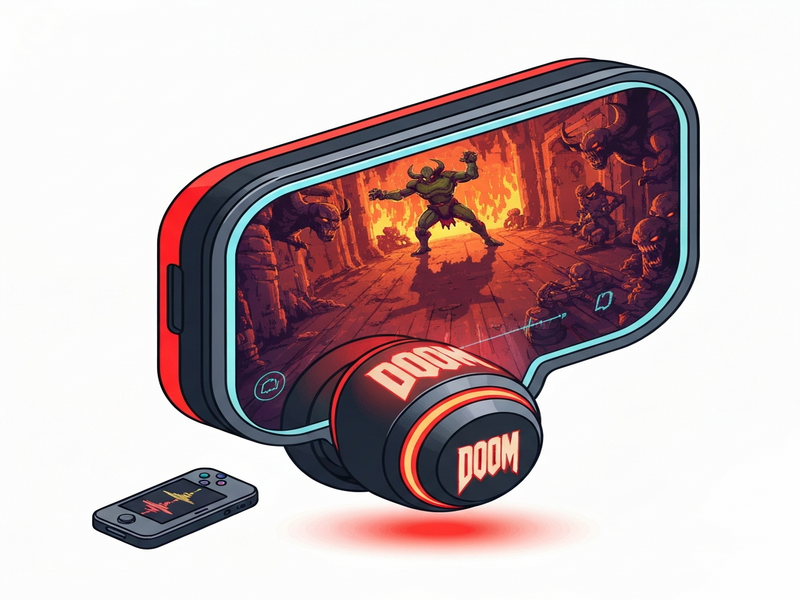
A prototype of Doom running on a Pinebuds Pro earbud.
Why This Matters: Portable Gaming & Tech Innovation
Portability has always been a driving force in gaming—from handheld consoles to cloud streaming. Earbud gaming pushes the envelope even further by turning a device that traditionally serves only audio into a full‑fledged gaming endpoint.
Redefining “Portable”
Traditional portable gaming devices still require a screen, battery, and often a dedicated controller. An earbud, however, is already part of daily life, always within reach, and powered by a tiny rechargeable cell. By leveraging the earbud’s existing hardware, developers can create a truly hands‑free gaming experience that fits in a pocket.
Synergy with AI Services
Imagine pairing the Doom earbud with AI‑driven features:
- Real‑time voice commands powered by ElevenLabs AI voice integration to switch weapons or pause the game.
- Dynamic difficulty adjustment using OpenAI ChatGPT integration that analyses player performance and suggests strategies.
- Context‑aware subtitles generated by a Chroma DB integration to store and retrieve game state data.
Business Opportunities
For startups and SMBs, the earbud platform opens a new market segment:
- Developers can sell custom game packs through the UBOS templates for quick start, reducing time‑to‑market.
- Brands can embed interactive marketing experiences using AI marketing agents that respond to user actions.
- Enterprises can prototype immersive training simulations via the Enterprise AI platform by UBOS, leveraging the same low‑latency audio channel.
These possibilities illustrate how a single hardware hack can ripple across multiple industry verticals, from entertainment to education and beyond.
Looking Ahead: Community, Challenges, and Next Steps
The initial reaction from the gaming community has been a mix of awe and curiosity. Forums are buzzing with suggestions to add multiplayer support, integrate modern shaders, or even port other classics like Quake or Wolfenstein 3D.
Scalability Concerns
Running a high‑traffic queue on a single VPS proved challenging during early demos. The developers plan to migrate to a more robust cloud infrastructure, possibly leveraging the Workflow automation studio to orchestrate scaling and load‑balancing automatically.
Potential Feature Roadmap
- Voice‑controlled menus via ChatGPT and Telegram integration for remote play.
- AI‑generated level designs using the AI Video Generator to create custom demonic arenas.
- Real‑time analytics dashboards powered by AI SEO Analyzer to track player engagement.
Open‑Source Momentum
Because the codebase is fully open, contributors can fork the project, add new features, or adapt it for other hardware platforms (e.g., true wireless earbuds from other manufacturers). The UBOS partner program could serve as a conduit for hardware partners to certify their devices for similar hacks.
In short, the Doom earbud project is more than a novelty; it’s a proof‑of‑concept that encourages a broader conversation about the future of portable gaming and the role of tech innovation in repurposing everyday devices.
Conclusion: A Glimpse into the Future of Gaming
Porting Doom to an earbud proves that with clever engineering, even the most constrained hardware can host immersive experiences. As developers continue to blend AI, low‑power microcontrollers, and open‑source ecosystems, we can expect a surge of new earbud gaming titles, innovative control schemes, and cross‑platform integrations.
For those eager to explore similar projects, the UBOS platform overview offers a suite of tools—from the Web app editor on UBOS to the UBOS portfolio examples—that can accelerate development cycles.
Whether you’re a startup looking for a unique product hook (UBOS for startups), an SMB seeking AI‑enhanced solutions (UBOS solutions for SMBs), or an enterprise aiming to pioneer immersive training (Enterprise AI platform by UBOS), the lessons from the Doom earbud project are directly applicable.
Stay tuned as the community pushes the boundaries of what earbuds can do—because the next level of portable gaming might just be sitting in your ear.