

- Updated: February 2, 2026
- 6 min read
Carbon Robotics Launches Large Plant Model AI for Real‑Time Weed Detection
Carbon Robotics Unveils Large Plant Model: A Game‑Changer for AI Plant Detection
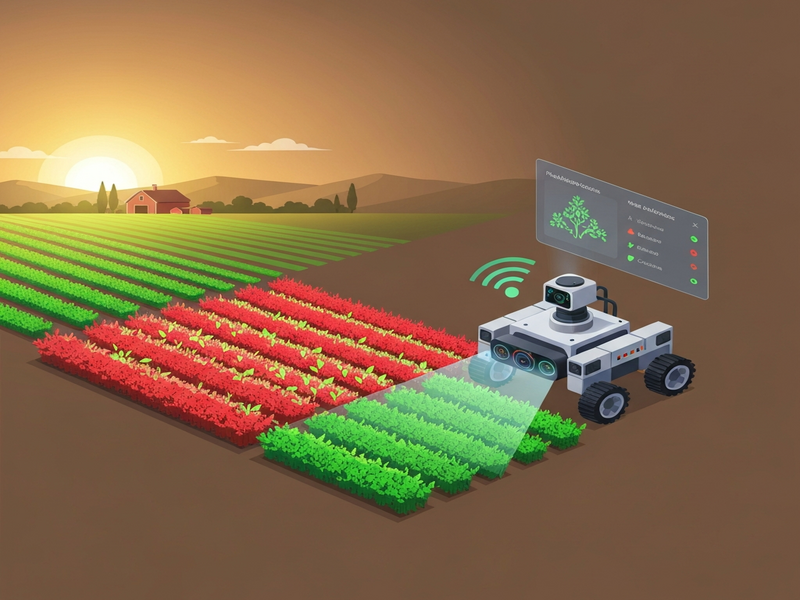
Carbon Robotics has launched the Large Plant Model (LPM), an AI plant detection system that can instantly recognize and classify any plant species in the field, enabling farmers to target weeds in real‑time without the need for costly retraining cycles.
In a landmark announcement on February 2, 2026, Seattle‑based Carbon Robotics revealed a breakthrough in agritech AI: a neural network trained on more than 150 million plant images that powers its autonomous LaserWeeder fleet. The new model, dubbed the Large Plant Model, moves the industry beyond static weed libraries and into a dynamic, on‑the‑fly identification paradigm that promises to slash labor costs, reduce herbicide usage, and accelerate the path to sustainable farming.
For agriculture technology professionals, investors, and sustainability enthusiasts, the LPM represents a tangible step toward truly intelligent, data‑driven farms. Below we unpack the model’s architecture, its immediate impact on weed control, and why it matters for the broader AI‑enabled agriculture ecosystem.
Large Plant Model: Training Data, Architecture, and Capabilities
Massive, Multi‑Regional Training Set
The LPM was trained on a curated dataset of 150 million photos and sensor readings collected from over 100 farms across 15 countries. Each image is paired with precise geo‑tagging, spectral data, and agronomic metadata, allowing the model to learn subtle variations in leaf shape, color, and growth stage that differentiate crops from weeds—even when they appear visually similar.
Deep‑Learning Architecture
Leveraging a hybrid of Chroma DB integration for vector storage and a transformer‑based vision backbone, the LPM can process up to 30 frames per second on the robot’s edge‑compute module. This speed enables real‑time decision making—the robot can scan a row, identify a weed, and fire a precision laser within milliseconds.
Zero‑Retraining Weed Identification
Prior to LPM, introducing a new weed required a full data‑labeling and model‑retraining cycle that could take up to 24 hours. The new model’s few‑shot learning capability means a farmer can simply upload a single reference photo of an emerging weed, and the LPM instantly incorporates it into its decision matrix. This “instant‑learn” feature eliminates downtime and keeps the fleet adaptive to evolving field conditions.
Seamless Integration with Carbon AI
The LPM is delivered to existing machines via an over‑the‑air software update to the UBOS platform overview of autonomous robotics. Once installed, the robot’s UI lets operators tag images as “kill” or “protect,” feeding continuous feedback that refines the model’s confidence scores.
How LPM Transforms Weed Control and Farm Efficiency
The practical implications of instant plant recognition are profound. Below is a concise list of the most immediate benefits:
- Reduced Herbicide Use: By targeting weeds with pinpoint laser strikes, farms can cut chemical applications by up to 90 %.
- Labor Savings: Automated identification removes the need for manual scouting, freeing up labor for higher‑value tasks.
- Higher Crop Yields: Early, precise weed removal reduces competition for nutrients, water, and light, translating into 5‑15 % yield gains.
- Scalable Precision: The model works across diverse climates and soil types, making it suitable for both smallholder plots and large‑scale agribusinesses.
- Data‑Driven Insights: Continuous image capture builds a longitudinal dataset that can be mined for disease detection, growth forecasting, and soil health analytics.
For UBOS solutions for SMBs, the LPM’s low‑maintenance workflow aligns perfectly with limited staffing budgets, while Enterprise AI platform by UBOS customers can integrate the plant data into broader ERP and supply‑chain systems for end‑to‑end optimization.
Carbon Robotics: From Startup to Multimillion‑Dollar Agritech Leader
Founded in 2018, Carbon Robotics began shipping its first LaserWeeder prototypes in 2022. The company’s mission—to replace chemical herbicides with AI‑driven laser precision—has attracted a strong investor base. To date, Carbon Robotics has raised **over $185 million** from marquee backers such as NVIDIA NVentures, Bond, and Anthos Capital.
The funding has fueled rapid expansion into new markets, including Europe, South America, and Southeast Asia. With a growing fleet of more than 1,200 autonomous robots, the firm now processes upwards of 2 billion plant observations per year, feeding the LPM’s ever‑expanding knowledge base.
Executive Insight
“The farmer can live in real time and say, ‘Hey, this is a new weed. I want you to kill this,’ and that was something that had never been done before. There’s no new labeling or retraining because the Large Plant Model understands, at a much deeper level, what it’s looking at and the type of plant.” – Paul Mikesell, Founder & CEO, Carbon Robotics
Broader Implications for Agritech and Sustainable Farming
The LPM’s release signals a shift from static, rule‑based weed management toward a truly adaptive, learning‑centric approach. Several industry trends are likely to accelerate:
- AI‑First Farm Management: Platforms will embed plant‑recognition APIs directly into field‑level decision tools, reducing reliance on third‑party scouting services.
- Regulatory Favorability: Governments pushing for reduced pesticide usage will view laser‑based, AI‑driven solutions as compliant pathways to meet sustainability targets.
- Cross‑Domain Data Fusion: Combining LPM outputs with satellite imagery, soil sensors, and weather forecasts will enable hyper‑local agronomic prescriptions.
- New Business Models: Subscription‑based robot‑as‑a‑service (RaaS) offerings can now promise “instant weed updates” as a differentiator.
Companies building complementary AI tools—such as AI marketing agents that promote sustainable practices, or the AI SEO Analyzer that helps agritech firms improve their online visibility—stand to benefit from the heightened attention on AI‑driven farming solutions.
Explore How UBOS Can Accelerate Your AI‑Powered Farming Journey
Whether you are a startup looking to prototype a new agritech service or an established enterprise seeking to integrate plant‑level intelligence, UBOS offers a suite of tools that complement Carbon Robotics’ LPM:
- Kick‑start development with the UBOS templates for quick start, including pre‑built vision pipelines.
- Build custom dashboards using the Web app editor on UBOS to visualize real‑time weed maps.
- Automate data pipelines with the Workflow automation studio, linking LPM outputs to irrigation controls.
- Scale your solution with the Enterprise AI platform by UBOS, ensuring security and compliance across multiple farms.
- Leverage AI‑generated content for outreach—try the AI Article Copywriter or the AI Video Generator to showcase your sustainability story.
- Enhance visual communication with the AI Image Generator for field‑level infographics.
- Optimize your LinkedIn presence using the AI LinkedIn Post Optimization tool.
Ready to see the Large Plant Model in action? Visit the UBOS homepage for a live demo of how AI can be woven into every layer of modern agriculture.
Read the Original Announcement
For the full technical briefing and additional commentary from Carbon Robotics’ leadership, see the TechCrunch article.
Andrii Bidochko
CTO UBOS
Andrii Bidochko is an AI entrepreneur and researcher focused on AI agents, reinforcement learning, and autonomous systems. He writes about the technologies shaping the future of machine intelligence, from frontier models and agent architectures to real-world AI applications.