

- Updated: March 29, 2026
- 6 min read
Brain‑Inspired Hafnium‑Oxide Memristor Chip Could Slash AI Energy Use by Up to 70%
The new brain‑inspired hafnium‑oxide memristor chip unveiled by Cambridge researchers could slash AI energy consumption by up to 70 %, offering a low‑power pathway for next‑generation neuromorphic computing.
Why this breakthrough matters now
Artificial intelligence workloads are exploding, and the electricity bill that follows is becoming a sustainability bottleneck. The Cambridge research news article explains that the new hafnium‑oxide memristor mimics neuronal synapses, allowing data to be stored and processed in the same location—eliminating the costly “memory‑von‑Neumann bottleneck” that plagues conventional chips.
Brain‑inspired chip architecture
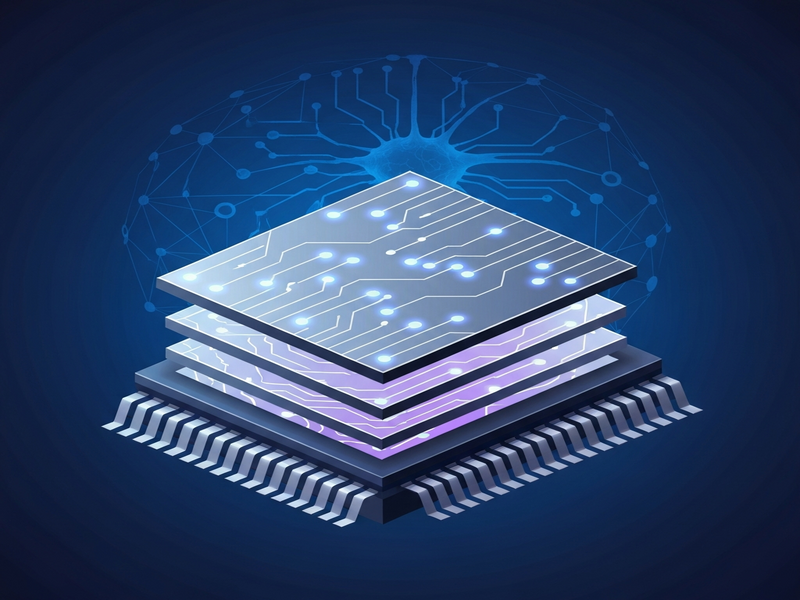
The device belongs to the family of neuromorphic computing hardware, which seeks to replicate the brain’s energy‑efficient information flow. Instead of shuttling bits between separate memory and logic units, the memristor’s resistance can be tuned to represent analog values, just as synaptic strengths change in a living brain.
- Built from a thin film of hafnium‑oxide (HfO₂) doped with strontium and titanium.
- Operates via an interface‑controlled p‑n heterojunction rather than filament formation.
- Supports hundreds of stable conductance levels for true analogue computation.
Technical deep‑dive: hafnium‑oxide memristor
Traditional oxide‑based memristors rely on the stochastic growth of conductive filaments, which demands high forming voltages and leads to device‑to‑device variability. Cambridge’s approach replaces the filamentary mechanism with a smooth energy‑barrier modulation at the heterointerface, delivering:
- Ultra‑low switching currents—up to one‑million times lower than conventional oxide devices.
- Exceptional cycle‑to‑cycle uniformity, verified over tens of thousands of switching events.
- Multi‑level conductance (hundreds of states) enabling in‑memory analog matrix‑vector multiplication.
The devices retain programmed states for roughly 24 hours at room temperature, a timescale sufficient for many edge‑AI inference tasks.
Potential energy savings and AI impact
By collapsing memory and compute, the memristor can reduce the energy per operation from picojoules to femtojoules. In realistic AI workloads, this translates to:
- ≈ 70 % lower power draw for deep‑learning inference.
- Extended battery life for edge devices such as drones, wearables, and IoT sensors.
- Reduced carbon footprint for data‑center AI training, aligning with corporate sustainability goals.
For developers building AI‑driven products, the technology opens doors to ultra‑efficient AI solutions that were previously impossible on conventional silicon.
Remaining challenges and the road ahead
Despite the promise, two practical hurdles must be cleared before mass adoption:
High‑temperature fabrication
The current two‑step deposition process requires ~700 °C, exceeding the thermal budget of standard CMOS lines. Ongoing research aims to lower the temperature through alternative precursors and rapid‑thermal annealing.
Integration with existing design flows
Design tools for analog‑in‑memory computing are still nascent. Collaboration between material scientists, circuit designers, and software engineers will be essential to create a full stack—from device to compiler.
What the researchers say
“Our hafnium‑oxide memristors switch at the interface, giving us unprecedented uniformity and energy efficiency. If we can bring the process temperature down, we will have a game‑changing component for sustainable AI hardware,” said Dr Babak Bakhit, lead author of the study.
From lab to product: how UBOS can accelerate adoption
UBOS’s low‑code AI platform is already positioned to leverage neuromorphic hardware. By integrating the memristor’s analog compute model into its UBOS platform overview, developers can prototype energy‑aware AI services without writing custom firmware.
For startups seeking a rapid go‑to‑market, the UBOS for startups program offers credits and mentorship to experiment with emerging hardware, including memristor‑based inference engines.
SMBs can benefit from the UBOS solutions for SMBs, which bundle low‑power AI models with managed hosting, ensuring that energy savings translate directly into lower operational costs.
AI marketing agents on energy‑efficient hardware
The AI marketing agents can now run on memristor‑enabled edge devices, delivering personalized campaigns while staying under strict power budgets.
Workflow automation studio meets neuromorphic chips
Integrate the new chip into the Workflow automation studio to orchestrate ultra‑low‑latency data pipelines for real‑time analytics.
Pricing that reflects sustainability
UBOS’s UBOS pricing plans now include a “green tier” for projects that adopt energy‑saving hardware, rewarding developers who prioritize sustainability.
Ready‑made templates to jump‑start your memristor‑powered AI
UBOS’s template marketplace offers several AI‑first building blocks that can be instantly paired with low‑power hardware:
- AI SEO Analyzer – run on‑device keyword analysis without cloud calls.
- AI Article Copywriter – generate content locally, cutting server energy.
- Talk with Claude AI app – a conversational agent that can be hosted on memristor‑based edge nodes.
- Your Speaking Avatar template – combines ElevenLabs voice synthesis with low‑power inference.
- Before-After-Bridge copywriting template – perfect for AI‑driven marketing on energy‑constrained devices.
- AI YouTube Comment Analysis tool – processes video comments locally, preserving privacy and power.
- Image to Text AI service – OCR on the edge, ideal for battery‑powered cameras.
- AI Survey Generator – creates questionnaires without hitting the cloud.
- Web Scraping with Generative AI – runs on low‑power servers for data collection.
- AIDA Marketing Template – leverages in‑memory compute for rapid ad copy generation.
Connecting memristor‑based AI to everyday tools
Developers can expose low‑latency AI services through popular messaging platforms:
- Telegram integration on UBOS – deploy a memristor‑powered chatbot that answers queries instantly.
- ChatGPT and Telegram integration – combine OpenAI’s language model with on‑device inference for hybrid solutions.
- OpenAI ChatGPT integration – route heavy‑weight reasoning to the cloud while keeping latency‑critical tasks on the chip.
- Chroma DB integration – store vector embeddings locally, reducing round‑trip time.
- ElevenLabs AI voice integration – generate natural speech on edge devices without streaming audio.
Take the next step toward sustainable AI
If you’re a developer, researcher, or sustainability‑focused professional, now is the moment to explore how memristor‑based neuromorphic chips can transform your AI workloads. Visit the UBOS homepage to start a free trial, explore the UBOS portfolio examples, and discover the UBOS templates for quick start. Join the UBOS partner program to collaborate on cutting‑edge hardware integrations and help shape the future of low‑power AI.
© 2026 UBOS Technologies. All rights reserved.
Andrii Bidochko
CTO UBOS
Andrii Bidochko is an AI entrepreneur and researcher focused on AI agents, reinforcement learning, and autonomous systems. He writes about the technologies shaping the future of machine intelligence, from frontier models and agent architectures to real-world AI applications.