

- Updated: March 26, 2026
- 6 min read
Arbor Energy Secures Billion‑Dollar Halcyon Rocket Turbine Order to Power Grids
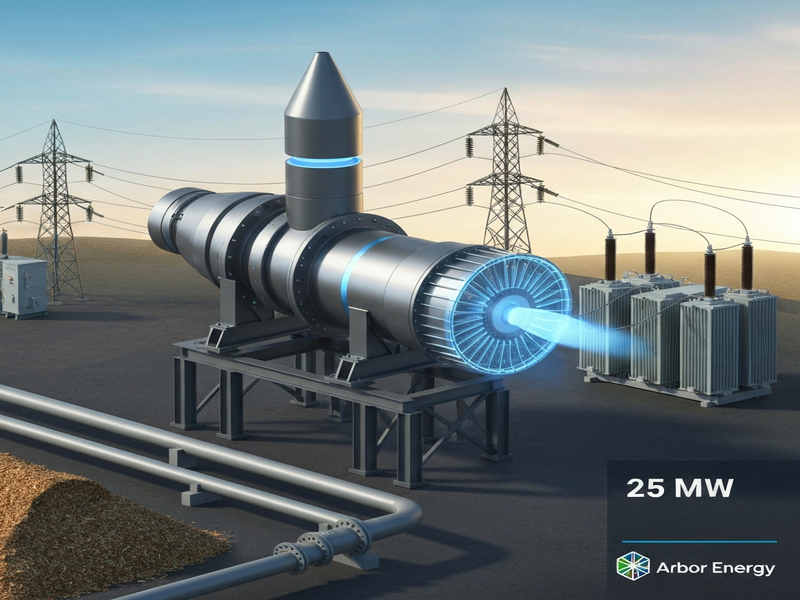
Arbor Energy has secured a billion‑dollar order for its Halcyon rocket turbines, a deal that could add up to 5 GW of carbon‑negative power to the grid by 2030.
Why the Halcyon Order Matters for the Energy Landscape
In late March 2026, Arbor Energy announced a landmark contract with GridMarket, a power‑project broker serving data centers and heavy industry. The agreement covers up to 200 modular turbines, each capable of generating 25 MW, translating to a potential 5 GW of clean capacity. If fully executed, the deal is valued in the single‑digit billions of dollars, positioning Arbor as a serious contender in the race to decarbonize the grid.
Beyond the headline‑grabbing price tag, the order showcases a new class of turbine technology—derived from rocket turbomachinery—that promises rapid manufacturing, fuel flexibility, and a pathway to carbon‑negative electricity.
Halcyon Rocket Turbine: Specs, Design, and Fuel Flexibility
The Halcyon turbine leverages high‑performance engine designs originally built for spaceflight. Its key attributes include:
- Modular 3‑D‑printed architecture that reduces lead times compared with traditional cast‑blade turbines.
- 25 MW output per unit, scalable through stacking of modules.
- Fuel‑agnostic combustion chamber—initially optimized for biomass syngas, now also certified for low‑leak natural gas.
- Integrated carbon‑capture ready design that isolates pure CO₂ for underground sequestration.
Arbor’s engineering team reports that the 3‑D‑printed components can be produced in a fraction of the time required for single‑crystal turbine blades, a bottleneck that has historically delayed large‑scale gas‑turbine rollouts.
“People want power now, and they want a lot of it,” said Brad Hartwig, co‑founder and CEO of Arbor Energy, during the TechCrunch interview. “Our modular approach lets us answer that demand without the 10‑year wait that traditional turbine supply chains impose.”
Grid Impact: Accelerating Renewable Energy Targets
GridMarket’s portfolio focuses on high‑intensity users—data centers, cryptocurrency farms, and heavy‑manufacturing complexes—that require reliable baseload power. By integrating Halcyon turbines, these customers can:
- Replace or supplement natural‑gas peaker plants with carbon‑negative generation.
- Achieve compliance with emerging net‑zero mandates in the United States, Europe, and Asia‑Pacific.
- Leverage the turbine’s rapid start‑up capability to balance intermittent renewables like wind and solar.
According to Arbor’s internal modeling, a single Halcyon unit running on biomass‑derived syngas can emit less than 10 g CO₂ per kWh, a figure that dwarfs the ~400 g/kWh typical of conventional natural‑gas plants without carbon capture.
When operated on low‑leak natural gas, emissions rise but remain dramatically lower than legacy gas turbines, especially when paired with post‑combustion carbon capture. This dual‑fuel flexibility ensures that the turbines can adapt to regional fuel availability while still delivering a clear emissions advantage.
Leadership Perspective: Vision and Execution
Brad Hartwig emphasized the strategic importance of the deal:
“Our goal is to deliver 10 GW of new capacity each year by 2035. This order is the first major step toward that vision. It validates that the market trusts rocket‑turbine technology to meet both speed and sustainability requirements.”
Hartwig also highlighted the company’s commitment to a “vegetarian‑first” fuel strategy, noting that the biomass feedstock not only avoids methane emissions from decomposition but also creates a revenue stream for agricultural waste producers.
How AI and Automation Can Amplify Turbine Operations
Arbor’s turbines generate massive streams of operational data—from temperature gradients to fuel composition metrics. Leveraging AI platforms can turn this data into actionable insights. For instance, the AI marketing agents on the UBOS platform can automatically generate performance dashboards for stakeholders, while the Workflow automation studio can orchestrate predictive maintenance schedules based on real‑time sensor feeds.
Developers building custom analytics can start with the Web app editor on UBOS, which offers drag‑and‑drop components for visualizing turbine KPIs. The Enterprise AI platform by UBOS further enables large utilities to scale these models across thousands of units.
For startups looking to prototype turbine‑related SaaS solutions, the UBOS for startups program provides sandbox environments, while the UBOS solutions for SMBs help smaller operators integrate AI‑driven monitoring without massive upfront investment.
Pricing transparency is essential for budgeting large projects. The UBOS pricing plans include tiered options that align with the scale of turbine fleets, from pilot deployments to enterprise‑wide rollouts.
Real‑world examples illustrate the impact. The UBOS portfolio examples showcase how energy firms have reduced downtime by 30% using AI‑enhanced predictive analytics.
Developers can accelerate their time‑to‑value with ready‑made templates. The UBOS templates for quick start include a “Power Plant Dashboard” that pulls telemetry via REST APIs, and a “Carbon Capture Tracker” that visualizes sequestration rates.
Template Marketplace Highlights for Energy Innovators
- AI SEO Analyzer – Optimize your turbine project’s online presence.
- AI Article Copywriter – Generate technical briefs for investors.
- AI Survey Generator – Collect stakeholder feedback on turbine performance.
- Web Scraping with Generative AI – Pull market data for competitive analysis.
- AIDA Marketing Template – Craft compelling pitches for new turbine contracts.
- Elevate Your Brand with AI – Build a strong brand narrative around carbon‑negative power.
- AI Video Generator – Produce visual demos of turbine operation for sales decks.
- AI Audio Transcription and Analysis – Convert field engineer logs into searchable text.
- Generative AI Text-to-Video – Turn technical reports into engaging video summaries.
- Know Your Target Audience – Identify key decision‑makers in utility procurement.
Future Outlook: Scaling to 10 GW per Year
Arbor’s roadmap envisions a production ramp of >100 turbines annually by 2030, with a long‑term target of delivering 10 GW per year. Achieving this scale will require:
- Expansion of 3‑D‑printing capacity across multiple geographic hubs.
- Strategic partnerships with biomass suppliers to secure a steady feedstock pipeline.
- Continued integration of AI‑driven predictive maintenance to keep availability above 95%.
- Policy advocacy for carbon‑capture incentives that make the biomass‑fuel pathway economically attractive.
Investors are taking note. The deal’s valuation—estimated in the low‑single‑digit billions—signals confidence that the market will reward fast, clean, and flexible power solutions. As the global energy transition accelerates, modular rocket turbines could become a cornerstone of resilient, low‑carbon grids.
Conclusion
The billion‑dollar Halcyon turbine order marks a pivotal moment for both Arbor Energy and the broader clean‑tech ecosystem. By marrying rocket‑engine performance with 3‑D‑printed modularity and fuel flexibility, Arbor offers a compelling answer to the world’s growing demand for reliable, carbon‑negative electricity. Coupled with AI‑enabled monitoring and automation—available through platforms like UBOS homepage—the technology is poised to scale rapidly, helping utilities meet ambitious net‑zero targets while delivering the power reliability that modern digital economies require.
For the full story, see the original TechCrunch article.
Andrii Bidochko
CTO UBOS
Andrii Bidochko is an AI entrepreneur and researcher focused on AI agents, reinforcement learning, and autonomous systems. He writes about the technologies shaping the future of machine intelligence, from frontier models and agent architectures to real-world AI applications.