

- Updated: February 22, 2026
- 6 min read
AI‑Driven Threats Turn the Internet into a Dark Forest – UBOS News
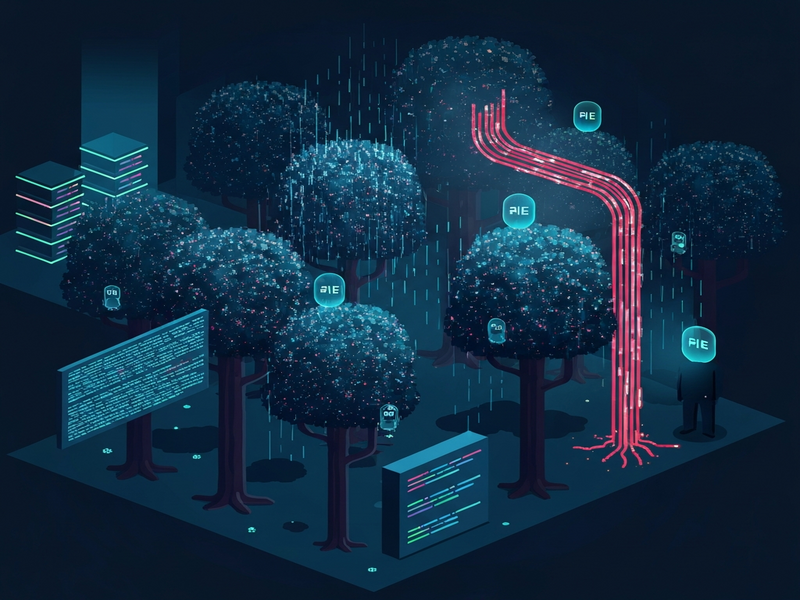
The Internet is rapidly turning into a “dark forest” where AI‑driven attackers operate silently, scanning, exploiting, and breaching systems without any human involvement.
Why the Internet Is Becoming a Dark Forest
In Liu Cixin’s The Three‑Body Problem, civilizations that reveal their location are instantly destroyed. The same principle now applies to digital ecosystems: any exposed service, IP address, or DNS record can become a beacon for autonomous AI agents. For a deep dive into the original concept, read the full analysis on OpenNHP. This article breaks down the emerging AI security threats, explains the “dark forest” metaphor, and shows how Zero Visibility architecture can protect enterprises.
AI‑Driven Security Threats: A New Breach Timeline
Traditional breach narratives involved a human hacker manually scanning a target, crafting an exploit, and then launching an attack. Today, AI can compress that entire workflow into seconds:
- Server is scanned by an AI‑powered reconnaissance engine.
- The AI fingerprints the operating system, services, and version numbers.
- An exploit chain is automatically generated.
- The breach begins—no human ever touched a keyboard.
This shift is not speculative; it is already happening. Two breakthroughs illustrate the scale of the threat.
PentAGI – Autonomous Penetration Testing for Everyone
PentAGI is an open‑source AI agent that can conduct full‑scale penetration tests without any human supervision. Deploy it with a single docker‑compose up, point it at a target, and walk away. Its capabilities include:
- Orchestrating 20+ security tools (Nmap, Metasploit, SQLmap, etc.) in parallel.
- Running up to 16 sub‑agents simultaneously for reconnaissance and exploitation.
- Supporting any LLM backend—OpenAI, Anthropic, Google Gemini, or local models via Ollama.
- Over 5,300 GitHub stars and 10,000+ Docker pulls, proving its rapid adoption.
What was once the domain of elite red‑team firms is now a free download, meaning threat actors can harness the same automation for offensive purposes.
Claude Code Security – 500+ Critical Vulnerabilities Discovered in Weeks
Anthropic’s Frontier Red Team used Claude Opus 4.6 to audit production open‑source codebases. The results were staggering:
- More than 500 high‑severity vulnerabilities uncovered across projects like GhostScript, OpenSC, and CGIF.
- Flaws that had survived years of expert human review, some hidden for over a decade.
- Memory corruption, authentication bypasses, and logic errors that traditional pattern‑matching tools missed.
When such reasoning power becomes widely available, attackers can automatically discover, prioritize, and exploit vulnerabilities at machine speed.
“If defenders can automate testing, attackers can automate exploitation.” – OpenNHP Vision Team
The “Dark Forest” Concept Explained
In a literal dark forest, every sound or flash of light reveals a hunter’s location. Survival depends on staying silent and invisible. The Internet is undergoing the same transformation.
From Open City to Hidden Wilderness
Early Internet architecture resembled an open city: any host could be discovered via a simple port scan, and security relied on strong keys and thick walls. This model assumed attackers were human—limited by time, cost, and fatigue. AI agents, however, have “air superiority.” They can:
- Scan the entire address space in seconds.
- Fingerprint services with near‑perfect accuracy.
- Generate and launch exploits without ever presenting credentials.
Consequently, the traditional security mantra—“detect and respond quickly”—no longer suffices. The real question becomes: Why is the infrastructure visible at all?
Visibility Equals Vulnerability
Every exposed IP, open port, or DNS record is a beacon for AI hunters. In the AI era, the attack surface is not just larger; it is fully illuminated. The only way to survive is to become invisible until a trusted party proves its identity.
Zero Visibility Architecture – Beyond Zero Trust
Zero Trust—“never trust, always verify”—was a breakthrough for human‑speed threats. Yet most Zero Trust implementations still expose an attack surface that AI can enumerate before authentication. Zero Visibility pushes the concept further by removing any discoverable footprint until cryptographic proof of identity is presented.
Core Principles of Zero Visibility
- No exposed IPs: Services are reachable only through encrypted tunnels that require a valid certificate.
- No open ports: All inbound traffic is blocked by default; ports are opened dynamically after identity verification.
- No DNS discoverability: Hostnames are resolved only for authenticated sessions, preventing enumeration.
- Cryptographic proof first: Identity is proven via zero‑knowledge proofs before any network handshake.
UBOS Enterprise AI Platform Implements Zero Visibility
The Enterprise AI platform by UBOS integrates Zero Visibility at the core of its architecture. Key features include:
- Dynamic service discovery that activates only after mutual TLS authentication.
- AI‑driven policy enforcement that continuously evaluates risk before granting connectivity.
- Built‑in OpenAI ChatGPT integration for real‑time threat analysis and automated response.
- Seamless integration with the Workflow automation studio to orchestrate secure, invisible deployments.
By eliminating the attack surface, the platform makes AI‑driven reconnaissance computationally irrelevant.
What This Means for Enterprises
Adopting Zero Visibility and AI‑enhanced defenses reshapes the security landscape across several dimensions:
- Reduced breach window: Without an exposed surface, attackers cannot even begin a scan.
- Lower operational costs: Automated identity verification replaces costly manual patching cycles.
- Improved compliance: Invisible infrastructure aligns with strict data‑privacy regulations that demand minimal exposure.
- Strategic advantage: Companies that hide their digital footprint gain a competitive edge in a market where AI attackers are proliferating.
For startups and SMBs, the UBOS for startups program offers a lightweight Zero Visibility stack that scales as the business grows. Larger enterprises can leverage the UBOS solutions for SMBs to transition from traditional firewalls to a fully hidden architecture.
Take the Next Step Toward a Dark‑Forest‑Resilient Future
If your organization is still relying on visible IPs and open ports, you are already a target for autonomous AI hunters. Shift to a Zero Visibility model today:
- Explore the UBOS platform overview to understand the building blocks of invisible infrastructure.
- Learn how AI marketing agents can automate secure outreach without exposing your backend.
- Review the UBOS pricing plans to find a package that fits your budget.
- Join the UBOS partner program to collaborate on cutting‑edge security solutions.
Remember: the more you hide, the less you invite. Let UBOS help you disappear from the AI hunter’s radar.
Andrii Bidochko
CTO UBOS
Andrii Bidochko is an AI entrepreneur and researcher focused on AI agents, reinforcement learning, and autonomous systems. He writes about the technologies shaping the future of machine intelligence, from frontier models and agent architectures to real-world AI applications.