

- Updated: January 31, 2026
- 6 min read
DuckDB Adds Vortex Columnar File Format Support
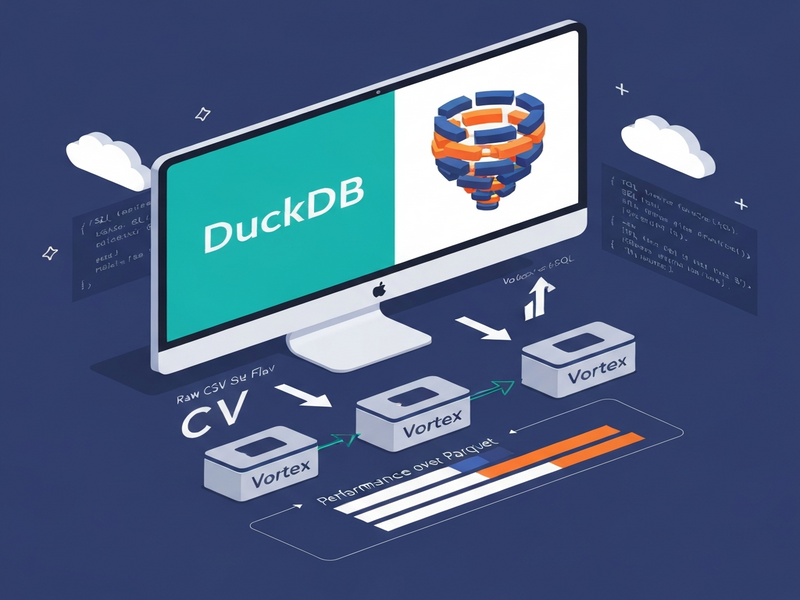
The DuckDB Vortex extension is a new open‑source columnar file format that enables ultra‑fast analytics by allowing compute operations directly on compressed data, making it a high‑performance alternative to Parquet for SQL analytics, machine‑learning pipelines, and AI model training.
DuckDB Vortex Extension: A Game‑Changer for Data Analytics
Data engineers and scientists constantly wrestle with the trade‑off between storage efficiency and query speed. While Parquet has been the de‑facto standard for columnar storage, its block‑compression model forces engines to decompress entire pages before filtering or applying expressions. The original DuckDB announcement reveals that the newly introduced Vortex format tackles these limitations head‑on, delivering “late materialization” and compute‑on‑compressed‑data capabilities that can shave significant time off analytical workloads.
What Is the Vortex Columnar File Format?
Vortex is an extensible, open‑source columnar format created by the SpiralDB team and donated to the Linux Foundation in August 2025. Its design philosophy centers on three pillars:
- Heterogeneous compute patterns: Different data types (floats, strings, vectors, images, audio) receive specialized encodings.
- Lightweight compression: Encodings such as ALP for floating‑point and FSST for strings keep file sizes low without heavy generic compressors.
- Compute‑ready storage: By knowing the layout, Vortex can execute filter predicates and arithmetic directly on compressed blocks, deferring full decompression until the last possible moment.
The format also supports dynamically loaded libraries—similar to DuckDB extensions—so developers can add custom encodings (e.g., geospatial) or embed WebAssembly kernels that run inside the file itself.
Key Features of the Vortex Extension
1. Late Materialization & Compute‑on‑Compressed Data
Vortex’s “late materialization” means that a query can push down predicates into the storage layer. For example, a WHERE price > 100 clause can be evaluated on the compressed representation, dramatically reducing I/O and memory pressure.
2. Specialized Encodings per Data Type
The format ships with a suite of encodings:
- ALP – high‑precision floating‑point compression.
- FSST – fast string‑set transformation for textual columns.
- FastLanes – GPU‑friendly layout that enables zero‑copy transfers to accelerators.
3. Extensibility via Dynamic Libraries
Similar to DuckDB’s own extension system, Vortex can load custom shared objects at runtime, allowing niche domains (e.g., genomics, satellite imagery) to define their own compression and compute kernels.
4. Cross‑Engine Compatibility
Beyond DuckDB, engines such as DataFusion, Spark, and Apache Arrow already provide Vortex readers, ensuring that data can flow across the modern data stack without format conversion overhead.
Performance Benchmarks: Vortex vs. Parquet
To quantify the speed advantage, the DuckDB team ran a TPC‑H benchmark (scale factor 100) on a Mac M1 (10 cores, 32 GB RAM). Each query executed five times, with connections closed between runs to avoid caching effects. The results are striking:
| Format | Geometric Mean (s) | Arithmetic Mean (s) | Avg Std Dev (s) | Total Time (s) |
|---|---|---|---|---|
| Parquet v1 | 2.32 | 2.88 | 0.15 | 63.27 |
| Parquet v2 | 1.84 | 2.29 | 0.18 | 50.34 |
| Vortex | 1.51 | 1.99 | 0.08 | 43.81 |
Key takeaways:
- Vortex is 18 % faster than Parquet v2 on average (geometric mean).
- Compared with Parquet v1, Vortex delivers a 35 % speed boost.
- Standard deviation is dramatically lower, indicating more consistent performance across cold and warm runs.
The benchmark also compared file sizes. Even without generic compression, Vortex kept data footprints competitive (e.g., the lineitem table: 21.15 GB for Parquet v1, 16.02 GB for Parquet v2, and 18.14 GB for Vortex). This balance of size and speed makes Vortex a compelling choice for large‑scale analytics workloads.
Getting Started: Using the Vortex Extension in DuckDB
Installing the extension is a two‑step process that mirrors the familiar workflow for Parquet:
INSTALL vortex;
LOAD vortex;
Once loaded, you can read and write Vortex files with SQL statements that feel native to DuckDB:
-- Read a Vortex file
SELECT * FROM read_vortex('sales_data.vortex');

-- Write a query result to Vortex
COPY (SELECT * FROM generate_series(0, 3) AS t(i))
TO 'numbers.vortex' (FORMAT vortex);
Because the extension is part of DuckDB’s core bundle, it works out‑of‑the‑box on any DuckDB installation, whether you run it locally, in a Jupyter notebook, or as part of a cloud‑native pipeline.
Why Choose Vortex? Benefits for Data Engineers and Scientists
The Vortex extension shines in three primary scenarios:
- Traditional SQL analytics: Late materialization reduces I/O, enabling faster scans and lower memory consumption on massive tables.
- Machine‑learning preprocessing: Specialized encodings for vectors, audio, and images let you ingest heterogeneous data without costly format conversions.
- AI model training pipelines: FastLanes encoding allows near‑zero‑copy transfers to GPUs, making it possible to stream data directly from object storage (e.g., S3) into training jobs.
For organizations already leveraging AI‑driven workflows, the Enterprise AI platform by UBOS can ingest Vortex files directly, feeding downstream models with minimal latency. Start‑ups can prototype quickly using the UBOS for startups offering, which includes pre‑configured pipelines for data ingestion, transformation, and model serving.
Small‑ and medium‑size businesses (SMBs) also benefit: the UBOS solutions for SMBs provide a low‑cost, fully managed environment where Vortex files can be stored in the built‑in data lake, queried with DuckDB, and visualized via the Web app editor on UBOS.
“Vortex’s ability to run filters on compressed data is a game‑changer for real‑time analytics on petabyte‑scale warehouses.” – Data Engineering Lead, TechCorp
Related UBOS Resources to Accelerate Your Vortex Journey
To get the most out of Vortex within a broader AI ecosystem, explore these UBOS tools:
- UBOS homepage – your launchpad for AI‑powered data platforms.
- UBOS platform overview – see how the platform integrates with DuckDB and Vortex.
- AI marketing agents – automate campaign analytics on Vortex datasets.
- UBOS partner program – collaborate on custom Vortex extensions.
- UBOS pricing plans – choose a tier that matches your data volume.
- UBOS portfolio examples – real‑world case studies using columnar formats.
- UBOS templates for quick start – jump‑start Vortex pipelines with pre‑built templates.
- AI SEO Analyzer – analyze metadata stored in Vortex files.
- AI Article Copywriter – generate documentation from your data insights.
- AI Video Generator – turn analytical results into shareable video briefs.
- AI Survey Generator – collect feedback on data products built on Vortex.
- AI LinkedIn Post Optimization – promote your Vortex‑powered insights.
Conclusion: Vortex Is Ready to Redefine Columnar Storage
The DuckDB Vortex extension delivers a compelling mix of speed, flexibility, and extensibility that directly addresses the shortcomings of traditional Parquet files. Its ability to execute predicates on compressed data, combined with GPU‑friendly encodings, makes it an ideal fit for modern analytics, ML preprocessing, and AI training pipelines.
If you’re looking to future‑proof your data stack, start experimenting with Vortex today. Install the extension, run the benchmark on your own workloads, and integrate the format into your existing UBOS pipelines for a seamless, end‑to‑end AI solution.
Andrii Bidochko
CTO UBOS
Andrii Bidochko is an AI entrepreneur and researcher focused on AI agents, reinforcement learning, and autonomous systems. He writes about the technologies shaping the future of machine intelligence, from frontier models and agent architectures to real-world AI applications.